Category: Food & Culture

Tenerife food, Canarian dishes, wine, markets and cultural experiences for curious travellers.

  • Iglesia de San Agustín Icod Guide: 16th-Century Church, Brick Arches and Altarpieces

    Iglesia de San Agustín Icod Guide: 16th-Century Church, Brick Arches and Altarpieces

    Iglesia de San Agustín is a useful stop for travellers who want to understand Tenerife beyond beaches and headline attractions. I would not cross the whole island only for this one place, but I would absolutely use it to add historical and local context to a day in Icod de los Vinos.

    In this guide I separate documented facts from practical planning. Dates, dimensions, artistic details and historical associations come from official tourism or municipal heritage sources. My suggestions about timing, route order, photography and combinations are travel-planning advice. I avoid inventing fixed opening hours, prices or guaranteed access when current official information is uncertain.

    At a glance

    PlaceIglesia de San Agustín
    WherePlaza Luis de León Huerta, 1, 38430 Icod de los Vinos
    Best forreligious architecture, altarpieces, old-town history and architectural details
    Time to allow25–45 minutes when interior access is available
    Planning ruleCombine it with nearby sights, verify current access and keep the route flexible.

    Why I would include Iglesia de San Agustín in a Tenerife itinerary

    One of the easiest mistakes on Tenerife is to jump from one major attraction to another without understanding the towns between them. Places like Iglesia de San Agustín slow the trip down in a useful way. They show how local history, religion, trade, architecture or landscape developed at the level of an individual community.

    I also value stops that work inside a compact cluster. In Icod de los Vinos, I can usually combine several worthwhile places without repeated driving. That gives me more time to notice details, stop for coffee, change plans if a door is closed and still finish the day without feeling that I have been chasing a checklist.

    My rule is simple: a small site earns its place when it helps explain the destination. I would rather spend thirty attentive minutes somewhere meaningful than add three generic viewpoints just to increase the number of stops.

    What the official record confirms

    • The church was built in the 16th century.
    • It is dedicated to San Sebastián.
    • The interior has one nave with two lateral chapels.
    • It contains two Baroque altarpieces, one Rococo altarpiece and two unusual brick arches.

    Why the brick arches catch my attention

    The official description specifically mentions two brick arches and offers possible explanations: the limited resources of the Augustinian community or the influence of Portuguese builders familiar with brick construction. I like this detail because it introduces uncertainty honestly. Architecture often records practical decisions whose exact motives are not fully documented.

    Rather than presenting one explanation as proven, I would point out the material difference and let it frame a broader question about craftsmanship, cost and cultural exchange. That is a more useful way to look at an old building than reducing it to a list of dates.

    Baroque and Rococo in one compact church

    The church contains two Baroque altarpieces and one Rococo example, which gives visitors a chance to compare styles within a relatively small interior. Baroque work often feels heavier and more dramatic, while Rococo decoration can appear lighter and more playful. I look for those contrasts rather than trying to memorise art-history labels.

    The single nave and lateral chapels also make the building easy to read spatially. If services are taking place, I keep the visit short or return later; the church’s primary role as a place of worship always comes before sightseeing.

    A good stop at the edge of the historic core

    Plaza Luis de León Huerta places the church on a natural walking line between civic buildings and the convent area. I would use it near the beginning of an old-town route, then continue toward the Franciscan complex, Plaza de la Pila and San Marcos.

    This sequence creates a clearer story than jumping directly from the Drago to the coast. It shows how multiple religious communities and civic spaces shaped Icod over centuries, while keeping the entire walk compact and manageable.

    What to combine with it nearby

    I would build the visit around nearby pages already covered on this site rather than create an isolated detour. Good combinations include Icod de los Vinos guide, Franciscan Convent Icod, Iglesia de San Marcos. For a broader planning option, I also keep Plaza de la Constitución in the same cluster.
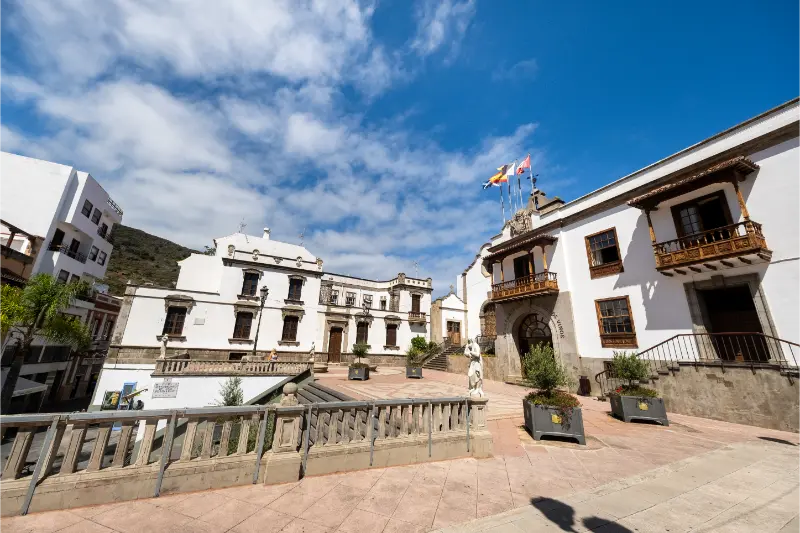
    Icod De Los Vinos Tenerife City View

    How I plan the visit

    I start by deciding whether Iglesia de San Agustín is the anchor of the outing or a supporting stop. For a small heritage site, the second option is usually better. I allow enough time to read information, look at details and take a few photographs, but I do not turn a short visit into half a day simply because the itinerary has empty space.

    I then check the official source shortly before travelling. Religious services, conservation work, local events, seasonal timetables or staffing can change access. If the interior is closed, I want the surrounding route to remain worthwhile.

    1. Start with the most time-sensitive stop, such as a museum or church interior.
    2. Continue on foot to exterior heritage, public squares and streets.
    3. Keep lunch or coffee flexible so a delay does not break the itinerary.
    4. Leave the final stop optional, especially if traffic, weather or a local event changes the pace.

    This style of planning works particularly well in Tenerife’s historic towns. Short map distances can hide steep streets, difficult parking and one-way systems, while a compact walking loop often reveals much more than several rushed car stops.

    How I read the history without oversimplifying it

    Heritage sites often mix documented facts, later restoration, local tradition and popular legend. I try to keep those layers separate. A date recorded by an official heritage inventory is not the same kind of evidence as a story passed through generations, even though both can be valuable for understanding the place.

    I also avoid treating Tenerife’s colonial period as a neutral backdrop. Conquest, Indigenous Guanche history, Atlantic trade, migration and religious institutions all shaped the island. Where one of those themes is relevant to Iglesia de San Agustín, I name it directly rather than reducing the story to decorative architecture.

    What I look for on site

    Before reaching for my phone, I look at materials and relationships: volcanic stone, timber, limewashed walls, ironwork, paving, courtyards, altarpieces, old trees or the way a building faces a square. These details usually tell me more than a single façade photograph.

    I also pay attention to later changes. Historic buildings are rarely frozen in one century. Fires, floods, new roads, restorations, changing religious use and civic adaptation can all become part of the story. I find a place more interesting when I can see those layers rather than searching for an imaginary “original” version.

    Getting there and moving around

    For Icod de los Vinos, I compare driving with public transport according to the rest of the day. A car is helpful when I am continuing to rural viewpoints or another municipality, but it can be inconvenient in older streets with limited parking. If I am concentrating on the historic centre, I prefer to park once and walk.
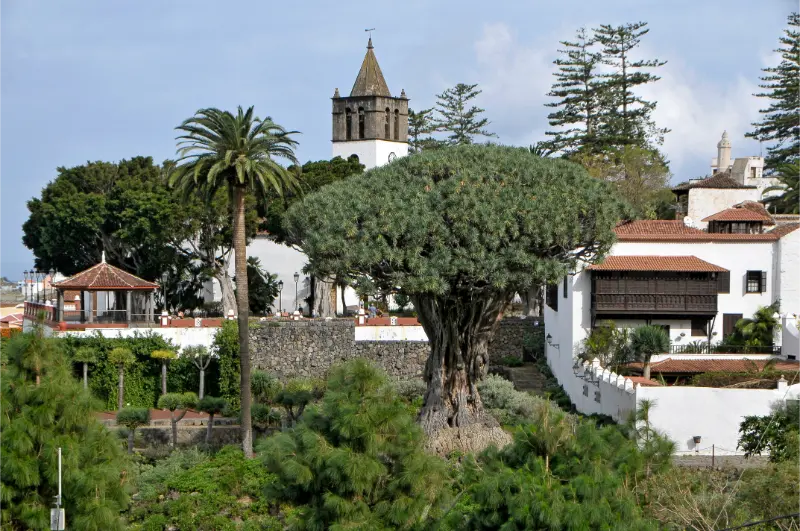
    Parque Del Drago Milenario Icod De Los Vinos Tenerife

    TITSA serves the main towns and tourist areas of Tenerife. I check the current journey planner instead of hard-coding a bus number into an evergreen article, because routes and stops can change. Travellers with a pushchair, luggage or limited mobility should also inspect the final approach: gradients, cobbles and steps often matter more than the intercity journey.

    Best time of day

    For architecture and street photography, morning or late afternoon usually gives softer light. For a church or museum, access arrangements matter more than the angle of the sun. I prefer arriving early enough that a closed door does not create pressure to rush the rest of the route.

    Weekends, feast days and local events can transform a quiet square into a busy community space. That can be a highlight if I want atmosphere, but it can also affect parking and interior access. I check local notices when travelling around major religious or municipal celebrations.

    Practical tips that make the stop better

    Comfortable shoes are my default even for short urban visits. Historic paving can be uneven and north-Tenerife towns often have steeper streets than a map suggests. I carry water and a light layer because cloud, breeze and sun can change quickly across short distances.

    I do not assume that a public-looking heritage building has toilets, step-free access or continuous opening. Travellers who need specific accessibility features should verify them directly with the venue or municipality. The same applies to reserved parking and interior photography rules.

    For churches and devotional spaces, I dress respectfully and keep noise low. For historic houses, I respect private sections even when the façade looks museum-like. For monumental trees or rural heritage, I stay on public access and avoid trampling roots, crops or private land.

    Photography without missing the place itself

    I take one wide establishing image, then look for details: stonework, wood, metal, inscriptions, paving, vegetation or the relationship between a building and its square. That produces a more useful visual record than ten almost identical front-on photographs.

    I never assume drone use is legal simply because a place looks quiet. Tenerife has controlled airspace, protected areas and populated zones. A travel guide cannot replace current aviation rules or local restrictions.

    Where to eat and how I fit meals into the route

    I prefer eating near the area I am already exploring instead of driving across the island for a single restaurant. In Icod de los Vinos, that might mean a café in the historic centre, a traditional Canarian lunch or a longer meal after the walking portion of the day. I check recent opening information because weekly closing days and kitchen hours change.
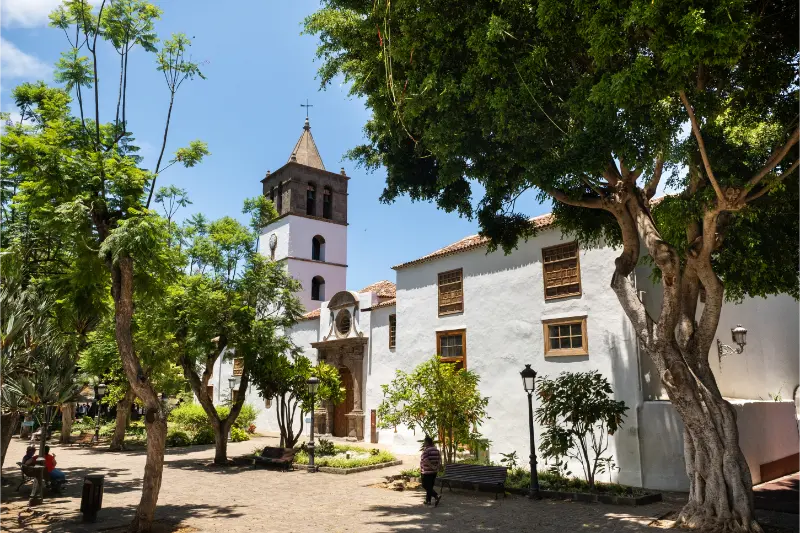
    Church In Icod De Los Vinos Tenerife

    Local food makes more sense when connected to the place: papas arrugadas, mojo, gofio, cheeses, fish and Tenerife wines all reflect agriculture, trade and everyday island life. I would rather choose a simple meal that fits the route than interrupt the day for a famous restaurant far away.

    Where to stay

    If I want to explore this part of Tenerife over more than one day, I compare current accommodation on Booking.com. I pay attention to the exact map position, parking, elevation and recent guest comments rather than relying only on the property name.

    For a first visit, I choose a base according to the majority of the itinerary. A good location saves more time over a week than staying next to one small attraction that I will visit only once.

    Activities and tours

    A heritage stop can pair well with one organised experience elsewhere on the island. I use the widget below to compare current options, but I avoid stacking a long excursion immediately before or after a dense driving day.

    Who will enjoy this stop most?

    Iglesia de San Agustín is best for travellers who enjoy context rather than only headline attractions. Couples and solo travellers can fold it into a slow walking day; families can use it as a short educational stop; repeat visitors may appreciate it because it reveals a layer of Tenerife that is easy to miss on a first trip.

    It may be less useful for someone with only a few hours on the island who is still trying to prioritise Teide, Anaga or a major beach. I would rather say that clearly than label every place a “must-see”. A good guide should help readers decide what fits their interests.

    Common mistakes I would avoid

    • Driving across Tenerife only for this single stop without combining it with the surrounding area.
    • Assuming old opening hours are guaranteed for a church, museum or locally managed heritage site.
    • Underestimating gradients, parking limitations or narrow streets in historic centres.
    • Treating local legends as proven history without saying they are traditions.
    • Ignoring services, worship, safety signs or private boundaries because a place appears tourist-oriented.

    Frequently asked questions

    When was Iglesia de San Agustín built?

    The official tourism listing dates the church to the 16th century.

    Who is the church dedicated to?

    It is dedicated to San Sebastián.

    What styles can I see inside?

    The church has two Baroque altarpieces and one Rococo altarpiece.

    Why are the brick arches unusual?

    The official listing notes that they may reflect limited Augustinian resources or Portuguese building influence, but presents these as possible explanations rather than certainty.

    Official information

    For the documented background used in this guide and for any current operational information, I check the official visitor or heritage information for Iglesia de San Agustín shortly before travelling. Same-day signs, staff instructions, parish notices, municipal updates and safety restrictions always take priority over an evergreen article.

    Final thoughts

    I would include Iglesia de San Agustín when it strengthens the story of a day in Icod de los Vinos. Its value is not measured by how many hours it occupies. A short stop can be meaningful when it explains architecture, faith, trade, landscape or everyday life.

    My preferred approach is simple: know the key facts before arriving, stay flexible about access, respect the place as part of local life and connect it with nearby sights. Done that way, it becomes one more piece of a Tenerife itinerary that feels coherent rather than crowded.
  • Ermita de San Antonio Icod Guide: Plague Vow, Wax Ex-Votos and Local Devotion

    Ermita de San Antonio Icod Guide: Plague Vow, Wax Ex-Votos and Local Devotion

    Ermita de San Antonio is a useful stop for travellers who want to understand Tenerife beyond beaches and headline attractions. I would not cross the whole island only for this one place, but I would absolutely use it to add historical and local context to a day in Icod de los Vinos.

    In this guide I separate documented facts from practical planning. Dates, dimensions, artistic details and historical associations come from official tourism or municipal heritage sources. My suggestions about timing, route order, photography and combinations are travel-planning advice. I avoid inventing fixed opening hours, prices or guaranteed access when current official information is uncertain.

    At a glance

    PlaceErmita de San Antonio
    WhereSan Antonio, 54, 38438 Icod de los Vinos
    Best forlocal religious history, votive traditions, quiet neighbourhood walks and heritage
    Time to allow15–30 minutes when accessible
    Planning ruleCombine it with nearby sights, verify current access and keep the route flexible.

    Why I would include Ermita de San Antonio in a Tenerife itinerary

    One of the easiest mistakes on Tenerife is to jump from one major attraction to another without understanding the towns between them. Places like Ermita de San Antonio slow the trip down in a useful way. They show how local history, religion, trade, architecture or landscape developed at the level of an individual community.

    I also value stops that work inside a compact cluster. In Icod de los Vinos, I can usually combine several worthwhile places without repeated driving. That gives me more time to notice details, stop for coffee, change plans if a door is closed and still finish the day without feeling that I have been chasing a checklist.

    My rule is simple: a small site earns its place when it helps explain the destination. I would rather spend thirty attentive minutes somewhere meaningful than add three generic viewpoints just to increase the number of stops.

    What the official record confirms

    • The chapel was founded at the beginning of the 17th century.
    • It was built in gratitude to Saint Anthony for freeing the population from plague.
    • Wax ex-votos hang on one of the walls.
    • The ex-votos are dedicated to Saint Lucy.

    A chapel born from fear of disease

    The official tourism record links the foundation of the chapel to gratitude after plague, a reminder that epidemic disease shaped religious life long before modern medicine. In the early 17th century, a vow or devotional foundation could express collective fear, thanksgiving and hope in a way that is difficult to grasp from architecture alone.

    That origin makes the chapel more meaningful than its modest scale suggests. I would not describe it as a major monument, but I would use it to explain how ordinary communities responded to crisis and how those responses became embedded in the landscape.

    Wax ex-votos and what they tell us

    The wax ex-votos dedicated to Saint Lucy are among the most distinctive features recorded by the official listing. Votive offerings generally represent a request, a body part, a recovery or a promise fulfilled. Even without interpreting each object individually, the collection shows how personal devotion accumulated over time.

    I avoid touching or rearranging anything in a devotional setting. These objects are not props for photography. I look at them as evidence of private stories made visible within a communal religious space, and that perspective is often more interesting than trying to identify every figure.

    How I would visit the San Antonio neighbourhood

    Because the chapel is outside the most obvious Drago-San Marcos circuit, I would include it when I have extra time or when I am deliberately exploring Icod beyond the postcard centre. The route can be combined with residential streets and viewpoints before returning toward the historic core.

    I keep expectations realistic: this is a small local heritage stop, not a visitor attraction with guaranteed services. That makes it ideal for a slow morning, but less suitable for a tight schedule built around fixed entrances and timed tickets.

    What to combine with it nearby

    I would build the visit around nearby pages already covered on this site rather than create an isolated detour. Good combinations include Icod de los Vinos guide, Iglesia de San Marcos, Plaza de la Constitución. For a broader planning option, I also keep Parque del Drago in the same cluster.

    Dragon Tree In Icod De Los Vinos Tenerife

    How I plan the visit

    I start by deciding whether Ermita de San Antonio is the anchor of the outing or a supporting stop. For a small heritage site, the second option is usually better. I allow enough time to read information, look at details and take a few photographs, but I do not turn a short visit into half a day simply because the itinerary has empty space.

    I then check the official source shortly before travelling. Religious services, conservation work, local events, seasonal timetables or staffing can change access. If the interior is closed, I want the surrounding route to remain worthwhile.

    1. Start with the most time-sensitive stop, such as a museum or church interior.
    2. Continue on foot to exterior heritage, public squares and streets.
    3. Keep lunch or coffee flexible so a delay does not break the itinerary.
    4. Leave the final stop optional, especially if traffic, weather or a local event changes the pace.

    This style of planning works particularly well in Tenerife’s historic towns. Short map distances can hide steep streets, difficult parking and one-way systems, while a compact walking loop often reveals much more than several rushed car stops.

    How I read the history without oversimplifying it

    Heritage sites often mix documented facts, later restoration, local tradition and popular legend. I try to keep those layers separate. A date recorded by an official heritage inventory is not the same kind of evidence as a story passed through generations, even though both can be valuable for understanding the place.

    I also avoid treating Tenerife’s colonial period as a neutral backdrop. Conquest, Indigenous Guanche history, Atlantic trade, migration and religious institutions all shaped the island. Where one of those themes is relevant to Ermita de San Antonio, I name it directly rather than reducing the story to decorative architecture.

    What I look for on site

    Before reaching for my phone, I look at materials and relationships: volcanic stone, timber, limewashed walls, ironwork, paving, courtyards, altarpieces, old trees or the way a building faces a square. These details usually tell me more than a single façade photograph.

    I also pay attention to later changes. Historic buildings are rarely frozen in one century. Fires, floods, new roads, restorations, changing religious use and civic adaptation can all become part of the story. I find a place more interesting when I can see those layers rather than searching for an imaginary “original” version.

    Getting there and moving around

    For Icod de los Vinos, I compare driving with public transport according to the rest of the day. A car is helpful when I am continuing to rural viewpoints or another municipality, but it can be inconvenient in older streets with limited parking. If I am concentrating on the historic centre, I prefer to park once and walk.

    Icod De Los Vinos Tenerife City View

    TITSA serves the main towns and tourist areas of Tenerife. I check the current journey planner instead of hard-coding a bus number into an evergreen article, because routes and stops can change. Travellers with a pushchair, luggage or limited mobility should also inspect the final approach: gradients, cobbles and steps often matter more than the intercity journey.

    Best time of day

    For architecture and street photography, morning or late afternoon usually gives softer light. For a church or museum, access arrangements matter more than the angle of the sun. I prefer arriving early enough that a closed door does not create pressure to rush the rest of the route.

    Weekends, feast days and local events can transform a quiet square into a busy community space. That can be a highlight if I want atmosphere, but it can also affect parking and interior access. I check local notices when travelling around major religious or municipal celebrations.

    Practical tips that make the stop better

    Comfortable shoes are my default even for short urban visits. Historic paving can be uneven and north-Tenerife towns often have steeper streets than a map suggests. I carry water and a light layer because cloud, breeze and sun can change quickly across short distances.

    I do not assume that a public-looking heritage building has toilets, step-free access or continuous opening. Travellers who need specific accessibility features should verify them directly with the venue or municipality. The same applies to reserved parking and interior photography rules.

    For churches and devotional spaces, I dress respectfully and keep noise low. For historic houses, I respect private sections even when the façade looks museum-like. For monumental trees or rural heritage, I stay on public access and avoid trampling roots, crops or private land.

    Photography without missing the place itself

    I take one wide establishing image, then look for details: stonework, wood, metal, inscriptions, paving, vegetation or the relationship between a building and its square. That produces a more useful visual record than ten almost identical front-on photographs.

    I never assume drone use is legal simply because a place looks quiet. Tenerife has controlled airspace, protected areas and populated zones. A travel guide cannot replace current aviation rules or local restrictions.

    Where to eat and how I fit meals into the route

    I prefer eating near the area I am already exploring instead of driving across the island for a single restaurant. In Icod de los Vinos, that might mean a café in the historic centre, a traditional Canarian lunch or a longer meal after the walking portion of the day. I check recent opening information because weekly closing days and kitchen hours change.

    Parque Del Drago Milenario Icod De Los Vinos Tenerife

    Local food makes more sense when connected to the place: papas arrugadas, mojo, gofio, cheeses, fish and Tenerife wines all reflect agriculture, trade and everyday island life. I would rather choose a simple meal that fits the route than interrupt the day for a famous restaurant far away.

    Where to stay

    If I want to explore this part of Tenerife over more than one day, I compare current accommodation on Booking.com. I pay attention to the exact map position, parking, elevation and recent guest comments rather than relying only on the property name.

    For a first visit, I choose a base according to the majority of the itinerary. A good location saves more time over a week than staying next to one small attraction that I will visit only once.

    Activities and tours

    A heritage stop can pair well with one organised experience elsewhere on the island. I use the widget below to compare current options, but I avoid stacking a long excursion immediately before or after a dense driving day.

    Who will enjoy this stop most?

    Ermita de San Antonio is best for travellers who enjoy context rather than only headline attractions. Couples and solo travellers can fold it into a slow walking day; families can use it as a short educational stop; repeat visitors may appreciate it because it reveals a layer of Tenerife that is easy to miss on a first trip.

    It may be less useful for someone with only a few hours on the island who is still trying to prioritise Teide, Anaga or a major beach. I would rather say that clearly than label every place a “must-see”. A good guide should help readers decide what fits their interests.

    Common mistakes I would avoid

    • Driving across Tenerife only for this single stop without combining it with the surrounding area.
    • Assuming old opening hours are guaranteed for a church, museum or locally managed heritage site.
    • Underestimating gradients, parking limitations or narrow streets in historic centres.
    • Treating local legends as proven history without saying they are traditions.
    • Ignoring services, worship, safety signs or private boundaries because a place appears tourist-oriented.

    Frequently asked questions

    Why was Ermita de San Antonio founded?

    The official tourism page says it was founded in gratitude to Saint Anthony for freeing the population from plague.

    How old is the chapel?

    It dates from the beginning of the 17th century.

    What are the wax objects inside?

    They are ex-votos, devotional offerings, and the official listing notes that they are dedicated to Saint Lucy.

    Is it in the main tourist centre?

    It is in the San Antonio area, so I would treat it as an extension of the main historic-centre walk rather than an automatic first stop.

    Official information

    For the documented background used in this guide and for any current operational information, I check the official visitor or heritage information for Ermita de San Antonio shortly before travelling. Same-day signs, staff instructions, parish notices, municipal updates and safety restrictions always take priority over an evergreen article.

    Final thoughts

    I would include Ermita de San Antonio when it strengthens the story of a day in Icod de los Vinos. Its value is not measured by how many hours it occupies. A short stop can be meaningful when it explains architecture, faith, trade, landscape or everyday life.

    My preferred approach is simple: know the key facts before arriving, stay flexible about access, respect the place as part of local life and connect it with nearby sights. Done that way, it becomes one more piece of a Tenerife itinerary that feels coherent rather than crowded.

  • Ermita de las Angustias Icod Guide: Mexican Virgin and the Caiman Legend

    Ermita de las Angustias Icod Guide: Mexican Virgin and the Caiman Legend

    Ermita de las Angustias is a useful stop for travellers who want to understand Tenerife beyond beaches and headline attractions. I would not cross the whole island only for this one place, but I would absolutely use it to add historical and local context to a day in Icod de los Vinos.

    In this guide I separate documented facts from practical planning. Dates, dimensions, artistic details and historical associations come from official tourism or municipal heritage sources. My suggestions about timing, route order, photography and combinations are travel-planning advice. I avoid inventing fixed opening hours, prices or guaranteed access when current official information is uncertain.

    At a glance

    PlaceErmita de las Angustias
    WhereLas Angustias S/N, 38430 Icod de los Vinos
    Best forunusual local legends, transatlantic art, religious heritage and quiet walks
    Time to allow20–40 minutes when access permits
    Planning ruleCombine it with nearby sights, verify current access and keep the route flexible.

    Why I would include Ermita de las Angustias in a Tenerife itinerary

    One of the easiest mistakes on Tenerife is to jump from one major attraction to another without understanding the towns between them. Places like Ermita de las Angustias slow the trip down in a useful way. They show how local history, religion, trade, architecture or landscape developed at the level of an individual community.

    I also value stops that work inside a compact cluster. In Icod de los Vinos, I can usually combine several worthwhile places without repeated driving. That gives me more time to notice details, stop for coffee, change plans if a door is closed and still finish the day without feeling that I have been chasing a checklist.

    My rule is simple: a small site earns its place when it helps explain the destination. I would rather spend thirty attentive minutes somewhere meaningful than add three generic viewpoints just to increase the number of stops.

    What the official record confirms

    • The image of the Virgin of Las Angustias was made in Mexico in the first half of the 17th century.
    • The chapel is famous locally for a preserved caiman displayed in a glass case.
    • A traditional legend links the animal to a shepherd who invoked the Virgin when the reptile threatened him.
    • The site reflects Icod’s historic connections with the Americas.

    A Mexican image in a Tenerife chapel

    The most important art-historical detail for me is not the caiman but the Virgin itself. The official tourism record states that the image was made in Mexico during the first half of the 17th century. That transatlantic origin is a reminder that northern Tenerife was connected to American trade, migration and devotional networks far more deeply than a simple island map suggests.

    I use this stop to connect local heritage with the wider Atlantic world. Similar stories appear in silverwork, sculpture and family fortunes across Tenerife. A small chapel therefore becomes evidence of movement between the Canaries and the Americas, not just a local religious site.

    The preserved caiman and how I present the legend

    The preserved caiman in a glass case is the detail most visitors remember. The official tourism page records a colourful legend about a shepherd who fed a reptile until it grew dangerous, then invoked the Virgin and survived the encounter. The animal was supposedly offered to the chapel in gratitude.

    I treat that story as folklore rather than zoological history. The distinction makes the article stronger, not weaker: legends are valuable because they reveal how a community remembers a place. I would tell the story clearly while making it equally clear that it belongs to local tradition.

    Why this stop works in a slower Icod itinerary

    Las Angustias is more rewarding for repeat visitors or travellers who enjoy unusual heritage than for someone rushing through Icod only to see the Drago. I would combine it with the historic centre, San Marcos and one museum or house, giving the day a theme around Atlantic connections and local stories.

    Because interior access can be limited, I avoid building a rigid schedule around the chapel. If it is closed, I continue the route and treat the location as a short exterior stop. That keeps the day enjoyable without inventing certainty where none exists.

    What to combine with it nearby

    I would build the visit around nearby pages already covered on this site rather than create an isolated detour. Good combinations include Icod de los Vinos guide, Iglesia de San Marcos, Museo Malvasía Icod. For a broader planning option, I also keep Casa del Plátano in the same cluster.

    Church In Icod De Los Vinos Tenerife

    How I plan the visit

    I start by deciding whether Ermita de las Angustias is the anchor of the outing or a supporting stop. For a small heritage site, the second option is usually better. I allow enough time to read information, look at details and take a few photographs, but I do not turn a short visit into half a day simply because the itinerary has empty space.

    I then check the official source shortly before travelling. Religious services, conservation work, local events, seasonal timetables or staffing can change access. If the interior is closed, I want the surrounding route to remain worthwhile.

    1. Start with the most time-sensitive stop, such as a museum or church interior.
    2. Continue on foot to exterior heritage, public squares and streets.
    3. Keep lunch or coffee flexible so a delay does not break the itinerary.
    4. Leave the final stop optional, especially if traffic, weather or a local event changes the pace.

    This style of planning works particularly well in Tenerife’s historic towns. Short map distances can hide steep streets, difficult parking and one-way systems, while a compact walking loop often reveals much more than several rushed car stops.

    How I read the history without oversimplifying it

    Heritage sites often mix documented facts, later restoration, local tradition and popular legend. I try to keep those layers separate. A date recorded by an official heritage inventory is not the same kind of evidence as a story passed through generations, even though both can be valuable for understanding the place.

    I also avoid treating Tenerife’s colonial period as a neutral backdrop. Conquest, Indigenous Guanche history, Atlantic trade, migration and religious institutions all shaped the island. Where one of those themes is relevant to Ermita de las Angustias, I name it directly rather than reducing the story to decorative architecture.

    What I look for on site

    Before reaching for my phone, I look at materials and relationships: volcanic stone, timber, limewashed walls, ironwork, paving, courtyards, altarpieces, old trees or the way a building faces a square. These details usually tell me more than a single façade photograph.

    I also pay attention to later changes. Historic buildings are rarely frozen in one century. Fires, floods, new roads, restorations, changing religious use and civic adaptation can all become part of the story. I find a place more interesting when I can see those layers rather than searching for an imaginary “original” version.

    Getting there and moving around

    For Icod de los Vinos, I compare driving with public transport according to the rest of the day. A car is helpful when I am continuing to rural viewpoints or another municipality, but it can be inconvenient in older streets with limited parking. If I am concentrating on the historic centre, I prefer to park once and walk.

    Dragon Tree In Icod De Los Vinos Tenerife

    TITSA serves the main towns and tourist areas of Tenerife. I check the current journey planner instead of hard-coding a bus number into an evergreen article, because routes and stops can change. Travellers with a pushchair, luggage or limited mobility should also inspect the final approach: gradients, cobbles and steps often matter more than the intercity journey.

    Best time of day

    For architecture and street photography, morning or late afternoon usually gives softer light. For a church or museum, access arrangements matter more than the angle of the sun. I prefer arriving early enough that a closed door does not create pressure to rush the rest of the route.

    Weekends, feast days and local events can transform a quiet square into a busy community space. That can be a highlight if I want atmosphere, but it can also affect parking and interior access. I check local notices when travelling around major religious or municipal celebrations.

    Practical tips that make the stop better

    Comfortable shoes are my default even for short urban visits. Historic paving can be uneven and north-Tenerife towns often have steeper streets than a map suggests. I carry water and a light layer because cloud, breeze and sun can change quickly across short distances.

    I do not assume that a public-looking heritage building has toilets, step-free access or continuous opening. Travellers who need specific accessibility features should verify them directly with the venue or municipality. The same applies to reserved parking and interior photography rules.

    For churches and devotional spaces, I dress respectfully and keep noise low. For historic houses, I respect private sections even when the façade looks museum-like. For monumental trees or rural heritage, I stay on public access and avoid trampling roots, crops or private land.

    Photography without missing the place itself

    I take one wide establishing image, then look for details: stonework, wood, metal, inscriptions, paving, vegetation or the relationship between a building and its square. That produces a more useful visual record than ten almost identical front-on photographs.

    I never assume drone use is legal simply because a place looks quiet. Tenerife has controlled airspace, protected areas and populated zones. A travel guide cannot replace current aviation rules or local restrictions.

    Where to eat and how I fit meals into the route

    I prefer eating near the area I am already exploring instead of driving across the island for a single restaurant. In Icod de los Vinos, that might mean a café in the historic centre, a traditional Canarian lunch or a longer meal after the walking portion of the day. I check recent opening information because weekly closing days and kitchen hours change.

    Icod De Los Vinos Tenerife City View

    Local food makes more sense when connected to the place: papas arrugadas, mojo, gofio, cheeses, fish and Tenerife wines all reflect agriculture, trade and everyday island life. I would rather choose a simple meal that fits the route than interrupt the day for a famous restaurant far away.

    Where to stay

    If I want to explore this part of Tenerife over more than one day, I compare current accommodation on Booking.com. I pay attention to the exact map position, parking, elevation and recent guest comments rather than relying only on the property name.

    For a first visit, I choose a base according to the majority of the itinerary. A good location saves more time over a week than staying next to one small attraction that I will visit only once.

    Activities and tours

    A heritage stop can pair well with one organised experience elsewhere on the island. I use the widget below to compare current options, but I avoid stacking a long excursion immediately before or after a dense driving day.

    Who will enjoy this stop most?

    Ermita de las Angustias is best for travellers who enjoy context rather than only headline attractions. Couples and solo travellers can fold it into a slow walking day; families can use it as a short educational stop; repeat visitors may appreciate it because it reveals a layer of Tenerife that is easy to miss on a first trip.

    It may be less useful for someone with only a few hours on the island who is still trying to prioritise Teide, Anaga or a major beach. I would rather say that clearly than label every place a “must-see”. A good guide should help readers decide what fits their interests.

    Common mistakes I would avoid

    • Driving across Tenerife only for this single stop without combining it with the surrounding area.
    • Assuming old opening hours are guaranteed for a church, museum or locally managed heritage site.
    • Underestimating gradients, parking limitations or narrow streets in historic centres.
    • Treating local legends as proven history without saying they are traditions.
    • Ignoring services, worship, safety signs or private boundaries because a place appears tourist-oriented.

    Frequently asked questions

    Where was the Virgin of Las Angustias made?

    The official tourism listing says the image was made in Mexico in the first half of the 17th century.

    Why is there a caiman in the chapel?

    A local legend says a shepherd killed the reptile after invoking the Virgin and donated it as an offering.

    Is the caiman story documented history?

    It is presented as a popular legend, so I treat it as folklore rather than a verified historical event.

    Is this a good stop with children?

    The unusual story may interest older children, but it remains an active religious space and should be visited respectfully.

    Official information

    For the documented background used in this guide and for any current operational information, I check the official visitor or heritage information for Ermita de las Angustias shortly before travelling. Same-day signs, staff instructions, parish notices, municipal updates and safety restrictions always take priority over an evergreen article.

    Final thoughts

    I would include Ermita de las Angustias when it strengthens the story of a day in Icod de los Vinos. Its value is not measured by how many hours it occupies. A short stop can be meaningful when it explains architecture, faith, trade, landscape or everyday life.

    My preferred approach is simple: know the key facts before arriving, stay flexible about access, respect the place as part of local life and connect it with nearby sights. Done that way, it becomes one more piece of a Tenerife itinerary that feels coherent rather than crowded.

  • Ermita de El Calvario Icod Guide: 19th-Century Chapel and September Tradition

    Ermita de El Calvario Icod Guide: 19th-Century Chapel and September Tradition

    Ermita de El Calvario is a useful stop for travellers who want to understand Tenerife beyond beaches and headline attractions. I would not cross the whole island only for this one place, but I would absolutely use it to add historical and local context to a day in Icod de los Vinos.

    In this guide I separate documented facts from practical planning. Dates, dimensions, artistic details and historical associations come from official tourism or municipal heritage sources. My suggestions about timing, route order, photography and combinations are travel-planning advice. I avoid inventing fixed opening hours, prices or guaranteed access when current official information is uncertain.

    At a glance

    PlaceErmita de El Calvario
    WherePlaza del Calvario, 1, 38430 Icod de los Vinos
    Best forlocal devotion, quiet architecture, historic plazas and festival context
    Time to allow20–40 minutes with the surrounding plaza
    Planning ruleCombine it with nearby sights, verify current access and keep the route flexible.

    Why I would include Ermita de El Calvario in a Tenerife itinerary

    One of the easiest mistakes on Tenerife is to jump from one major attraction to another without understanding the towns between them. Places like Ermita de El Calvario slow the trip down in a useful way. They show how local history, religion, trade, architecture or landscape developed at the level of an individual community.

    I also value stops that work inside a compact cluster. In Icod de los Vinos, I can usually combine several worthwhile places without repeated driving. That gives me more time to notice details, stop for coffee, change plans if a door is closed and still finish the day without feeling that I have been chasing a checklist.

    My rule is simple: a small site earns its place when it helps explain the destination. I would rather spend thirty attentive minutes somewhere meaningful than add three generic viewpoints just to increase the number of stops.

    What the official record confirms

    • The chapel was completed in the 19th century.
    • Inside is a Crucified Christ accompanied by Saint John and the Virgin.
    • The figures can be viewed through the glass of the door when the interior is closed.
    • The surrounding Plaza del Calvario developed as an important historic public space and is associated with major local festivities.

    The chapel is only half the story

    Ermita de El Calvario is small, but the surrounding plaza gives it much more context. Municipal heritage records describe changes linked to water supply, transport and later landscaping, so I would spend time looking around rather than focusing only on the chapel door. This is a good example of how a religious landmark can also anchor the urban history of a neighbourhood.

    A fountain and water-distribution point were added after an 1815 donation, and later transport infrastructure increased movement through the area. Those details help explain why the Calvario became more than a devotional stop: it was woven into the practical expansion of Icod.

    What can be seen even when the door is closed

    The official tourism listing notes that the Crucified Christ, Saint John and the Virgin can be appreciated through the glazed door. That makes this an unusually forgiving stop for travellers who arrive outside interior-access hours. I still avoid pressing against the glass or obstructing worshippers, but the arrangement allows a basic understanding of the devotional group.

    I look for the relationship between the figures and the small scale of the building. Calvario chapels often work through intimacy rather than grandeur, and this one is most effective when approached quietly as part of the town rather than as a museum display.

    September festivities and local meaning

    The municipal heritage page identifies the feast of the Santísimo Cristo del Calvario, held on the last Sunday of September, as one of Icod’s major celebrations. During the festivities the plaza is decorated and the image moves between the chapel and the parish church of San Marcos.

    For visitors, that means two things. First, a festival period can be culturally rewarding. Second, access, traffic and parking may be very different from an ordinary day. I would check the municipal programme if travelling in late September and decide whether I want to experience the event or avoid the crowds.

    What to combine with it nearby

    I would build the visit around nearby pages already covered on this site rather than create an isolated detour. Good combinations include Icod de los Vinos guide, Iglesia de San Marcos, Plaza de la Constitución. For a broader planning option, I also keep Franciscan Convent Icod in the same cluster.

    Parque Del Drago Milenario Icod De Los Vinos Tenerife

    How I plan the visit

    I start by deciding whether Ermita de El Calvario is the anchor of the outing or a supporting stop. For a small heritage site, the second option is usually better. I allow enough time to read information, look at details and take a few photographs, but I do not turn a short visit into half a day simply because the itinerary has empty space.

    I then check the official source shortly before travelling. Religious services, conservation work, local events, seasonal timetables or staffing can change access. If the interior is closed, I want the surrounding route to remain worthwhile.

    1. Start with the most time-sensitive stop, such as a museum or church interior.
    2. Continue on foot to exterior heritage, public squares and streets.
    3. Keep lunch or coffee flexible so a delay does not break the itinerary.
    4. Leave the final stop optional, especially if traffic, weather or a local event changes the pace.

    This style of planning works particularly well in Tenerife’s historic towns. Short map distances can hide steep streets, difficult parking and one-way systems, while a compact walking loop often reveals much more than several rushed car stops.

    How I read the history without oversimplifying it

    Heritage sites often mix documented facts, later restoration, local tradition and popular legend. I try to keep those layers separate. A date recorded by an official heritage inventory is not the same kind of evidence as a story passed through generations, even though both can be valuable for understanding the place.

    I also avoid treating Tenerife’s colonial period as a neutral backdrop. Conquest, Indigenous Guanche history, Atlantic trade, migration and religious institutions all shaped the island. Where one of those themes is relevant to Ermita de El Calvario, I name it directly rather than reducing the story to decorative architecture.

    What I look for on site

    Before reaching for my phone, I look at materials and relationships: volcanic stone, timber, limewashed walls, ironwork, paving, courtyards, altarpieces, old trees or the way a building faces a square. These details usually tell me more than a single façade photograph.

    I also pay attention to later changes. Historic buildings are rarely frozen in one century. Fires, floods, new roads, restorations, changing religious use and civic adaptation can all become part of the story. I find a place more interesting when I can see those layers rather than searching for an imaginary “original” version.

    Getting there and moving around

    For Icod de los Vinos, I compare driving with public transport according to the rest of the day. A car is helpful when I am continuing to rural viewpoints or another municipality, but it can be inconvenient in older streets with limited parking. If I am concentrating on the historic centre, I prefer to park once and walk.

    Church In Icod De Los Vinos Tenerife

    TITSA serves the main towns and tourist areas of Tenerife. I check the current journey planner instead of hard-coding a bus number into an evergreen article, because routes and stops can change. Travellers with a pushchair, luggage or limited mobility should also inspect the final approach: gradients, cobbles and steps often matter more than the intercity journey.

    Best time of day

    For architecture and street photography, morning or late afternoon usually gives softer light. For a church or museum, access arrangements matter more than the angle of the sun. I prefer arriving early enough that a closed door does not create pressure to rush the rest of the route.

    Weekends, feast days and local events can transform a quiet square into a busy community space. That can be a highlight if I want atmosphere, but it can also affect parking and interior access. I check local notices when travelling around major religious or municipal celebrations.

    Practical tips that make the stop better

    Comfortable shoes are my default even for short urban visits. Historic paving can be uneven and north-Tenerife towns often have steeper streets than a map suggests. I carry water and a light layer because cloud, breeze and sun can change quickly across short distances.

    I do not assume that a public-looking heritage building has toilets, step-free access or continuous opening. Travellers who need specific accessibility features should verify them directly with the venue or municipality. The same applies to reserved parking and interior photography rules.

    For churches and devotional spaces, I dress respectfully and keep noise low. For historic houses, I respect private sections even when the façade looks museum-like. For monumental trees or rural heritage, I stay on public access and avoid trampling roots, crops or private land.

    Photography without missing the place itself

    I take one wide establishing image, then look for details: stonework, wood, metal, inscriptions, paving, vegetation or the relationship between a building and its square. That produces a more useful visual record than ten almost identical front-on photographs.

    I never assume drone use is legal simply because a place looks quiet. Tenerife has controlled airspace, protected areas and populated zones. A travel guide cannot replace current aviation rules or local restrictions.

    Where to eat and how I fit meals into the route

    I prefer eating near the area I am already exploring instead of driving across the island for a single restaurant. In Icod de los Vinos, that might mean a café in the historic centre, a traditional Canarian lunch or a longer meal after the walking portion of the day. I check recent opening information because weekly closing days and kitchen hours change.

    Dragon Tree In Icod De Los Vinos Tenerife

    Local food makes more sense when connected to the place: papas arrugadas, mojo, gofio, cheeses, fish and Tenerife wines all reflect agriculture, trade and everyday island life. I would rather choose a simple meal that fits the route than interrupt the day for a famous restaurant far away.

    Where to stay

    If I want to explore this part of Tenerife over more than one day, I compare current accommodation on Booking.com. I pay attention to the exact map position, parking, elevation and recent guest comments rather than relying only on the property name.

    For a first visit, I choose a base according to the majority of the itinerary. A good location saves more time over a week than staying next to one small attraction that I will visit only once.

    Activities and tours

    A heritage stop can pair well with one organised experience elsewhere on the island. I use the widget below to compare current options, but I avoid stacking a long excursion immediately before or after a dense driving day.

    Who will enjoy this stop most?

    Ermita de El Calvario is best for travellers who enjoy context rather than only headline attractions. Couples and solo travellers can fold it into a slow walking day; families can use it as a short educational stop; repeat visitors may appreciate it because it reveals a layer of Tenerife that is easy to miss on a first trip.

    It may be less useful for someone with only a few hours on the island who is still trying to prioritise Teide, Anaga or a major beach. I would rather say that clearly than label every place a “must-see”. A good guide should help readers decide what fits their interests.

    Common mistakes I would avoid

    • Driving across Tenerife only for this single stop without combining it with the surrounding area.
    • Assuming old opening hours are guaranteed for a church, museum or locally managed heritage site.
    • Underestimating gradients, parking limitations or narrow streets in historic centres.
    • Treating local legends as proven history without saying they are traditions.
    • Ignoring services, worship, safety signs or private boundaries because a place appears tourist-oriented.

    Frequently asked questions

    When was Ermita de El Calvario built?

    The official tourism listing says the small chapel was completed in the 19th century.

    Can I see the religious figures if the chapel is closed?

    The Crucified Christ, Saint John and the Virgin can be viewed through the glazed door.

    What happens here in September?

    The Santísimo Cristo del Calvario festivities are traditionally held on the last Sunday of September, with religious and local events.

    Is the plaza worth seeing too?

    Yes. Its water, transport and festival history makes the surrounding public space part of the visit.

    Official information

    For the documented background used in this guide and for any current operational information, I check the official visitor or heritage information for Ermita de El Calvario shortly before travelling. Same-day signs, staff instructions, parish notices, municipal updates and safety restrictions always take priority over an evergreen article.

    Final thoughts

    I would include Ermita de El Calvario when it strengthens the story of a day in Icod de los Vinos. Its value is not measured by how many hours it occupies. A short stop can be meaningful when it explains architecture, faith, trade, landscape or everyday life.

    My preferred approach is simple: know the key facts before arriving, stay flexible about access, respect the place as part of local life and connect it with nearby sights. Done that way, it becomes one more piece of a Tenerife itinerary that feels coherent rather than crowded.

  • Casa de los Cáceres Icod Guide: 18th-Century Patio and 365 Openings Legend

    Casa de los Cáceres Icod Guide: 18th-Century Patio and 365 Openings Legend

    Casa de los Cáceres is a useful stop for travellers who want to understand Tenerife beyond beaches and headline attractions. I would not cross the whole island only for this one place, but I would absolutely use it to add historical and local context to a day in Icod de los Vinos.

    In this guide I separate documented facts from practical planning. Dates, dimensions, artistic details and historical associations come from official tourism or municipal heritage sources. My suggestions about timing, route order, photography and combinations are travel-planning advice. I avoid inventing fixed opening hours, prices or guaranteed access when current official information is uncertain.

    At a glance

    PlaceCasa de los Cáceres
    WherePlaza de la Constitución, 9, 38430 Icod de los Vinos
    Best forCanarian architecture, courtyards, historic houses and photography
    Time to allow20–45 minutes depending on current public access
    Planning ruleCombine it with nearby sights, verify current access and keep the route flexible.

    Why I would include Casa de los Cáceres in a Tenerife itinerary

    One of the easiest mistakes on Tenerife is to jump from one major attraction to another without understanding the towns between them. Places like Casa de los Cáceres slow the trip down in a useful way. They show how local history, religion, trade, architecture or landscape developed at the level of an individual community.

    I also value stops that work inside a compact cluster. In Icod de los Vinos, I can usually combine several worthwhile places without repeated driving. That gives me more time to notice details, stop for coffee, change plans if a door is closed and still finish the day without feeling that I have been chasing a checklist.

    My rule is simple: a small site earns its place when it helps explain the destination. I would rather spend thirty attentive minutes somewhere meaningful than add three generic viewpoints just to increase the number of stops.

    What the official record confirms

    • The house was built in the 18th century.
    • Its rooms are organised around a porticoed central courtyard with columns.
    • A local tradition says the house has 365 openings between windows and doors.
    • It stands directly on Plaza de la Constitución in the historic centre.

    Reading the house from the plaza

    Casa de los Cáceres is one of the buildings that gives Plaza de la Constitución its sense of enclosure and status. Before thinking about the interior, I look at how the façade addresses the square and how its scale compares with neighbouring houses. In a compact town centre, architecture is easier to understand when I see the relationship between building and public space.

    The 18th-century date places the house in a period when prosperous families were shaping Icod’s civic core. I would pair it with Casa Lorenzo Cáceres to compare different expressions of elite domestic architecture instead of viewing one mansion in isolation.

    The courtyard is the key to understanding the plan

    The official description highlights a porticoed central courtyard with columns around which the rooms are arranged. That layout is one of the most useful features for understanding traditional Canarian houses: the courtyard is not leftover space, but a practical organising element for light, circulation and ventilation.

    If the building is open, I pay attention to transitions from street to interior, the change in light and the way galleries connect rooms. If it is closed, the broader lesson still works because similar courtyard logic appears in many historic houses across Tenerife and especially in La Laguna and La Orotava.

    What to make of the “365 openings” story

    The popular claim that the house contains 365 openings—one for every day of the year—is memorable, but I treat it as a local tradition rather than a reason to count windows. Its value is cultural: stories like this show how residents attach identity to prominent buildings and make architectural details easier to remember.

    For a useful article, I prefer to state the legend clearly as a tradition rather than convert it into an unqualified fact. That distinction matters in heritage writing, where an appealing anecdote can easily become more famous than the documented history of the building itself.

    What to combine with it nearby

    I would build the visit around nearby pages already covered on this site rather than create an isolated detour. Good combinations include Plaza de la Constitución, Casa Lorenzo Cáceres, Icod de los Vinos guide. For a broader planning option, I also keep Parque del Drago in the same cluster.

    Icod De Los Vinos Tenerife City View

    How I plan the visit

    I start by deciding whether Casa de los Cáceres is the anchor of the outing or a supporting stop. For a small heritage site, the second option is usually better. I allow enough time to read information, look at details and take a few photographs, but I do not turn a short visit into half a day simply because the itinerary has empty space.

    I then check the official source shortly before travelling. Religious services, conservation work, local events, seasonal timetables or staffing can change access. If the interior is closed, I want the surrounding route to remain worthwhile.

    1. Start with the most time-sensitive stop, such as a museum or church interior.
    2. Continue on foot to exterior heritage, public squares and streets.
    3. Keep lunch or coffee flexible so a delay does not break the itinerary.
    4. Leave the final stop optional, especially if traffic, weather or a local event changes the pace.

    This style of planning works particularly well in Tenerife’s historic towns. Short map distances can hide steep streets, difficult parking and one-way systems, while a compact walking loop often reveals much more than several rushed car stops.

    How I read the history without oversimplifying it

    Heritage sites often mix documented facts, later restoration, local tradition and popular legend. I try to keep those layers separate. A date recorded by an official heritage inventory is not the same kind of evidence as a story passed through generations, even though both can be valuable for understanding the place.

    I also avoid treating Tenerife’s colonial period as a neutral backdrop. Conquest, Indigenous Guanche history, Atlantic trade, migration and religious institutions all shaped the island. Where one of those themes is relevant to Casa de los Cáceres, I name it directly rather than reducing the story to decorative architecture.

    What I look for on site

    Before reaching for my phone, I look at materials and relationships: volcanic stone, timber, limewashed walls, ironwork, paving, courtyards, altarpieces, old trees or the way a building faces a square. These details usually tell me more than a single façade photograph.

    I also pay attention to later changes. Historic buildings are rarely frozen in one century. Fires, floods, new roads, restorations, changing religious use and civic adaptation can all become part of the story. I find a place more interesting when I can see those layers rather than searching for an imaginary “original” version.

    Getting there and moving around

    For Icod de los Vinos, I compare driving with public transport according to the rest of the day. A car is helpful when I am continuing to rural viewpoints or another municipality, but it can be inconvenient in older streets with limited parking. If I am concentrating on the historic centre, I prefer to park once and walk.

    Parque Del Drago Milenario Icod De Los Vinos Tenerife

    TITSA serves the main towns and tourist areas of Tenerife. I check the current journey planner instead of hard-coding a bus number into an evergreen article, because routes and stops can change. Travellers with a pushchair, luggage or limited mobility should also inspect the final approach: gradients, cobbles and steps often matter more than the intercity journey.

    Best time of day

    For architecture and street photography, morning or late afternoon usually gives softer light. For a church or museum, access arrangements matter more than the angle of the sun. I prefer arriving early enough that a closed door does not create pressure to rush the rest of the route.

    Weekends, feast days and local events can transform a quiet square into a busy community space. That can be a highlight if I want atmosphere, but it can also affect parking and interior access. I check local notices when travelling around major religious or municipal celebrations.

    Practical tips that make the stop better

    Comfortable shoes are my default even for short urban visits. Historic paving can be uneven and north-Tenerife towns often have steeper streets than a map suggests. I carry water and a light layer because cloud, breeze and sun can change quickly across short distances.

    I do not assume that a public-looking heritage building has toilets, step-free access or continuous opening. Travellers who need specific accessibility features should verify them directly with the venue or municipality. The same applies to reserved parking and interior photography rules.

    For churches and devotional spaces, I dress respectfully and keep noise low. For historic houses, I respect private sections even when the façade looks museum-like. For monumental trees or rural heritage, I stay on public access and avoid trampling roots, crops or private land.

    Photography without missing the place itself

    I take one wide establishing image, then look for details: stonework, wood, metal, inscriptions, paving, vegetation or the relationship between a building and its square. That produces a more useful visual record than ten almost identical front-on photographs.

    I never assume drone use is legal simply because a place looks quiet. Tenerife has controlled airspace, protected areas and populated zones. A travel guide cannot replace current aviation rules or local restrictions.

    Where to eat and how I fit meals into the route

    I prefer eating near the area I am already exploring instead of driving across the island for a single restaurant. In Icod de los Vinos, that might mean a café in the historic centre, a traditional Canarian lunch or a longer meal after the walking portion of the day. I check recent opening information because weekly closing days and kitchen hours change.

    Church In Icod De Los Vinos Tenerife

    Local food makes more sense when connected to the place: papas arrugadas, mojo, gofio, cheeses, fish and Tenerife wines all reflect agriculture, trade and everyday island life. I would rather choose a simple meal that fits the route than interrupt the day for a famous restaurant far away.

    Where to stay

    If I want to explore this part of Tenerife over more than one day, I compare current accommodation on Booking.com. I pay attention to the exact map position, parking, elevation and recent guest comments rather than relying only on the property name.

    For a first visit, I choose a base according to the majority of the itinerary. A good location saves more time over a week than staying next to one small attraction that I will visit only once.

    Activities and tours

    A heritage stop can pair well with one organised experience elsewhere on the island. I use the widget below to compare current options, but I avoid stacking a long excursion immediately before or after a dense driving day.

    Who will enjoy this stop most?

    Casa de los Cáceres is best for travellers who enjoy context rather than only headline attractions. Couples and solo travellers can fold it into a slow walking day; families can use it as a short educational stop; repeat visitors may appreciate it because it reveals a layer of Tenerife that is easy to miss on a first trip.

    It may be less useful for someone with only a few hours on the island who is still trying to prioritise Teide, Anaga or a major beach. I would rather say that clearly than label every place a “must-see”. A good guide should help readers decide what fits their interests.

    Common mistakes I would avoid

    • Driving across Tenerife only for this single stop without combining it with the surrounding area.
    • Assuming old opening hours are guaranteed for a church, museum or locally managed heritage site.
    • Underestimating gradients, parking limitations or narrow streets in historic centres.
    • Treating local legends as proven history without saying they are traditions.
    • Ignoring services, worship, safety signs or private boundaries because a place appears tourist-oriented.

    Frequently asked questions

    When was Casa de los Cáceres built?

    The official tourism listing dates the house to the 18th century.

    What is special about the interior?

    The rooms are arranged around a porticoed central courtyard with columns.

    Does the house really have 365 doors and windows?

    The official tourism page reports this as a local saying or tradition, not as a verified architectural count.

    Where is it?

    It stands on Plaza de la Constitución, also known locally as Plaza de la Pila.

    Official information

    For the documented background used in this guide and for any current operational information, I check the official visitor or heritage information for Casa de los Cáceres shortly before travelling. Same-day signs, staff instructions, parish notices, municipal updates and safety restrictions always take priority over an evergreen article.

    Final thoughts

    I would include Casa de los Cáceres when it strengthens the story of a day in Icod de los Vinos. Its value is not measured by how many hours it occupies. A short stop can be meaningful when it explains architecture, faith, trade, landscape or everyday life.

    My preferred approach is simple: know the key facts before arriving, stay flexible about access, respect the place as part of local life and connect it with nearby sights. Done that way, it becomes one more piece of a Tenerife itinerary that feels coherent rather than crowded.

  • Capilla de los Dolores Icod Guide: Rococo Altarpiece and Franciscan Heritage

    Capilla de los Dolores Icod Guide: Rococo Altarpiece and Franciscan Heritage

    Capilla de los Dolores is a useful stop for travellers who want to understand Tenerife beyond beaches and headline attractions. I would not cross the whole island only for this one place, but I would absolutely use it to add historical and local context to a day in Icod de los Vinos.

    In this guide I separate documented facts from practical planning. Dates, dimensions, artistic details and historical associations come from official tourism or municipal heritage sources. My suggestions about timing, route order, photography and combinations are travel-planning advice. I avoid inventing fixed opening hours, prices or guaranteed access when current official information is uncertain.

    At a glance

    PlaceCapilla de los Dolores
    WhereSan Francisco, 2, 38438 Icod de los Vinos
    Best forreligious art, Rococo details, compact heritage walks and architecture
    Time to allow15–30 minutes when interior access is available
    Planning ruleCombine it with nearby sights, verify current access and keep the route flexible.

    Why I would include Capilla de los Dolores in a Tenerife itinerary

    One of the easiest mistakes on Tenerife is to jump from one major attraction to another without understanding the towns between them. Places like Capilla de los Dolores slow the trip down in a useful way. They show how local history, religion, trade, architecture or landscape developed at the level of an individual community.

    I also value stops that work inside a compact cluster. In Icod de los Vinos, I can usually combine several worthwhile places without repeated driving. That gives me more time to notice details, stop for coffee, change plans if a door is closed and still finish the day without feeling that I have been chasing a checklist.

    My rule is simple: a small site earns its place when it helps explain the destination. I would rather spend thirty attentive minutes somewhere meaningful than add three generic viewpoints just to increase the number of stops.

    What the official record confirms

    • The chapel formed part of the former Franciscan convent.
    • It was built in the 17th century.
    • Its exterior is noted for a delicate cornice.
    • The main altarpiece is Rococo in style.

    Why this small chapel matters beside the convent

    Capilla de los Dolores makes most sense when I read it as part of the former Franciscan complex rather than as an isolated chapel. The official tourism record places its construction in the 17th century, when religious institutions were important social and architectural anchors in Icod. That relationship helps explain why such a small interior can carry unusually refined decorative work.

    I would visit the convent courtyard first or immediately afterward. Seeing the two spaces together makes the scale and function of the old complex easier to understand. It also prevents the common mistake of spending more time searching for a small doorway than actually appreciating the ensemble around it.

    The Rococo altarpiece and the details I look for

    The main altarpiece is the feature I would focus on if the chapel is open. Rococo decoration tends to be lighter and more fluid than earlier Baroque work, so I look for movement, curves and ornamental rhythm rather than just the central image. The delicate cornice mentioned by the official listing is another detail worth viewing from outside before stepping in.

    Photography rules can vary in religious interiors, and light may be limited. I prefer to look first and photograph second. A small chapel rewards attention to proportions, joinery and the way the altar fits the architecture more than a wide-angle image that tries to capture everything at once.

    How to fit it into an Icod heritage walk

    The chapel is close enough to San Marcos, the Drago and the historic squares that I would never make a special drive for it alone. Instead, I use it to add depth to a route through the convent quarter before continuing toward Plaza Andrés de Lorenzo Cáceres.

    If access is closed, the visit is not wasted. The exterior, convent surroundings and nearby streets still help explain how Icod developed around religious and civic institutions. I simply keep the stop short and continue the loop rather than waiting around for an uncertain opening.

    What to combine with it nearby

    I would build the visit around nearby pages already covered on this site rather than create an isolated detour. Good combinations include Franciscan Convent Icod, Icod de los Vinos guide, Iglesia de San Marcos. For a broader planning option, I also keep Plaza Andrés de Lorenzo Cáceres in the same cluster.

    Dragon Tree In Icod De Los Vinos Tenerife

    How I plan the visit

    I start by deciding whether Capilla de los Dolores is the anchor of the outing or a supporting stop. For a small heritage site, the second option is usually better. I allow enough time to read information, look at details and take a few photographs, but I do not turn a short visit into half a day simply because the itinerary has empty space.

    I then check the official source shortly before travelling. Religious services, conservation work, local events, seasonal timetables or staffing can change access. If the interior is closed, I want the surrounding route to remain worthwhile.

    1. Start with the most time-sensitive stop, such as a museum or church interior.
    2. Continue on foot to exterior heritage, public squares and streets.
    3. Keep lunch or coffee flexible so a delay does not break the itinerary.
    4. Leave the final stop optional, especially if traffic, weather or a local event changes the pace.

    This style of planning works particularly well in Tenerife’s historic towns. Short map distances can hide steep streets, difficult parking and one-way systems, while a compact walking loop often reveals much more than several rushed car stops.

    How I read the history without oversimplifying it

    Heritage sites often mix documented facts, later restoration, local tradition and popular legend. I try to keep those layers separate. A date recorded by an official heritage inventory is not the same kind of evidence as a story passed through generations, even though both can be valuable for understanding the place.

    I also avoid treating Tenerife’s colonial period as a neutral backdrop. Conquest, Indigenous Guanche history, Atlantic trade, migration and religious institutions all shaped the island. Where one of those themes is relevant to Capilla de los Dolores, I name it directly rather than reducing the story to decorative architecture.

    What I look for on site

    Before reaching for my phone, I look at materials and relationships: volcanic stone, timber, limewashed walls, ironwork, paving, courtyards, altarpieces, old trees or the way a building faces a square. These details usually tell me more than a single façade photograph.

    I also pay attention to later changes. Historic buildings are rarely frozen in one century. Fires, floods, new roads, restorations, changing religious use and civic adaptation can all become part of the story. I find a place more interesting when I can see those layers rather than searching for an imaginary “original” version.

    Getting there and moving around

    For Icod de los Vinos, I compare driving with public transport according to the rest of the day. A car is helpful when I am continuing to rural viewpoints or another municipality, but it can be inconvenient in older streets with limited parking. If I am concentrating on the historic centre, I prefer to park once and walk.

    Icod De Los Vinos Tenerife City View

    TITSA serves the main towns and tourist areas of Tenerife. I check the current journey planner instead of hard-coding a bus number into an evergreen article, because routes and stops can change. Travellers with a pushchair, luggage or limited mobility should also inspect the final approach: gradients, cobbles and steps often matter more than the intercity journey.

    Best time of day

    For architecture and street photography, morning or late afternoon usually gives softer light. For a church or museum, access arrangements matter more than the angle of the sun. I prefer arriving early enough that a closed door does not create pressure to rush the rest of the route.

    Weekends, feast days and local events can transform a quiet square into a busy community space. That can be a highlight if I want atmosphere, but it can also affect parking and interior access. I check local notices when travelling around major religious or municipal celebrations.

    Practical tips that make the stop better

    Comfortable shoes are my default even for short urban visits. Historic paving can be uneven and north-Tenerife towns often have steeper streets than a map suggests. I carry water and a light layer because cloud, breeze and sun can change quickly across short distances.

    I do not assume that a public-looking heritage building has toilets, step-free access or continuous opening. Travellers who need specific accessibility features should verify them directly with the venue or municipality. The same applies to reserved parking and interior photography rules.

    For churches and devotional spaces, I dress respectfully and keep noise low. For historic houses, I respect private sections even when the façade looks museum-like. For monumental trees or rural heritage, I stay on public access and avoid trampling roots, crops or private land.

    Photography without missing the place itself

    I take one wide establishing image, then look for details: stonework, wood, metal, inscriptions, paving, vegetation or the relationship between a building and its square. That produces a more useful visual record than ten almost identical front-on photographs.

    I never assume drone use is legal simply because a place looks quiet. Tenerife has controlled airspace, protected areas and populated zones. A travel guide cannot replace current aviation rules or local restrictions.

    Where to eat and how I fit meals into the route

    I prefer eating near the area I am already exploring instead of driving across the island for a single restaurant. In Icod de los Vinos, that might mean a café in the historic centre, a traditional Canarian lunch or a longer meal after the walking portion of the day. I check recent opening information because weekly closing days and kitchen hours change.

    Parque Del Drago Milenario Icod De Los Vinos Tenerife

    Local food makes more sense when connected to the place: papas arrugadas, mojo, gofio, cheeses, fish and Tenerife wines all reflect agriculture, trade and everyday island life. I would rather choose a simple meal that fits the route than interrupt the day for a famous restaurant far away.

    Where to stay

    If I want to explore this part of Tenerife over more than one day, I compare current accommodation on Booking.com. I pay attention to the exact map position, parking, elevation and recent guest comments rather than relying only on the property name.

    For a first visit, I choose a base according to the majority of the itinerary. A good location saves more time over a week than staying next to one small attraction that I will visit only once.

    Activities and tours

    A heritage stop can pair well with one organised experience elsewhere on the island. I use the widget below to compare current options, but I avoid stacking a long excursion immediately before or after a dense driving day.

    Who will enjoy this stop most?

    Capilla de los Dolores is best for travellers who enjoy context rather than only headline attractions. Couples and solo travellers can fold it into a slow walking day; families can use it as a short educational stop; repeat visitors may appreciate it because it reveals a layer of Tenerife that is easy to miss on a first trip.

    It may be less useful for someone with only a few hours on the island who is still trying to prioritise Teide, Anaga or a major beach. I would rather say that clearly than label every place a “must-see”. A good guide should help readers decide what fits their interests.

    Common mistakes I would avoid

    • Driving across Tenerife only for this single stop without combining it with the surrounding area.
    • Assuming old opening hours are guaranteed for a church, museum or locally managed heritage site.
    • Underestimating gradients, parking limitations or narrow streets in historic centres.
    • Treating local legends as proven history without saying they are traditions.
    • Ignoring services, worship, safety signs or private boundaries because a place appears tourist-oriented.

    Frequently asked questions

    How old is Capilla de los Dolores?

    The official Tenerife tourism listing dates it to the 17th century.

    Was it part of the Franciscan convent?

    Yes. It formed part of the old Franciscan complex.

    What is the main artistic feature?

    The Rococo main altarpiece is the principal highlight, together with the chapel’s delicate cornice.

    Can I rely on fixed opening hours?

    I would verify current access shortly before visiting because small religious heritage spaces may not keep continuous tourist hours.

    Official information

    For the documented background used in this guide and for any current operational information, I check the official visitor or heritage information for Capilla de los Dolores shortly before travelling. Same-day signs, staff instructions, parish notices, municipal updates and safety restrictions always take priority over an evergreen article.

    Final thoughts

    I would include Capilla de los Dolores when it strengthens the story of a day in Icod de los Vinos. Its value is not measured by how many hours it occupies. A short stop can be meaningful when it explains architecture, faith, trade, landscape or everyday life.

    My preferred approach is simple: know the key facts before arriving, stay flexible about access, respect the place as part of local life and connect it with nearby sights. Done that way, it becomes one more piece of a Tenerife itinerary that feels coherent rather than crowded.

  • Plaza de la Constitución Icod Guide: Plaza de la Pila, Fountain and Historic Houses

    Plaza de la Constitución Icod Guide: Plaza de la Pila, Fountain and Historic Houses

    Plaza de la Constitución (Plaza de la Pila) is a useful stop for travellers who want to understand Tenerife beyond beaches and headline attractions. I would not cross the whole island only for this one place, but I would absolutely use it to add historical and local context to a day in Icod de los Vinos.

    In this guide I separate documented facts from practical planning. Dates, dimensions, artistic details and historical associations come from official tourism or municipal heritage sources. My suggestions about timing, route order, photography and combinations are travel-planning advice. I avoid inventing fixed opening hours, prices or guaranteed access when current official information is uncertain.

    At a glance

    PlacePlaza de la Constitución (Plaza de la Pila)
    WherePlaza Constitución, 4, 38430 Icod de los Vinos
    Best forhistoric architecture, shaded breaks, photography and old-town orientation
    Time to allow30–60 minutes, longer with nearby museums and churches
    Planning ruleCombine it with nearby sights, verify current access and keep the route flexible.

    Why I would include Plaza de la Constitución (Plaza de la Pila) in a Tenerife itinerary

    One of the easiest mistakes on Tenerife is to jump from one major attraction to another without understanding the towns between them. Places like Plaza de la Constitución (Plaza de la Pila) slow the trip down in a useful way. They show how local history, religion, trade, architecture or landscape developed at the level of an individual community.

    I also value stops that work inside a compact cluster. In Icod de los Vinos, I can usually combine several worthwhile places without repeated driving. That gives me more time to notice details, stop for coffee, change plans if a door is closed and still finish the day without feeling that I have been chasing a checklist.

    My rule is simple: a small site earns its place when it helps explain the destination. I would rather spend thirty attentive minutes somewhere meaningful than add three generic viewpoints just to increase the number of stops.

    What the official record confirms

    • The square is popularly known as Plaza de la Pila.
    • Municipal heritage records date its creation to 1631–1632.
    • The central fountain was installed in 1716 and historically supplied water to this part of town.
    • Important 17th- to 19th-century houses surround the square, including Casa Lorenzo-Cáceres and Casa de los Cáceres.

    Why locals still call it Plaza de la Pila

    The official name is Plaza de la Constitución, but the local nickname tells a more practical story. The fountain installed in 1716 was not merely ornamental: it formed part of the town’s water distribution and gave the square the name people still use. I find that detail useful because it changes the square from a pretty garden into evidence of how an early modern town actually functioned.

    I also like the way the fountain anchors the space without overwhelming it. Palms, hibiscus and myrtle soften the stone, while the surrounding façades make the square feel enclosed and intimate. It is one of the best places in Icod to slow down before moving into the busier Drago area.

    The 1631 decision that reshaped the town centre

    Municipal heritage material records a meeting on 18 August 1631 in which local representatives proposed creating a larger public square. Existing buildings were removed and residents contributed to the works, with the new space inaugurated in September 1632. That civic origin is one reason I would include the plaza in a heritage walk rather than treating it as just a photo stop.

    The square quickly became a focal point for social, civil and religious life. Leading families built houses around it, helping create the architectural ensemble that visitors see today. Standing in the centre, I can read several centuries at once: water infrastructure, elite domestic architecture, public life and the later landscaping that made the square more comfortable.

    How I connect the square with the Drago and San Marcos

    The square works especially well because it sits within a compact cluster. I can walk from here to San Marcos, Plaza Andrés de Lorenzo Cáceres and the Drago in minutes. That makes it easy to build a two-hour old-town route without moving the car or repeatedly checking maps.

    My preferred sequence is to start here while the streets are quieter, continue toward San Marcos and the Drago, then return through the convent area. If a museum interior is open, I insert it into the route rather than making the whole day depend on fixed opening hours.

    What to combine with it nearby

    I would build the visit around nearby pages already covered on this site rather than create an isolated detour. Good combinations include Icod de los Vinos guide, Iglesia de San Marcos, Plaza Andrés de Lorenzo Cáceres. For a broader planning option, I also keep Parque del Drago in the same cluster.

    Church In Icod De Los Vinos Tenerife

    How I plan the visit

    I start by deciding whether Plaza de la Constitución (Plaza de la Pila) is the anchor of the outing or a supporting stop. For a small heritage site, the second option is usually better. I allow enough time to read information, look at details and take a few photographs, but I do not turn a short visit into half a day simply because the itinerary has empty space.

    I then check the official source shortly before travelling. Religious services, conservation work, local events, seasonal timetables or staffing can change access. If the interior is closed, I want the surrounding route to remain worthwhile.

    1. Start with the most time-sensitive stop, such as a museum or church interior.
    2. Continue on foot to exterior heritage, public squares and streets.
    3. Keep lunch or coffee flexible so a delay does not break the itinerary.
    4. Leave the final stop optional, especially if traffic, weather or a local event changes the pace.

    This style of planning works particularly well in Tenerife’s historic towns. Short map distances can hide steep streets, difficult parking and one-way systems, while a compact walking loop often reveals much more than several rushed car stops.

    How I read the history without oversimplifying it

    Heritage sites often mix documented facts, later restoration, local tradition and popular legend. I try to keep those layers separate. A date recorded by an official heritage inventory is not the same kind of evidence as a story passed through generations, even though both can be valuable for understanding the place.

    I also avoid treating Tenerife’s colonial period as a neutral backdrop. Conquest, Indigenous Guanche history, Atlantic trade, migration and religious institutions all shaped the island. Where one of those themes is relevant to Plaza de la Constitución (Plaza de la Pila), I name it directly rather than reducing the story to decorative architecture.

    What I look for on site

    Before reaching for my phone, I look at materials and relationships: volcanic stone, timber, limewashed walls, ironwork, paving, courtyards, altarpieces, old trees or the way a building faces a square. These details usually tell me more than a single façade photograph.

    I also pay attention to later changes. Historic buildings are rarely frozen in one century. Fires, floods, new roads, restorations, changing religious use and civic adaptation can all become part of the story. I find a place more interesting when I can see those layers rather than searching for an imaginary “original” version.

    Getting there and moving around

    For Icod de los Vinos, I compare driving with public transport according to the rest of the day. A car is helpful when I am continuing to rural viewpoints or another municipality, but it can be inconvenient in older streets with limited parking. If I am concentrating on the historic centre, I prefer to park once and walk.

    Dragon Tree In Icod De Los Vinos Tenerife

    TITSA serves the main towns and tourist areas of Tenerife. I check the current journey planner instead of hard-coding a bus number into an evergreen article, because routes and stops can change. Travellers with a pushchair, luggage or limited mobility should also inspect the final approach: gradients, cobbles and steps often matter more than the intercity journey.

    Best time of day

    For architecture and street photography, morning or late afternoon usually gives softer light. For a church or museum, access arrangements matter more than the angle of the sun. I prefer arriving early enough that a closed door does not create pressure to rush the rest of the route.

    Weekends, feast days and local events can transform a quiet square into a busy community space. That can be a highlight if I want atmosphere, but it can also affect parking and interior access. I check local notices when travelling around major religious or municipal celebrations.

    Practical tips that make the stop better

    Comfortable shoes are my default even for short urban visits. Historic paving can be uneven and north-Tenerife towns often have steeper streets than a map suggests. I carry water and a light layer because cloud, breeze and sun can change quickly across short distances.

    I do not assume that a public-looking heritage building has toilets, step-free access or continuous opening. Travellers who need specific accessibility features should verify them directly with the venue or municipality. The same applies to reserved parking and interior photography rules.

    For churches and devotional spaces, I dress respectfully and keep noise low. For historic houses, I respect private sections even when the façade looks museum-like. For monumental trees or rural heritage, I stay on public access and avoid trampling roots, crops or private land.

    Photography without missing the place itself

    I take one wide establishing image, then look for details: stonework, wood, metal, inscriptions, paving, vegetation or the relationship between a building and its square. That produces a more useful visual record than ten almost identical front-on photographs.

    I never assume drone use is legal simply because a place looks quiet. Tenerife has controlled airspace, protected areas and populated zones. A travel guide cannot replace current aviation rules or local restrictions.

    Where to eat and how I fit meals into the route

    I prefer eating near the area I am already exploring instead of driving across the island for a single restaurant. In Icod de los Vinos, that might mean a café in the historic centre, a traditional Canarian lunch or a longer meal after the walking portion of the day. I check recent opening information because weekly closing days and kitchen hours change.

    Icod De Los Vinos Tenerife City View

    Local food makes more sense when connected to the place: papas arrugadas, mojo, gofio, cheeses, fish and Tenerife wines all reflect agriculture, trade and everyday island life. I would rather choose a simple meal that fits the route than interrupt the day for a famous restaurant far away.

    Where to stay

    If I want to explore this part of Tenerife over more than one day, I compare current accommodation on Booking.com. I pay attention to the exact map position, parking, elevation and recent guest comments rather than relying only on the property name.

    For a first visit, I choose a base according to the majority of the itinerary. A good location saves more time over a week than staying next to one small attraction that I will visit only once.

    Activities and tours

    A heritage stop can pair well with one organised experience elsewhere on the island. I use the widget below to compare current options, but I avoid stacking a long excursion immediately before or after a dense driving day.

    Who will enjoy this stop most?

    Plaza de la Constitución (Plaza de la Pila) is best for travellers who enjoy context rather than only headline attractions. Couples and solo travellers can fold it into a slow walking day; families can use it as a short educational stop; repeat visitors may appreciate it because it reveals a layer of Tenerife that is easy to miss on a first trip.

    It may be less useful for someone with only a few hours on the island who is still trying to prioritise Teide, Anaga or a major beach. I would rather say that clearly than label every place a “must-see”. A good guide should help readers decide what fits their interests.

    Common mistakes I would avoid

    • Driving across Tenerife only for this single stop without combining it with the surrounding area.
    • Assuming old opening hours are guaranteed for a church, museum or locally managed heritage site.
    • Underestimating gradients, parking limitations or narrow streets in historic centres.
    • Treating local legends as proven history without saying they are traditions.
    • Ignoring services, worship, safety signs or private boundaries because a place appears tourist-oriented.

    Frequently asked questions

    Why is Plaza de la Constitución called Plaza de la Pila?

    The nickname refers to the fountain installed in 1716, historically used to supply water to this part of Icod.

    When was the square created?

    Municipal heritage records place the decision in 1631 and the inauguration in September 1632.

    Is the Drago Milenario nearby?

    Yes. The Parque del Drago and several major historic buildings are only a short walk away.

    Is the square free to visit?

    Yes. It is a public urban space, although nearby museums or attractions may have their own access arrangements.

    Official information

    For the documented background used in this guide and for any current operational information, I check the official visitor or heritage information for Plaza de la Constitución (Plaza de la Pila) shortly before travelling. Same-day signs, staff instructions, parish notices, municipal updates and safety restrictions always take priority over an evergreen article.

    Final thoughts

    I would include Plaza de la Constitución (Plaza de la Pila) when it strengthens the story of a day in Icod de los Vinos. Its value is not measured by how many hours it occupies. A short stop can be meaningful when it explains architecture, faith, trade, landscape or everyday life.

    My preferred approach is simple: know the key facts before arriving, stay flexible about access, respect the place as part of local life and connect it with nearby sights. Done that way, it becomes one more piece of a Tenerife itinerary that feels coherent rather than crowded.

  • Iglesia de San Juan Bautista La Orotava Guide: 1728 Church and Sacred Art

    Iglesia de San Juan Bautista La Orotava Guide: 1728 Church and Sacred Art

    Iglesia de San Juan Bautista is the kind of Tenerife stop that becomes much more rewarding when I understand what I am looking at before I arrive. It is not a place I would oversell as a reason to cross the whole island on its own; its strength is the way it adds detail to a well-planned day in La Orotava.

    In this guide I separate documented information from practical trip planning. Historical dates, dimensions and heritage details come from official tourism or municipal sources. Suggestions about timing, route order, photography and combinations are my planning approach. I avoid inventing fixed opening hours, prices or guaranteed access when the responsible source does not publish dependable current information.

    At a glance

    PlaceIglesia de San Juan Bautista
    WherePlaza de San Juan, 38300 La Orotava
    Best forsacred art, religious architecture and deeper La Orotava heritage routes
    Time to allow30–60 minutes when the church is open
    Planning ruleCombine it with nearby sights, verify same-day access and keep the schedule flexible.

    Why I would add Iglesia de San Juan Bautista to a Tenerife itinerary

    Large attractions explain only part of Tenerife. The island becomes more memorable when I connect its beaches and volcanic scenery with the civic spaces, religious buildings, houses and working waterfronts that show how individual communities developed. Iglesia de San Juan Bautista adds exactly that kind of context.

    I also like stops that improve an itinerary without creating another long drive. In La Orotava, several worthwhile places sit close enough to combine on foot or in a short local loop. That means I can spend more time observing and less time looking for parking or repeating the same road.

    For me, the goal is not to collect attractions. It is to build a route with a clear story: maritime history on the coast, architecture in the old town, religious art around a parish, or the relationship between public spaces and local life. When a small site helps that story, it earns its place in the schedule.

    What the official record confirms

    • Construction began in 1728.
    • The church has a single nave laid out as a Latin cross.
    • Its architecture shows a marked Portuguese influence.
    • Important sculptures include Pedro Roldán’s 1689 Señor atado a la Columna and later works by José Luján Pérez and Fernando Estévez.

    An 18th-century church with a different architectural accent

    Construction began in 1728, and the official tourism description points to a marked Portuguese influence. That detail makes San Juan Bautista especially useful after seeing La Concepción: rather than treating all historic churches as interchangeable, I can compare proportions, façades and spatial organisation across different parts of town.

    The building has a single nave with a Latin-cross plan. I take a moment outside to understand that simple geometry before focusing on individual artworks inside. Architecture makes more sense when I know how the main axis, crossing and chapels relate to each other.

    A strong collection of Canarian and Spanish sculpture

    The church’s sculpture is one of its main reasons for a focused visit. Turismo de Tenerife identifies the Señor atado a la Columna, carved by the Sevillian Pedro Roldán in 1689, alongside a 17th-century Virgen de los Remedios. It also lists a Virgen de Gloria by José Luján Pérez and 19th-century figures by Fernando Estévez.

    Those names connect La Orotava with wider artistic networks. Roldán represents the powerful Sevillian baroque tradition, while Luján Pérez and Estévez are central to Canarian sculpture. I find the church much more rewarding when I approach it as a small art collection rather than only as a religious building.

    Respectful visiting and realistic access

    This remains a working parish. I dress and behave accordingly, silence my phone and avoid photography during services. If a chapel is roped off or a ceremony is underway, I adjust the visit rather than trying to complete a checklist.

    Opening patterns can change with parish life, feast days and maintenance. I verify current information shortly before arriving and keep another nearby stop ready. La Orotava has enough heritage within walking distance that a closed door does not need to spoil the day.

    What to combine with it nearby

    I would build the visit around nearby pages already covered on this site rather than create an isolated detour. Good combinations include La Orotava travel guide, Iglesia de la Concepción, Iglesia de San Agustín. For a broader overview, I also keep Casa de los Balcones in the same planning cluster.

    How I plan the visit

    I start by deciding whether Iglesia de San Juan Bautista is the anchor of the outing or one stop within a wider walk. For a small heritage site, the second option is usually better. I allow enough time to read information panels, notice architectural details and take a few photographs without stretching a short stop into half a day.

    I then check the current official page on the same day or the evening before. Religious services, cultural events, restoration work, sea conditions or local festivals can change access. A flexible route is more resilient than a timetable that depends on every door opening exactly when expected.

    1. Start with the most time-sensitive stop, such as a museum interior, church access or safe bathing window.
    2. Continue on foot to nearby exterior sights and public spaces.
    3. Leave lunch or coffee flexible so a good local discovery does not become a scheduling problem.
    4. Keep the final stop optional, especially if traffic, weather or an event changes the pace of the day.

    This approach is especially useful in Tenerife because short map distances can hide steep gradients, one-way streets and difficult parking. A compact local cluster usually creates a better day than zig-zagging between distant municipalities.

    Getting there and moving around

    For La Orotava, I compare driving with public transport according to the rest of the day. A car is useful when the itinerary continues to rural viewpoints or another municipality, but it can become a burden in historic streets where parking is limited. If I am concentrating on the centre, I prefer to park once and walk.

    Historic Street In La Orotava Tenerife

    TITSA bus connections serve the main towns and tourist areas of Tenerife. I check the current route planner rather than copying a bus number into an evergreen article, because services and stops can change. When travelling with luggage, a pushchair or limited mobility, I also inspect the final approach on a map; the last few hundred metres can matter more than the intercity journey.

    Best time of day

    For architecture and street photography, morning or late afternoon usually gives softer light and fewer harsh shadows. For an active church or museum, opening arrangements matter more than photography. For a beach or waterfront, sea state and local safety information matter more than the clock.

    I also think about the rhythm of the surrounding town. A square may be quiet in the morning and animated before dinner; a working harbour feels different when fishing activity is underway; a heritage street can be easier to appreciate before the busiest visitor period. If I am staying nearby, returning at a second time of day is often more rewarding than trying to force everything into one visit.

    Practical tips that make the stop better

    Comfortable shoes are my default choice even for short urban visits. Historic paving can be uneven, and the north of Tenerife has steep streets that look gentler on a map than they feel on foot. I carry water and a light layer because conditions can change quickly between sun, cloud and Atlantic breeze.

    I do not assume that a public-looking heritage building has public toilets, step-free access or an always-open interior. Travellers who need specific accessibility features should verify them with the venue or municipality before relying on the visit. The same applies to parking reserved for disabled visitors.

    For churches and devotional spaces, I dress respectfully and keep noise low. For working harbour or beach areas, I obey barriers, flags and staff instructions. For historic houses, I respect private sections even when the exterior looks like a museum. These simple habits make tourism less intrusive for the people who use these places every day.

    Photography without missing the place itself

    I take a wide establishing photograph first, then look for details: stone, wood, ironwork, inscriptions, paving, old trees or the relationship between a building and the street around it. That method produces a better visual record than taking ten nearly identical front-on pictures.

    I never use a drone in an urban or protected area without checking the current legal requirements and local restrictions. Tenerife has controlled airspace, protected natural areas and crowded visitor zones; a general travel article should not be treated as flight authorisation.

    Where to eat and how I fit meals into the route

    I prefer eating near the cluster I am already exploring instead of driving across the island for a restaurant reservation. In La Orotava, that can mean a simple café, Canarian lunch, fish on the coast or a longer meal after the walking portion of the day. I check recent opening information because kitchens and weekly closing days can change.

    La Orotava Historic Center And Mountains Tenerife

    If I am interested in local food, I look beyond a single famous dish. Papas arrugadas, mojo, gofio, local cheeses, fish and island wines make more sense when connected to the agricultural and maritime history I have just been exploring. Food becomes part of the destination rather than a separate checklist.

    Where to stay

    If I want to explore this part of Tenerife over more than one day, I compare current accommodation on Booking.com. I look carefully at the exact map position, parking, elevation and recent guest comments instead of relying only on the property name.

    For a first visit to Tenerife I choose my base according to the majority of the itinerary, not one small attraction. A good base saves more time over a week than choosing a hotel simply because it is close to one place I plan to see once.

    Activities and tours

    A small local heritage or coastal stop can pair well with one organised experience on another day. I use the widget below to compare current tours and activities, while avoiding a schedule that stacks a long excursion immediately before or after a dense driving day.

    Who will enjoy this stop most?

    Iglesia de San Juan Bautista is a good fit for travellers who enjoy context rather than only headline attractions. Couples and solo travellers can fold it into a slow walking day; families can use it as a shorter educational stop between more active plans; repeat visitors may appreciate it because it reveals a layer of Tenerife that is easy to miss on a first trip.

    It may be less satisfying for someone with only a few hours on the island who is trying to prioritise Teide, Anaga or a major beach. I would rather be realistic about that than label every place a “must-see”. A useful travel site should help readers decide what fits their interests, not make every attraction sound equally essential.

    Common mistakes I would avoid

    • Driving across Tenerife only for this one stop without combining it with the surrounding area.
    • Assuming online opening hours are guaranteed when the place is religious, cultural or locally managed.
    • Underestimating hills, parking limitations or Atlantic conditions because the destination looks urban on a map.
    • Trying to photograph everything before taking time to understand the historical context.
    • Ignoring local events, services or safety instructions because an older travel article says something different.

    Frequently asked questions

    When did construction begin?

    The official tourism listing dates the start of construction to 1728.

    What is the plan of the church?

    It has a single nave with a Latin-cross plan.

    Which artists are represented?

    The official listing names Pedro Roldán, José Luján Pérez and Fernando Estévez among the sculptors represented.

    Can tourists always enter?

    No. It is an active parish, so services, religious events and local arrangements can affect access.

    Official information

    For the documented background used in this guide and for any current operational information, I check the official visitor information for Iglesia de San Juan Bautista shortly before travelling. Same-day signs, staff instructions, parish notices, municipal updates, weather and safety restrictions always take priority over an evergreen article.

    Final thoughts

    I would include Iglesia de San Juan Bautista when it strengthens the story of a day in La Orotava. Its value is not measured by how many hours it occupies. A short stop can be meaningful when it explains the history, architecture, sea culture or everyday life around it.

    La Orotava Historic Center Panorama Tenerife

    My preferred approach is simple: know the key facts before arriving, stay flexible about access, respect the place as part of local life and connect it with nearby sights. Done that way, this becomes one more piece of a Tenerife itinerary that feels coherent rather than crowded.

  • Casa Mesa La Orotava Guide: Plateresque Doorway and Historic Balcony

    Casa Mesa La Orotava Guide: Plateresque Doorway and Historic Balcony

    Casa Mesa is the kind of Tenerife stop that becomes much more rewarding when I understand what I am looking at before I arrive. It is not a place I would oversell as a reason to cross the whole island on its own; its strength is the way it adds detail to a well-planned day in La Orotava.

    In this guide I separate documented information from practical trip planning. Historical dates, dimensions and heritage details come from official tourism or municipal sources. Suggestions about timing, route order, photography and combinations are my planning approach. I avoid inventing fixed opening hours, prices or guaranteed access when the responsible source does not publish dependable current information.

    At a glance

    PlaceCasa Mesa
    WhereCalle Tomás Zerolo, 27, 38314 La Orotava
    Best forarchitecture details, quiet old-town walks and travellers interested in historic houses
    Time to allow15–30 minutes for an exterior stop
    Planning ruleCombine it with nearby sights, verify same-day access and keep the schedule flexible.

    Why I would add Casa Mesa to a Tenerife itinerary

    Large attractions explain only part of Tenerife. The island becomes more memorable when I connect its beaches and volcanic scenery with the civic spaces, religious buildings, houses and working waterfronts that show how individual communities developed. Casa Mesa adds exactly that kind of context.

    I also like stops that improve an itinerary without creating another long drive. In La Orotava, several worthwhile places sit close enough to combine on foot or in a short local loop. That means I can spend more time observing and less time looking for parking or repeating the same road.

    For me, the goal is not to collect attractions. It is to build a route with a clear story: maritime history on the coast, architecture in the old town, religious art around a parish, or the relationship between public spaces and local life. When a small site helps that story, it earns its place in the schedule.

    What the official record confirms

    • Casa Mesa was built in the 16th century by Diego de Mesa.
    • The property has been divided into two houses since the early 20th century.
    • The section retaining the Casa Mesa name has a notable Plateresque doorway.
    • The adjoining Casa Torrehermosa is distinguished by a traditional balcony.

    Why a doorway can justify a stop

    Casa Mesa is a good test of whether I am actually looking at a historic town or merely moving through it. The official description is short, but the Plateresque doorway gives the house a clear architectural identity. This decorative language developed in Spain around the transition from Gothic to Renaissance forms and often uses finely worked stone like metalwork.

    I do not need an open interior for the stop to be worthwhile. The façade itself is part of the protected historic streetscape, and comparing it with nearby wooden balconies and later neoclassical buildings makes La Orotava’s architectural variety easier to see.

    Historic Center Of La Orotava Tenerife

    One historic house, two properties

    The house was built in the 16th century by Diego de Mesa and has been divided into two properties since the early 20th century. One keeps the Casa Mesa name and its distinctive doorway, while the part known as Casa Torrehermosa is noted for its balcony.

    That division is a useful reminder that historic buildings do not remain frozen in one form. Inheritance, changing ownership and practical needs alter interiors and property boundaries. Heritage travel becomes more realistic when I expect adaptation rather than imagining every old house as an untouched museum.

    How to include Casa Mesa without overplanning

    I treat Casa Mesa as a detail-rich stop between larger sights. It sits naturally in a route with Santo Domingo, the craft museum area and other old-town houses. Ten attentive minutes can be more satisfying than scheduling a separate cross-island drive for a façade.

    This is also a good place to slow down on steep streets. La Orotava rewards compact walking loops, but gradients can be tiring. I arrange the route so that cafés, gardens or shaded plazas break up the climbs.

    What to combine with it nearby

    I would build the visit around nearby pages already covered on this site rather than create an isolated detour. Good combinations include La Orotava travel guide, Casa de los Balcones, Iglesia de Santo Domingo. For a broader overview, I also keep Plaza de la Constitución in the same planning cluster.

    How I plan the visit

    I start by deciding whether Casa Mesa is the anchor of the outing or one stop within a wider walk. For a small heritage site, the second option is usually better. I allow enough time to read information panels, notice architectural details and take a few photographs without stretching a short stop into half a day.

    I then check the current official page on the same day or the evening before. Religious services, cultural events, restoration work, sea conditions or local festivals can change access. A flexible route is more resilient than a timetable that depends on every door opening exactly when expected.

    1. Start with the most time-sensitive stop, such as a museum interior, church access or safe bathing window.
    2. Continue on foot to nearby exterior sights and public spaces.
    3. Leave lunch or coffee flexible so a good local discovery does not become a scheduling problem.
    4. Keep the final stop optional, especially if traffic, weather or an event changes the pace of the day.

    This approach is especially useful in Tenerife because short map distances can hide steep gradients, one-way streets and difficult parking. A compact local cluster usually creates a better day than zig-zagging between distant municipalities.

    Getting there and moving around

    For La Orotava, I compare driving with public transport according to the rest of the day. A car is useful when the itinerary continues to rural viewpoints or another municipality, but it can become a burden in historic streets where parking is limited. If I am concentrating on the centre, I prefer to park once and walk.

    Historic Street In La Orotava Tenerife

    TITSA bus connections serve the main towns and tourist areas of Tenerife. I check the current route planner rather than copying a bus number into an evergreen article, because services and stops can change. When travelling with luggage, a pushchair or limited mobility, I also inspect the final approach on a map; the last few hundred metres can matter more than the intercity journey.

    Best time of day

    For architecture and street photography, morning or late afternoon usually gives softer light and fewer harsh shadows. For an active church or museum, opening arrangements matter more than photography. For a beach or waterfront, sea state and local safety information matter more than the clock.

    I also think about the rhythm of the surrounding town. A square may be quiet in the morning and animated before dinner; a working harbour feels different when fishing activity is underway; a heritage street can be easier to appreciate before the busiest visitor period. If I am staying nearby, returning at a second time of day is often more rewarding than trying to force everything into one visit.

    Practical tips that make the stop better

    Comfortable shoes are my default choice even for short urban visits. Historic paving can be uneven, and the north of Tenerife has steep streets that look gentler on a map than they feel on foot. I carry water and a light layer because conditions can change quickly between sun, cloud and Atlantic breeze.

    I do not assume that a public-looking heritage building has public toilets, step-free access or an always-open interior. Travellers who need specific accessibility features should verify them with the venue or municipality before relying on the visit. The same applies to parking reserved for disabled visitors.

    For churches and devotional spaces, I dress respectfully and keep noise low. For working harbour or beach areas, I obey barriers, flags and staff instructions. For historic houses, I respect private sections even when the exterior looks like a museum. These simple habits make tourism less intrusive for the people who use these places every day.

    Photography without missing the place itself

    I take a wide establishing photograph first, then look for details: stone, wood, ironwork, inscriptions, paving, old trees or the relationship between a building and the street around it. That method produces a better visual record than taking ten nearly identical front-on pictures.

    I never use a drone in an urban or protected area without checking the current legal requirements and local restrictions. Tenerife has controlled airspace, protected natural areas and crowded visitor zones; a general travel article should not be treated as flight authorisation.

    Where to eat and how I fit meals into the route

    I prefer eating near the cluster I am already exploring instead of driving across the island for a restaurant reservation. In La Orotava, that can mean a simple café, Canarian lunch, fish on the coast or a longer meal after the walking portion of the day. I check recent opening information because kitchens and weekly closing days can change.

    If I am interested in local food, I look beyond a single famous dish. Papas arrugadas, mojo, gofio, local cheeses, fish and island wines make more sense when connected to the agricultural and maritime history I have just been exploring. Food becomes part of the destination rather than a separate checklist.

    Where to stay

    If I want to explore this part of Tenerife over more than one day, I compare current accommodation on Booking.com. I look carefully at the exact map position, parking, elevation and recent guest comments instead of relying only on the property name.

    For a first visit to Tenerife I choose my base according to the majority of the itinerary, not one small attraction. A good base saves more time over a week than choosing a hotel simply because it is close to one place I plan to see once.

    Activities and tours

    A small local heritage or coastal stop can pair well with one organised experience on another day. I use the widget below to compare current tours and activities, while avoiding a schedule that stacks a long excursion immediately before or after a dense driving day.

    Who will enjoy this stop most?

    Casa Mesa is a good fit for travellers who enjoy context rather than only headline attractions. Couples and solo travellers can fold it into a slow walking day; families can use it as a shorter educational stop between more active plans; repeat visitors may appreciate it because it reveals a layer of Tenerife that is easy to miss on a first trip.

    It may be less satisfying for someone with only a few hours on the island who is trying to prioritise Teide, Anaga or a major beach. I would rather be realistic about that than label every place a “must-see”. A useful travel site should help readers decide what fits their interests, not make every attraction sound equally essential.

    Common mistakes I would avoid

    • Driving across Tenerife only for this one stop without combining it with the surrounding area.
    • Assuming online opening hours are guaranteed when the place is religious, cultural or locally managed.
    • Underestimating hills, parking limitations or Atlantic conditions because the destination looks urban on a map.
    • Trying to photograph everything before taking time to understand the historical context.
    • Ignoring local events, services or safety instructions because an older travel article says something different.

    Frequently asked questions

    How old is Casa Mesa?

    The official Tenerife tourism page says it was built in the 16th century by Diego de Mesa.

    Why are there two names connected with the property?

    The building has been divided into two properties since the early 20th century; one retains the Casa Mesa name and the other is known as Casa Torrehermosa.

    What should I look for?

    The Plateresque doorway of Casa Mesa and the balcony associated with Casa Torrehermosa are the main exterior details.

    Do I need much time?

    No. It works best as a 15–30 minute architectural stop within a wider La Orotava walk.

    La Orotava Historic Center And Mountains Tenerife

    Official information

    For the documented background used in this guide and for any current operational information, I check the official visitor information for Casa Mesa shortly before travelling. Same-day signs, staff instructions, parish notices, municipal updates, weather and safety restrictions always take priority over an evergreen article.

    Final thoughts

    I would include Casa Mesa when it strengthens the story of a day in La Orotava. Its value is not measured by how many hours it occupies. A short stop can be meaningful when it explains the history, architecture, sea culture or everyday life around it.

    My preferred approach is simple: know the key facts before arriving, stay flexible about access, respect the place as part of local life and connect it with nearby sights. Done that way, this becomes one more piece of a Tenerife itinerary that feels coherent rather than crowded.

  • Casa Lercaro La Orotava Guide: 17th-Century Mansion and Gofio Mill

    Casa Lercaro La Orotava Guide: 17th-Century Mansion and Gofio Mill

    Casa Lercaro is the kind of Tenerife stop that becomes much more rewarding when I understand what I am looking at before I arrive. It is not a place I would oversell as a reason to cross the whole island on its own; its strength is the way it adds detail to a well-planned day in La Orotava.

    In this guide I separate documented information from practical trip planning. Historical dates, dimensions and heritage details come from official tourism or municipal sources. Suggestions about timing, route order, photography and combinations are my planning approach. I avoid inventing fixed opening hours, prices or guaranteed access when the responsible source does not publish dependable current information.

    At a glance

    PlaceCasa Lercaro
    WhereCalle Colegio, 5-7, 38300 La Orotava
    Best forhistoric houses, Canarian architecture, courtyards and traditional food heritage
    Time to allow30–60 minutes depending on current access
    Planning ruleCombine it with nearby sights, verify same-day access and keep the schedule flexible.

    Why I would add Casa Lercaro to a Tenerife itinerary

    Large attractions explain only part of Tenerife. The island becomes more memorable when I connect its beaches and volcanic scenery with the civic spaces, religious buildings, houses and working waterfronts that show how individual communities developed. Casa Lercaro adds exactly that kind of context.

    I also like stops that improve an itinerary without creating another long drive. In La Orotava, several worthwhile places sit close enough to combine on foot or in a short local loop. That means I can spend more time observing and less time looking for parking or repeating the same road.

    For me, the goal is not to collect attractions. It is to build a route with a clear story: maritime history on the coast, architecture in the old town, religious art around a parish, or the relationship between public spaces and local life. When a small site helps that story, it earns its place in the schedule.

    What the official record confirms

    • Casa Lercaro is also known as Casa Ponte Fonte.
    • It was built in the 17th century after the marriage of Jerónimo Ponte Fonte and Catalina Grimaldi.
    • The façade includes sgraffito bands, elaborate carpentry and a central iron balcony with a wooden base.
    • The BIC property contains a patio with Corinthian columns and the Molino de Gofio del Hoyo museum.

    A house shaped by marriage, trade and status

    Casa Lercaro is also called Casa Ponte Fonte, and the official account links its 17th-century construction to the marriage of Jerónimo Ponte Fonte and Catalina Grimaldi. Family alliances like this are not minor details: they help explain how wealthy households consolidated property, commercial connections and social position in La Orotava.

    I use the house to understand why the old town feels so different from a rural village. The Orotava Valley generated agricultural wealth, and merchant and landowning families translated part of that wealth into architecture—stone portals, courtyards, carved wood and heraldic symbols.

    Sgraffito, carpentry and the family coat of arms

    The façade rewards a slower look. Turismo de Tenerife highlights the sgraffito borders, the carpentry of windows and balconies, the central iron balcony with a decorated wooden base and the marble family coat of arms above the third-floor opening. None of these features needs specialist knowledge to appreciate; they simply require time and attention.

    I photograph details from the public street without blocking entrances. Strong midday light can flatten carved wood and relief work, so softer morning or late-afternoon light is often better for texture.

    The gofio mill inside the heritage story

    One of the most useful features is the Molino de Gofio del Hoyo, now interpreted as a museum. That creates a link between elite domestic architecture and an everyday Canarian staple. Gofio is not just something to order in a restaurant; its production depended on mills, grain supply and local food systems.

    When access is available, I like this combination because it prevents the visit from becoming only about wealthy families. The mill introduces work, food and technology into the same property and makes the house easier to connect with the broader social history of Tenerife.

    What to combine with it nearby

    I would build the visit around nearby pages already covered on this site rather than create an isolated detour. Good combinations include La Orotava travel guide, Casa de los Balcones, MAIT crafts museum. For a broader overview, I also keep Iglesia de Santo Domingo in the same planning cluster.

    Jardines Victoria Fountain La Orotava Tenerife

    How I plan the visit

    I start by deciding whether Casa Lercaro is the anchor of the outing or one stop within a wider walk. For a small heritage site, the second option is usually better. I allow enough time to read information panels, notice architectural details and take a few photographs without stretching a short stop into half a day.

    I then check the current official page on the same day or the evening before. Religious services, cultural events, restoration work, sea conditions or local festivals can change access. A flexible route is more resilient than a timetable that depends on every door opening exactly when expected.

    1. Start with the most time-sensitive stop, such as a museum interior, church access or safe bathing window.
    2. Continue on foot to nearby exterior sights and public spaces.
    3. Leave lunch or coffee flexible so a good local discovery does not become a scheduling problem.
    4. Keep the final stop optional, especially if traffic, weather or an event changes the pace of the day.

    This approach is especially useful in Tenerife because short map distances can hide steep gradients, one-way streets and difficult parking. A compact local cluster usually creates a better day than zig-zagging between distant municipalities.

    Getting there and moving around

    For La Orotava, I compare driving with public transport according to the rest of the day. A car is useful when the itinerary continues to rural viewpoints or another municipality, but it can become a burden in historic streets where parking is limited. If I am concentrating on the centre, I prefer to park once and walk.

    Historic Center Of La Orotava Tenerife

    TITSA bus connections serve the main towns and tourist areas of Tenerife. I check the current route planner rather than copying a bus number into an evergreen article, because services and stops can change. When travelling with luggage, a pushchair or limited mobility, I also inspect the final approach on a map; the last few hundred metres can matter more than the intercity journey.

    Best time of day

    For architecture and street photography, morning or late afternoon usually gives softer light and fewer harsh shadows. For an active church or museum, opening arrangements matter more than photography. For a beach or waterfront, sea state and local safety information matter more than the clock.

    I also think about the rhythm of the surrounding town. A square may be quiet in the morning and animated before dinner; a working harbour feels different when fishing activity is underway; a heritage street can be easier to appreciate before the busiest visitor period. If I am staying nearby, returning at a second time of day is often more rewarding than trying to force everything into one visit.

    Practical tips that make the stop better

    Comfortable shoes are my default choice even for short urban visits. Historic paving can be uneven, and the north of Tenerife has steep streets that look gentler on a map than they feel on foot. I carry water and a light layer because conditions can change quickly between sun, cloud and Atlantic breeze.

    I do not assume that a public-looking heritage building has public toilets, step-free access or an always-open interior. Travellers who need specific accessibility features should verify them with the venue or municipality before relying on the visit. The same applies to parking reserved for disabled visitors.

    For churches and devotional spaces, I dress respectfully and keep noise low. For working harbour or beach areas, I obey barriers, flags and staff instructions. For historic houses, I respect private sections even when the exterior looks like a museum. These simple habits make tourism less intrusive for the people who use these places every day.

    Photography without missing the place itself

    I take a wide establishing photograph first, then look for details: stone, wood, ironwork, inscriptions, paving, old trees or the relationship between a building and the street around it. That method produces a better visual record than taking ten nearly identical front-on pictures.

    I never use a drone in an urban or protected area without checking the current legal requirements and local restrictions. Tenerife has controlled airspace, protected natural areas and crowded visitor zones; a general travel article should not be treated as flight authorisation.

    Where to eat and how I fit meals into the route

    I prefer eating near the cluster I am already exploring instead of driving across the island for a restaurant reservation. In La Orotava, that can mean a simple café, Canarian lunch, fish on the coast or a longer meal after the walking portion of the day. I check recent opening information because kitchens and weekly closing days can change.

    Historic Street In La Orotava Tenerife

    If I am interested in local food, I look beyond a single famous dish. Papas arrugadas, mojo, gofio, local cheeses, fish and island wines make more sense when connected to the agricultural and maritime history I have just been exploring. Food becomes part of the destination rather than a separate checklist.

    Where to stay

    If I want to explore this part of Tenerife over more than one day, I compare current accommodation on Booking.com. I look carefully at the exact map position, parking, elevation and recent guest comments instead of relying only on the property name.

    For a first visit to Tenerife I choose my base according to the majority of the itinerary, not one small attraction. A good base saves more time over a week than choosing a hotel simply because it is close to one place I plan to see once.

    Activities and tours

    A small local heritage or coastal stop can pair well with one organised experience on another day. I use the widget below to compare current tours and activities, while avoiding a schedule that stacks a long excursion immediately before or after a dense driving day.

    Who will enjoy this stop most?

    Casa Lercaro is a good fit for travellers who enjoy context rather than only headline attractions. Couples and solo travellers can fold it into a slow walking day; families can use it as a shorter educational stop between more active plans; repeat visitors may appreciate it because it reveals a layer of Tenerife that is easy to miss on a first trip.

    It may be less satisfying for someone with only a few hours on the island who is trying to prioritise Teide, Anaga or a major beach. I would rather be realistic about that than label every place a “must-see”. A useful travel site should help readers decide what fits their interests, not make every attraction sound equally essential.

    Common mistakes I would avoid

    • Driving across Tenerife only for this one stop without combining it with the surrounding area.
    • Assuming online opening hours are guaranteed when the place is religious, cultural or locally managed.
    • Underestimating hills, parking limitations or Atlantic conditions because the destination looks urban on a map.
    • Trying to photograph everything before taking time to understand the historical context.
    • Ignoring local events, services or safety instructions because an older travel article says something different.

    Frequently asked questions

    Is Casa Lercaro the same as Casa Ponte Fonte?

    Yes. The official tourism page notes that the house is also known as Casa Ponte Fonte.

    When was it built?

    It was built in the 17th century.

    What architectural details stand out?

    Look for sgraffito decoration, fine wooden windows and balconies, the central iron balcony and the marble family coat of arms.

    Is there a museum inside?

    The property contains the Molino de Gofio del Hoyo, which has been converted into a museum.

    Official information

    For the documented background used in this guide and for any current operational information, I check the official visitor information for Casa Lercaro shortly before travelling. Same-day signs, staff instructions, parish notices, municipal updates, weather and safety restrictions always take priority over an evergreen article.

    Final thoughts

    I would include Casa Lercaro when it strengthens the story of a day in La Orotava. Its value is not measured by how many hours it occupies. A short stop can be meaningful when it explains the history, architecture, sea culture or everyday life around it.

    My preferred approach is simple: know the key facts before arriving, stay flexible about access, respect the place as part of local life and connect it with nearby sights. Done that way, this becomes one more piece of a Tenerife itinerary that feels coherent rather than crowded.