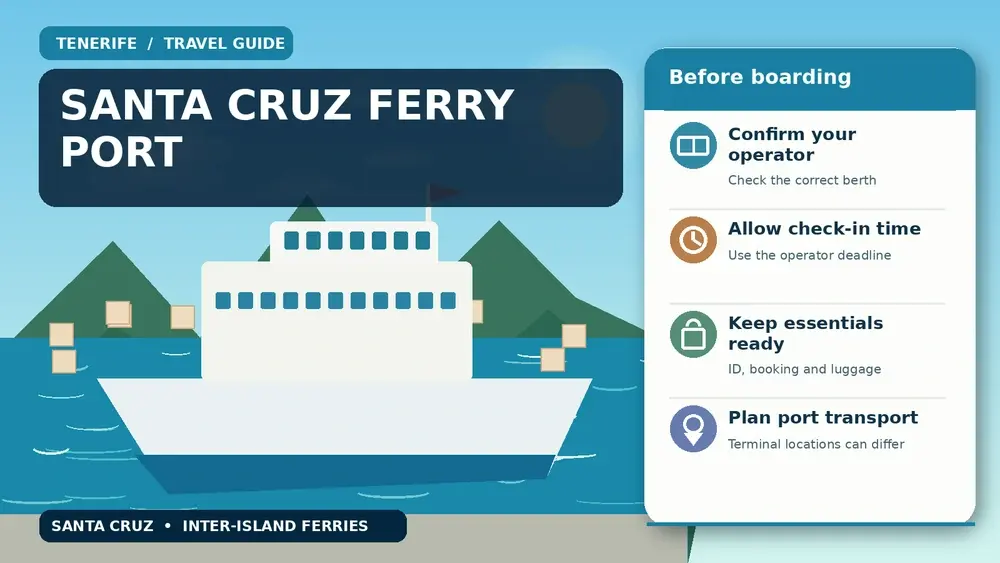
Quick summary: Santa Cruz is Tenerife’s major capital-city port and an important ferry gateway, especially for connections involving Gran Canaria and inter-island networks. Unlike Los Cristianos, the port is spread along a large waterfront, so I check the operator, quay and access instructions before travelling. “Port of Santa Cruz” is not one tiny terminal door.
| Best for | Major inter-island connections and capital-city access |
|---|---|
| City centre | Close, but the exact ferry berth can still require a walk or shuttle |
| Transport | Taxi, TITSA, tram/bus connections in the city, vehicle access |
| Key rule | Confirm operator, terminal/quay and boarding deadline |
Understanding the port layout
Santa Cruz de Tenerife has a long working waterfront used by ferries, cruise ships, cargo and other traffic. I do not navigate simply to “Puerto de Santa Cruz” and hope to see my ship. I open the operator’s terminal instructions and enter the specific access point. Fred. Olsen identifies its Muelle Ribera terminal and gives separate road and pedestrian directions.
The waterfront is close to central Santa Cruz, but “close” is relative when luggage, fencing, port security and large quays are involved. If I arrive by taxi, I show the ferry company and sailing rather than only saying “the port.” That reduces the risk of being dropped at a cruise terminal or another entrance.
Which routes use Santa Cruz?
Santa Cruz is central to Tenerife’s connections with Gran Canaria and can be part of wider inter-island itineraries. Routes, frequencies and vessel ports can change, so I search by exact date. Some western-island services are more naturally associated with Los Cristianos. The simplest rule is never to assume that every Tenerife ferry leaves from the same harbour.
If I am building an island-hopping holiday, I check the port before booking the hotel and again before departure. A same-day connection that looks easy on a ferry search engine can become awkward if the first ship arrives in Los Cristianos and the second leaves from Santa Cruz.
Foot passengers and luggage
For foot passengers, I arrive early enough to locate the check-in area without stress. Fred. Olsen lists trolleys and a small luggage transport service at its Santa Cruz operation, but I still follow the specific fare and ticket conditions. Valuables, medication, travel documents and batteries stay with me.
A small wheeled case is easier on the city-port transition than multiple loose bags. If I have several hours before check-in, I use a planned luggage-storage option rather than dragging cases through Santa Cruz. This is especially useful if I want to visit the market, TEA or the old centre before an afternoon sailing.
Arriving by car
Drivers approach the port from the city’s seafront road network and then follow operator signage. The exact entrance matters because the port perimeter is large. I add a margin for urban traffic and do not schedule refuelling after the advertised vehicle check-in cut-off. If the car is rented, I check ferry permission before the day of travel.
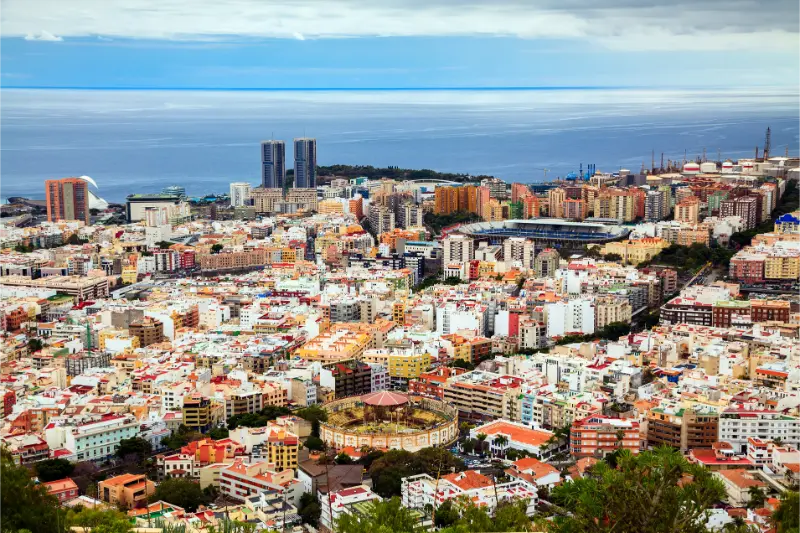
Vehicle boarding is usually organised in staging lanes. I keep the booking accessible on my phone and, when possible, offline. Once on board, I remove the things I need during the crossing because access to the vehicle deck may be restricted.
From the city centre to the ferry
Santa Cruz is one of the few places in Tenerife where a ferry departure can pair naturally with a city stay. Taxis are the simplest option with luggage. Public transport can bring me into the metropolitan hub, but I still check the final walking route to the specific terminal. The tram is excellent for moving between Santa Cruz and La Laguna, but it does not replace the final port access step.
If my hotel is central, I ask reception for the realistic taxi time to the operator’s terminal rather than measuring the straight-line distance. Port roads and security entrances can make a short map distance feel longer.
Connections between Santa Cruz and Los Cristianos
Fred. Olsen lists a complimentary ferry bus linking Santa Cruz and Los Cristianos for passengers on certain western-island services. I treat this as an operator connection, not a general free public bus. Eligibility, meeting point and timetable should be confirmed on the booking.
Without an operator shuttle, the road journey between the two ports is substantial enough that I allow a generous margin. A traffic problem on TF-1 can break a tight connection. If two separate tickets are involved, I plan even more conservatively because the second carrier may not protect a missed connection.
Parking and overnight strategy
For a car that is not boarding the ferry, I check official or commercial parking close to the port and read the access hours. I avoid leaving a vehicle in an apparently convenient street space for several days without confirming signs and restrictions. In central Santa Cruz, a paid garage can be worth the predictability.
For an early sailing, a city-centre night works well because restaurants and services are close. For a late arrival, I avoid stacking a long cross-island drive after the ferry if I know I will be tired. Tenerife’s roads are good, but fatigue is a poor way to begin or end an island-hopping leg.
How I would build this into a real Tenerife trip
I treat Santa Cruz Tenerife ferry port as one layer of the holiday rather than a reason to over-plan every hour. My usual method is to identify the one decision that could create a genuine problem—missing a ferry, choosing an unsuitable room, arriving after the last bus, or assuming a service exists at a beach—and verify that point first. Everything else can stay flexible. Tenerife is easy to enjoy when the important logistics are checked early and the day still has enough breathing room for weather, traffic and spontaneous stops.

I also keep geography in mind. Tenerife may look compact on a map, but the TF-1, TF-5, mountain roads and the separation between the north, south and metropolitan area can turn a small planning error into a long detour. I group activities by area, avoid crossing the island unnecessarily, and leave a buffer around anything with a fixed departure or appointment. That same habit improves almost every trip, whether I am driving, using TITSA buses, catching a ferry or arranging an accessible transfer.
Useful related guides on My Tenerife Experience
Where I would stay
I choose accommodation according to the hardest part of the itinerary, not simply the lowest nightly rate. For an early ferry I value a walkable or short-taxi location; for a no-car stay I prioritise bus connections; for accessibility I verify the exact route from the room to the entrance, restaurant and pool; and for a road trip I care more about straightforward parking than a postcard address. I compare places to stay in Tenerife and then read the most recent reviews for details that matter to my specific trip.
Official information I would recheck before travelling
- Fred. Olsen Express: Tenerife ports and terminal information
- Autoridad Portuaria de Santa Cruz de Tenerife
Frequently asked questions
Is Santa Cruz ferry port walkable from the centre?
Parts of the port are close to central Santa Cruz, but the exact berth and secured access route matter. With luggage, a taxi can be easier.
Is Santa Cruz the same port as Los Cristianos?
No. They are separate ports on different parts of Tenerife.
Should I book accommodation near the port for an early ferry?
It can reduce stress, especially when the alternative is a long pre-dawn drive from the south or north.
Final thoughts
Santa Cruz ferry travel becomes much easier when I plan for the exact terminal instead of treating the whole waterfront as one small passenger station. My preference is to use official information for rules, timetables and safety-critical details, then use the rest of the day for the part of Tenerife I actually came to experience. A practical guide should reduce friction, not make the island feel complicated.

Extra practical note 1
Confirm the exact quay because Santa Cruz is a large working port. I treat this as a small decision with a large payoff. Tenerife trips often combine airports, coast, cities and mountain roads in a single week, so a detail that seems minor at home can become important when plans are linked together. I verify the current rule or service, keep a realistic time buffer and avoid assuming that every municipality, operator or hotel works in exactly the same way. This approach gives me flexibility without turning the holiday into administration.
I also think about the return journey. What is easy on arrival can be different when I am tired, carrying purchases, travelling after dark or working around a fixed flight or ferry. A short note saved on my phone—address, booking reference, official link or opening time—usually does more for the trip than a long list of generic tips. When circumstances change, I choose the simpler option and protect the part of the day that matters most.
Extra practical note 2
Use a taxi when luggage makes the pedestrian route awkward. I treat this as a small decision with a large payoff. Tenerife trips often combine airports, coast, cities and mountain roads in a single week, so a detail that seems minor at home can become important when plans are linked together. I verify the current rule or service, keep a realistic time buffer and avoid assuming that every municipality, operator or hotel works in exactly the same way. This approach gives me flexibility without turning the holiday into administration.
I also think about the return journey. What is easy on arrival can be different when I am tired, carrying purchases, travelling after dark or working around a fixed flight or ferry. A short note saved on my phone—address, booking reference, official link or opening time—usually does more for the trip than a long list of generic tips. When circumstances change, I choose the simpler option and protect the part of the day that matters most.
Leave a Reply