
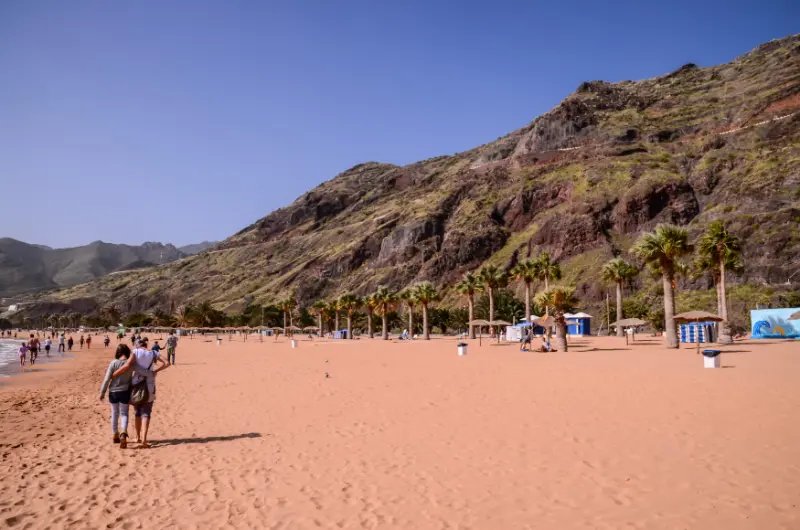
Playa de Las Teresitas is the beach I would add to a Santa Cruz or Anaga day when I want an easy swim rather than a wild Atlantic beach. It sits beside the village of San Andrés, northeast of Santa Cruz, and its pale sand, palms and sheltered water look very different from the black volcanic beaches found elsewhere on Tenerife. The contrast is part of the appeal.
The official Tenerife tourism site describes Las Teresitas as roughly 1.3 kilometres long, around 80 metres wide, family-oriented and protected by breakwaters that reduce wave action. It also lists practical services such as toilets, showers, lifeguarding, accessible facilities, bars and restaurants. Those features make it one of the simplest beaches to recommend to first-time visitors who want comfort.
Why Las Teresitas feels different
Many travellers picture Tenerife as a dark-sand volcanic island, so Las Teresitas can be surprising. The light-coloured sand and rows of palms create a softer, almost resort-like visual atmosphere even though the beach is next to a local fishing village rather than a major hotel strip. Behind it rise the dry lower slopes of Anaga, which gives the beach a dramatic natural frame.
I would not call it Tenerife’s ‘best’ beach in every sense because beach preferences are personal. For wild scenery I prefer Benijo; for easy south-coast hotel access I would choose Fañabé or Del Duque; for wind sports, El Médano. Las Teresitas is strongest when calm water, space, services and proximity to Santa Cruz matter.
Swimming and family use
The breakwater usually makes the shoreline calmer than many open Atlantic beaches, which is one reason families like it. I still treat the ocean as the ocean: I follow flags and lifeguard instructions, keep young children within reach and do not assume that calm-looking water means zero risk. Weather, currents and local conditions can change.
With children I choose a base near the services, create shade early and avoid the hottest middle part of the day if possible. The beach is long enough that walking farther from the busiest access points can change the atmosphere noticeably.
How to get there from Santa Cruz
Las Teresitas is close enough to Santa Cruz that I do not consider a rental car essential. Urban buses serve San Andrés and the beach area, and a taxi can be practical for a family. If I am already driving for an Anaga day, I use the beach as the last stop and accept that parking is easier at some times than others.
The advantage of public transport is that I do not spend part of a beach day circling for a space during a busy weekend. The advantage of a car is flexibility if I am continuing toward Anaga viewpoints. My Tenerife without a car guide and driving guide compare both approaches.
Parking
There is parking by the beach, but I never interpret the existence of a car park as a guarantee of an easy space at midday on a sunny weekend. If driving, I arrive earlier, avoid blocking access roads and never leave valuables visible in the vehicle. For a relaxed city-and-beach day, I often prefer leaving the car in Santa Cruz and using public transport.
San Andrés: do not skip the village
The small village immediately beside Las Teresitas is part of the experience. Instead of eating only at a beach kiosk, I like the option of walking into San Andrés for fish or Canarian food. A long lunch there gives the day a local rhythm that is different from the southern resorts.
I also respect that San Andrés is a residential place, not an extension of the beach. I park legally, keep beach gear out of doorways and avoid treating narrow streets as photo sets. Small habits matter in places that receive large numbers of day visitors.
What to bring
- Shade or sun protection, especially for children.
- Water even if you plan to use beach bars.
- A light layer if combining the beach with higher Anaga viewpoints.
- Secure footwear if you plan a long walk beyond the sand.
- Only the valuables you genuinely need.
I usually bring less to Las Teresitas than to a remote beach because services are close. That is one of the reasons I recommend it to travellers who do not want a logistical expedition every time they swim.
Best combinations for one day
Santa Cruz + Las Teresitas
This is the easiest combination. I spend the morning in Santa Cruz—market, historic streets, TEA or the Auditorio area—then travel to San Andrés for lunch and beach time. My Santa Cruz guide provides a realistic city plan.
Anaga + Las Teresitas
If I drive, I can start in La Laguna or Cruz del Carmen, enjoy selected Anaga viewpoints and finish at Las Teresitas when I no longer want mountain roads. I keep the hiking modest because wet laurel forest and a hot beach day require different clothing and energy. Read my Anaga Rural Park guide before planning trails.
Las Teresitas only
There is nothing wrong with dedicating a full slow day to the beach and San Andrés. Not every Tenerife day needs three attractions. In fact, a relaxed day here can be the ideal counterweight after Teide or a long road trip.
Best time of day
I like morning for easier logistics and softer light, or late afternoon for a calmer end to a Santa Cruz day. Midday can be perfectly enjoyable if you want a classic beach day and have shade. Weekends and holidays can feel busier because the beach is popular with local residents as well as visitors.
Weather differences from the south
The northeast can be cloudier or windier than Costa Adeje even when the south is bright. I look at the local forecast rather than the island-wide symbol on a weather app. If Las Teresitas is grey while the south is sunny, that does not mean the forecast was ‘wrong’; Tenerife’s relief creates real microclimates.

Is Las Teresitas good without a car?
Yes, particularly if you are staying in Santa Cruz or La Laguna. It is one of the island beaches I am comfortable recommending to travellers who do not rent a car because public transport reaches the area and the beach itself has services. The challenge is not the beach; it is adding remote Anaga stops on the same day.
Where to stay
For repeated beach visits combined with city life, I would stay in Santa Cruz rather than search for a resort directly on Las Teresitas. The capital gives far more restaurants, transport and evening options. You can compare Santa Cruz accommodation.
Official information
For current services and beach information, I use Tenerife Tourism’s official Las Teresitas page. It currently lists the beach as 1,300 metres long, family-friendly and equipped with services including toilets, showers, lifeguarding, accessible access and food options.
Frequently asked questions
Is Las Teresitas natural golden sand?
The beach’s appearance has been heavily shaped by human intervention, including imported light-coloured sand and breakwaters. I visit for the present-day beach experience rather than treating it as an untouched natural cove.

Can I visit from Costa Adeje?
Yes, but I would combine it with Santa Cruz or Anaga so the long cross-island journey has more purpose. For a beach-only day from the south, closer beaches are more efficient.
Is it safe for children?
It is popular with families and generally more sheltered than many open-ocean beaches, but I still follow flags, lifeguards and normal water-safety rules.
How long would I stay?
Two to four hours works well as part of a city day; a full day is worthwhile if the goal is simple beach relaxation with lunch in San Andrés.
How I decide whether to include Las Teresitas in a first-week plan
If I already have several south-coast beach days, I include Las Teresitas only when it is attached to Santa Cruz or Anaga. That way the journey adds a genuinely different part of Tenerife rather than simply another stretch of sand. If the holiday is based in the capital, the decision reverses: Las Teresitas becomes the easy local beach and the southern resorts become the long excursion.
This is a useful general rule for Tenerife. I group places by geography and experience instead of chasing a list of famous names. The island feels smaller, the driving falls and I spend more time actually being somewhere.
Photography, shade and a slower beach rhythm
Las Teresitas is especially photogenic when the mountains behind San Andrés are clear, but I do not build the visit around obtaining one exact postcard image. Light, haze and cloud change quickly in the northeast. I take a few photographs, then put the phone away and use the beach for what it does best: easy swimming, walking and a long break from sightseeing.
If I plan several hours here, shade becomes part of the itinerary. The pale sand and open waterfront can feel bright even on a mild day, and reflected light adds to sun exposure. I reapply sunscreen after swimming and give children regular shaded breaks instead of waiting until everyone feels overheated.
Leave a Reply