Category: Food & Culture

Tenerife food, Canarian dishes, wine, markets and cultural experiences for curious travellers.

  • Plaza de la Libertad Garachico Guide: Gardens, Bandstand and Bolívar

    Plaza de la Libertad Garachico Guide: Gardens, Bandstand and Bolívar

    Plaza de la Libertad Garachico is a place I would add when I want a Tenerife itinerary to explain the island rather than simply collect viewpoints. It fits naturally into a visit to Garachico and gives context that is easy to miss when I only stop at the most photographed landmark.

    Plaza de la Libertad has changed both appearance and name repeatedly. Historical names have included Plaza de Santa Ana, Plaza de la Constitución and later political names before the modern Plaza de la Libertad, making the square a small record of changing civic memory.

    Quick facts

    PlaceGarachico
    TypeHistoric Square
    Time I allow20–45 minutes, longer if I stop for coffee or combine nearby monuments
    Address / areaGlorieta San Francisco, Garachico
    Best approachCombine it with nearby sights on foot and verify current access before travelling

    Why this place is worth understanding

    After the 1706 eruption, the relationship between the square and Santa Ana church changed, and by 1821 a street separated the two. The space was remodelled again in 1912, when its gardens were improved and a music kiosk was designed using a model brought from Mexico.

    In 1970 the Garachico community living in Venezuela donated a bronze statue of Simón Bolívar, made by local sculptor Juan Jaén. The monument is a visible reminder of the strong migration links between the Canary Islands and Venezuela.

    Further work in 1990–1991 renewed the paving and gardens. Shields of Bolivarian countries were incorporated into the square, reinforcing the transatlantic theme that appears elsewhere in Garachico’s art, families and migration history.

    I use this square as a pause rather than another attraction to ‘complete’. Sitting for ten minutes often reveals more than walking a fast loop. The mix of religious architecture, civic monuments, gardens and cafés shows how historic centres keep functioning after their original economic role changes. The Venezuela connection is particularly worth noticing because it turns a local plaza into part of a much wider migration story.

    What I look for on the visit

    I try to arrive with two or three details in mind instead of reading a long list while I am standing in front of the building. That keeps the visit focused and makes the history easier to remember. The details I would prioritize here are:

    • The bandstand and garden geometry.
    • The simón bolívar monument and bolivarian references.
    • The façades framing the square.
    • The short visual connection to san francisco convent and santa ana church.

    I also step back and look at the surrounding streets. Historic buildings make more sense when I see their relationship with plazas, former transport routes, the coast and neighbouring institutions. A tight photograph of one doorway rarely explains as much as a wider view of how the place sits inside the town.

    How I fit it into a Garachico day

    Garachico is one of the places where I find it especially rewarding to slow down. The historic centre is compact, so the temptation is to photograph the church, the castle and the lava pools in quick succession and move on. I get more from it by reading the town as a sequence: the old port economy, the defensive structures, the religious buildings, the 1706 eruption and the way the settlement rebuilt around a changed coastline.

    Garachico Coast And Natural Pools Tenerife

    For practical planning, I usually park once and walk. The old centre is small enough that repeatedly moving the car makes little sense, and the most interesting details are between the headline sights: stone doorways, changes in street level, glimpses of courtyards and the relationship between the plazas and the seafront. Comfortable shoes are useful even for a short visit because paving can be uneven.

    The weather on the northwest coast can be different from the resort south. Cloud, wind and sea conditions can change the feel of a visit quickly, so I keep the historic walk independent from any plan to swim at El Caletón. That way a rough sea does not ruin the day: the architecture and town history still make the trip worthwhile.

    Garachico is also a good example of why I avoid building a Tenerife itinerary around isolated attractions. A single monument may need only twenty minutes, but the value comes from linking several nearby places. A two- or three-hour walk can tell a coherent story without long drives, and it leaves enough time for a meal or a coffee rather than turning the day into a checklist.

    My preferred sequence is to start in the historic centre before the busiest part of the day, connect the civic and religious monuments on foot, then reach the seafront. I decide on swimming only after I see the actual sea conditions at El Caletón. If the coast is rough, I use the extra time for the castle, Puerta de Tierra, a longer lunch or another nearby town such as Los Silos instead of forcing a beach plan.

    Garachico Historic Town Tenerife

    Access, opening hours and respectful behaviour

    I treat permanent historical information and day-to-day visitor access as two different things. The building or site may be centuries old, but hours, exhibitions, restoration work and the availability of interior rooms can change. I therefore use the official source for the final check rather than relying on an old timetable copied by a third-party travel site.

    For an outdoor heritage stop I still check for temporary works, festival closures or event installations. A public square or park can remain accessible while part of it is fenced, and a fortress or interpretation space can change interior opening arrangements even when the exterior is always visible.

    Accessibility and visiting with children

    Historic centres in Tenerife can combine slopes, steps, narrow thresholds and uneven paving. I never label a whole visit ‘accessible’ based only on the main street. For a wheelchair, mobility scooter or pushchair, I check the exact entrance and the route between stops, and I am prepared to enjoy an exterior view if the historic fabric creates unavoidable barriers.

    With children I make the story concrete. A fort protecting ships, a gate controlling goods, a silver cross made in Havana, a volcanic eruption that changed a harbour or a cave adapted as a place of worship is easier to remember than a long sequence of dates. I keep indoor visits short and alternate them with plazas, gardens or the seafront.

    Photography: the views that explain the place

    My first photograph is usually a contextual one. I include the street, plaza, coastline or neighbouring building so the image shows where the monument belongs. After that I look for materials: basalt, carved stone, tea wood, plaster, metalwork or garden geometry. Side light in the morning or late afternoon often reveals texture better than flat midday sun.

    I avoid blocking doors and narrow pavements while composing a shot. In churches and working civic buildings I follow photography rules and never use a tripod if it interferes with other visitors. The goal is to document the place without turning local daily life into a photo set.

    A compact walking route nearby

    Rather than sending myself across the island for unrelated stops, I build a small cluster around this page. These are the guides I would use next:

    These links are deliberately local. I prefer a route where each stop adds another piece of the same story, because it reduces driving and makes the day feel less fragmented. It also leaves space for a meal, a market, weather changes and the small unplanned discoveries that usually become the most memorable part of a town visit.

    Where I would stay

    If I wanted to explore this part of Tenerife at a slower pace, I would compare accommodation in Garachico. Staying nearby can be useful for quieter morning streets and for avoiding a long return drive after a full day in the northwest or east of the island.

    Official information

    Before travelling I check the official information for Plaza de la Libertad Garachico. I use the official page for current access, temporary closures, events and opening arrangements because those details can change after this article is published.

    Garachico Town And Coast Tenerife

    Common planning mistakes I avoid

    • Treating a small historic site as a reason for a long cross-island drive instead of combining it with nearby places.
    • Assuming an old opening-hours screenshot is still valid.
    • Moving the car between attractions that are only a few minutes apart on foot.
    • Focusing on the façade and missing the relationship with the square, street or former coastline.
    • Packing too many churches or museums into one block until the details blur together.
    • Ignoring local events, services or municipal activity that can temporarily change access.

    Frequently asked questions

    Is it worth visiting on a first trip to Tenerife?

    Yes if I am already planning time in Garachico. I would not normally cross the island for this one stop alone, but it adds genuine depth to a town visit and helps me understand details that the general sightseeing route can otherwise miss.

    How much time do I need?

    I would allow 20–45 minutes, longer if I stop for coffee or combine nearby monuments. The exact time depends on interior access, events and how many nearby sights I connect. For a square, garden or exterior-only stop, I may stay less; for a church, historic house or cultural building I allow more.

    Do I need a car?

    Not for the monument itself once I am in the historic centre. A car can be useful for reaching the town from another part of Tenerife, but I prefer to park once and continue on foot. Bus travel is also possible in many cases, although I check the return timetable before starting the day.

    Can I rely on published opening hours?

    I use them as a starting point, not a guarantee. Religious services, holidays, restoration, municipal events and temporary exhibitions can alter normal access. The official link above is the source I check closest to the visit.

    What should I combine with it?

    I combine it with two or three nearby heritage stops and the seafront. If sea conditions are safe, El Caletón can be an optional final stop, but I never make the cultural visit dependent on swimming conditions.

    Final thoughts

    Plaza de la Libertad Garachico works best for me as part of a connected story rather than as a stand-alone pin. I would keep the visit flexible, read the setting as carefully as the monument itself and use the surrounding streets to understand how Garachico changed over time. That slower approach is exactly what helps a Tenerife trip move beyond the standard highlights.
  • Puerta de Tierra Garachico Guide: Old Port Gate and Hidden Garden

    Puerta de Tierra Garachico Guide: Old Port Gate and Hidden Garden

    Puerta de Tierra Garachico is a place I would add when I want a Tenerife itinerary to explain the island rather than simply collect viewpoints. It fits naturally into a visit to Garachico and gives context that is easy to miss when I only stop at the most photographed landmark.

    Puerta de Tierra is a surviving reminder of Garachico’s sixteenth-century port. The gate marked the passage through which people and goods moved between the harbour and the town during the period when maritime commerce shaped local prosperity.

    Quick facts

    PlaceGarachico
    TypeHistoric Park
    Time I allow20–40 minutes as part of a longer Garachico walk
    Address / areaPlaza Juan González de la Torre, Garachico
    Best approachCombine it with nearby sights on foot and verify current access before travelling

    Why this place is worth understanding

    The eruption of 1706 destroyed the old harbour’s role and radically changed the coastline, but the gateway remained as a physical reference to the vanished port. For me, that makes it more than a decorative ruin: it is a surviving piece of transport infrastructure from a landscape that no longer exists.

    The gate now sits within a small landscaped park. The municipal tourism information also highlights an old wine press from the Hacienda de San Juan Degollado, creating a useful link between port history and the agricultural products that were processed and traded through places like Garachico.

    A corner of the park commemorates the poet Rafael Alberti, who visited Garachico in 1991. It is an unexpected cultural detail that adds another chronological layer to a site best known for much earlier history.

    The mental exercise I find most useful here is to remove the modern road, gardens and present shoreline from the picture and imagine cargo, passengers and port controls passing through the same threshold. That shift makes the gate intelligible. Without the old harbour context it can look like a pleasant stone feature in a garden; with that context it becomes evidence of how Garachico worked before the eruption.

    What I look for on the visit

    I try to arrive with two or three details in mind instead of reading a long list while I am standing in front of the building. That keeps the visit focused and makes the history easier to remember. The details I would prioritize here are:

    • The old gateway as a piece of port infrastructure.
    • The garden layout around the surviving masonry.
    • The historic wine press.
    • The contrast between today’s inland-feeling park and the former harbour function.

    I also step back and look at the surrounding streets. Historic buildings make more sense when I see their relationship with plazas, former transport routes, the coast and neighbouring institutions. A tight photograph of one doorway rarely explains as much as a wider view of how the place sits inside the town.

    How I fit it into a Garachico day

    Garachico is one of the places where I find it especially rewarding to slow down. The historic centre is compact, so the temptation is to photograph the church, the castle and the lava pools in quick succession and move on. I get more from it by reading the town as a sequence: the old port economy, the defensive structures, the religious buildings, the 1706 eruption and the way the settlement rebuilt around a changed coastline.

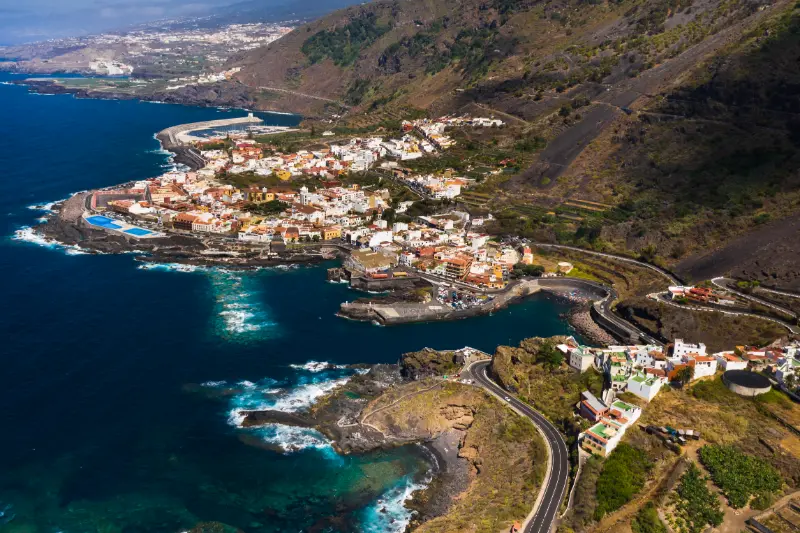
    Garachico Coast Aerial View Tenerife

    For practical planning, I usually park once and walk. The old centre is small enough that repeatedly moving the car makes little sense, and the most interesting details are between the headline sights: stone doorways, changes in street level, glimpses of courtyards and the relationship between the plazas and the seafront. Comfortable shoes are useful even for a short visit because paving can be uneven.

    The weather on the northwest coast can be different from the resort south. Cloud, wind and sea conditions can change the feel of a visit quickly, so I keep the historic walk independent from any plan to swim at El Caletón. That way a rough sea does not ruin the day: the architecture and town history still make the trip worthwhile.

    Garachico is also a good example of why I avoid building a Tenerife itinerary around isolated attractions. A single monument may need only twenty minutes, but the value comes from linking several nearby places. A two- or three-hour walk can tell a coherent story without long drives, and it leaves enough time for a meal or a coffee rather than turning the day into a checklist.

    My preferred sequence is to start in the historic centre before the busiest part of the day, connect the civic and religious monuments on foot, then reach the seafront. I decide on swimming only after I see the actual sea conditions at El Caletón. If the coast is rough, I use the extra time for the castle, Puerta de Tierra, a longer lunch or another nearby town such as Los Silos instead of forcing a beach plan.

    Garachico Coast And Natural Pools Tenerife

    Access, opening hours and respectful behaviour

    I treat permanent historical information and day-to-day visitor access as two different things. The building or site may be centuries old, but hours, exhibitions, restoration work and the availability of interior rooms can change. I therefore use the official source for the final check rather than relying on an old timetable copied by a third-party travel site.

    For an outdoor heritage stop I still check for temporary works, festival closures or event installations. A public square or park can remain accessible while part of it is fenced, and a fortress or interpretation space can change interior opening arrangements even when the exterior is always visible.

    Accessibility and visiting with children

    Historic centres in Tenerife can combine slopes, steps, narrow thresholds and uneven paving. I never label a whole visit ‘accessible’ based only on the main street. For a wheelchair, mobility scooter or pushchair, I check the exact entrance and the route between stops, and I am prepared to enjoy an exterior view if the historic fabric creates unavoidable barriers.

    With children I make the story concrete. A fort protecting ships, a gate controlling goods, a silver cross made in Havana, a volcanic eruption that changed a harbour or a cave adapted as a place of worship is easier to remember than a long sequence of dates. I keep indoor visits short and alternate them with plazas, gardens or the seafront.

    Photography: the views that explain the place

    My first photograph is usually a contextual one. I include the street, plaza, coastline or neighbouring building so the image shows where the monument belongs. After that I look for materials: basalt, carved stone, tea wood, plaster, metalwork or garden geometry. Side light in the morning or late afternoon often reveals texture better than flat midday sun.

    I avoid blocking doors and narrow pavements while composing a shot. In churches and working civic buildings I follow photography rules and never use a tripod if it interferes with other visitors. The goal is to document the place without turning local daily life into a photo set.

    A compact walking route nearby

    Rather than sending myself across the island for unrelated stops, I build a small cluster around this page. These are the guides I would use next:

    These links are deliberately local. I prefer a route where each stop adds another piece of the same story, because it reduces driving and makes the day feel less fragmented. It also leaves space for a meal, a market, weather changes and the small unplanned discoveries that usually become the most memorable part of a town visit.

    Where I would stay

    If I wanted to explore this part of Tenerife at a slower pace, I would compare accommodation in Garachico. Staying nearby can be useful for quieter morning streets and for avoiding a long return drive after a full day in the northwest or east of the island.

    Official information

    Before travelling I check the official information for Puerta de Tierra Garachico. I use the official page for current access, temporary closures, events and opening arrangements because those details can change after this article is published.

    Common planning mistakes I avoid

    • Treating a small historic site as a reason for a long cross-island drive instead of combining it with nearby places.
    • Assuming an old opening-hours screenshot is still valid.
    • Moving the car between attractions that are only a few minutes apart on foot.
    • Focusing on the façade and missing the relationship with the square, street or former coastline.
    • Packing too many churches or museums into one block until the details blur together.
    • Ignoring local events, services or municipal activity that can temporarily change access.

    Frequently asked questions

    Is it worth visiting on a first trip to Tenerife?

    Yes if I am already planning time in Garachico. I would not normally cross the island for this one stop alone, but it adds genuine depth to a town visit and helps me understand details that the general sightseeing route can otherwise miss.

    How much time do I need?

    I would allow 20–40 minutes as part of a longer Garachico walk. The exact time depends on interior access, events and how many nearby sights I connect. For a square, garden or exterior-only stop, I may stay less; for a church, historic house or cultural building I allow more.

    Garachico Historic Town Tenerife

    Do I need a car?

    Not for the monument itself once I am in the historic centre. A car can be useful for reaching the town from another part of Tenerife, but I prefer to park once and continue on foot. Bus travel is also possible in many cases, although I check the return timetable before starting the day.

    Can I rely on published opening hours?

    I use them as a starting point, not a guarantee. Religious services, holidays, restoration, municipal events and temporary exhibitions can alter normal access. The official link above is the source I check closest to the visit.

    What should I combine with it?

    I combine it with two or three nearby heritage stops and the seafront. If sea conditions are safe, El Caletón can be an optional final stop, but I never make the cultural visit dependent on swimming conditions.

    Final thoughts

    Puerta de Tierra Garachico works best for me as part of a connected story rather than as a stand-alone pin. I would keep the visit flexible, read the setting as carefully as the monument itself and use the surrounding streets to understand how Garachico changed over time. That slower approach is exactly what helps a Tenerife trip move beyond the standard highlights.

  • San Francisco Convent Garachico Guide: Cloisters, Culture and History

    San Francisco Convent Garachico Guide: Cloisters, Culture and History

    San Francisco Convent Garachico is a place I would add when I want a Tenerife itinerary to explain the island rather than simply collect viewpoints. It fits naturally into a visit to Garachico and gives context that is easy to miss when I only stop at the most photographed landmark.

    The former Franciscan convent traces its origins to 1524, when Cristóbal de Ponte provided land to the Franciscan order beside an existing hermitage dedicated to Nuestra Señora de los Ángeles. Its foundation belongs to the prosperous period when Garachico’s port connected the island with wider Atlantic trade.

    Quick facts

    PlaceGarachico
    TypeFormer Convent
    Time I allow45–90 minutes if exhibition and interior spaces are accessible
    Address / areaGlorieta de San Francisco, Garachico
    Best approachCombine it with nearby sights on foot and verify current access before travelling

    Why this place is worth understanding

    The complex is arranged on two levels and is especially notable for its two spacious cloisters. Traditional tea wood appears in posts, galleries and other structural details, while a broad stone staircase is covered by a richly worked Mudéjar-influenced timber ceiling.

    The convent ceased its monastic role during the nineteenth-century confiscations and later became a civic building. Today it functions as a cultural centre, with the municipal library and archive as well as exhibition spaces, so its value is both historical and contemporary.

    This continued public use changes the character of a visit. I am not entering a frozen monument designed only for tourists; I am stepping into a historic complex that has been adapted to everyday cultural functions. That makes respectful behaviour and checking current access especially important.

    This is one of the places where I pay attention to reuse rather than searching for an imagined ‘original’ state. A convent can become a library, archive and exhibition venue without losing its historical meaning. In fact, continued public use often helps me understand the scale of the cloisters and circulation spaces better than an empty monument would.

    What I look for on the visit

    I try to arrive with two or three details in mind instead of reading a long list while I am standing in front of the building. That keeps the visit focused and makes the history easier to remember. The details I would prioritize here are:

    • The proportions and timber galleries of the cloisters.
    • The large stone staircase and its carved wooden ceiling.
    • How modern cultural uses occupy historic rooms.
    • The relationship with plaza de la libertad and santa ana church.

    I also step back and look at the surrounding streets. Historic buildings make more sense when I see their relationship with plazas, former transport routes, the coast and neighbouring institutions. A tight photograph of one doorway rarely explains as much as a wider view of how the place sits inside the town.

    How I fit it into a Garachico day

    Garachico is one of the places where I find it especially rewarding to slow down. The historic centre is compact, so the temptation is to photograph the church, the castle and the lava pools in quick succession and move on. I get more from it by reading the town as a sequence: the old port economy, the defensive structures, the religious buildings, the 1706 eruption and the way the settlement rebuilt around a changed coastline.

    Aerial View Of Garachico Tenerife

    For practical planning, I usually park once and walk. The old centre is small enough that repeatedly moving the car makes little sense, and the most interesting details are between the headline sights: stone doorways, changes in street level, glimpses of courtyards and the relationship between the plazas and the seafront. Comfortable shoes are useful even for a short visit because paving can be uneven.

    The weather on the northwest coast can be different from the resort south. Cloud, wind and sea conditions can change the feel of a visit quickly, so I keep the historic walk independent from any plan to swim at El Caletón. That way a rough sea does not ruin the day: the architecture and town history still make the trip worthwhile.

    Garachico is also a good example of why I avoid building a Tenerife itinerary around isolated attractions. A single monument may need only twenty minutes, but the value comes from linking several nearby places. A two- or three-hour walk can tell a coherent story without long drives, and it leaves enough time for a meal or a coffee rather than turning the day into a checklist.

    My preferred sequence is to start in the historic centre before the busiest part of the day, connect the civic and religious monuments on foot, then reach the seafront. I decide on swimming only after I see the actual sea conditions at El Caletón. If the coast is rough, I use the extra time for the castle, Puerta de Tierra, a longer lunch or another nearby town such as Los Silos instead of forcing a beach plan.

    Garachico Coast Aerial View Tenerife

    Access, opening hours and respectful behaviour

    I treat permanent historical information and day-to-day visitor access as two different things. The building or site may be centuries old, but hours, exhibitions, restoration work and the availability of interior rooms can change. I therefore use the official source for the final check rather than relying on an old timetable copied by a third-party travel site.

    Parts of the complex may have municipal, library, exhibition or other working uses. I do not assume every historic room is open, and I follow signs rather than wandering into offices. If a courtyard or gallery is accessible, I take time to observe materials and circulation instead of treating the interior only as a backdrop for photos.

    Accessibility and visiting with children

    Historic centres in Tenerife can combine slopes, steps, narrow thresholds and uneven paving. I never label a whole visit ‘accessible’ based only on the main street. For a wheelchair, mobility scooter or pushchair, I check the exact entrance and the route between stops, and I am prepared to enjoy an exterior view if the historic fabric creates unavoidable barriers.

    With children I make the story concrete. A fort protecting ships, a gate controlling goods, a silver cross made in Havana, a volcanic eruption that changed a harbour or a cave adapted as a place of worship is easier to remember than a long sequence of dates. I keep indoor visits short and alternate them with plazas, gardens or the seafront.

    Photography: the views that explain the place

    My first photograph is usually a contextual one. I include the street, plaza, coastline or neighbouring building so the image shows where the monument belongs. After that I look for materials: basalt, carved stone, tea wood, plaster, metalwork or garden geometry. Side light in the morning or late afternoon often reveals texture better than flat midday sun.

    I avoid blocking doors and narrow pavements while composing a shot. In churches and working civic buildings I follow photography rules and never use a tripod if it interferes with other visitors. The goal is to document the place without turning local daily life into a photo set.

    A compact walking route nearby

    Rather than sending myself across the island for unrelated stops, I build a small cluster around this page. These are the guides I would use next:

    These links are deliberately local. I prefer a route where each stop adds another piece of the same story, because it reduces driving and makes the day feel less fragmented. It also leaves space for a meal, a market, weather changes and the small unplanned discoveries that usually become the most memorable part of a town visit.

    Where I would stay

    If I wanted to explore this part of Tenerife at a slower pace, I would compare accommodation in Garachico. Staying nearby can be useful for quieter morning streets and for avoiding a long return drive after a full day in the northwest or east of the island.

    Official information

    Before travelling I check the official information for San Francisco Convent Garachico. I use the official page for current access, temporary closures, events and opening arrangements because those details can change after this article is published.

    Garachico Coast And Natural Pools Tenerife

    Common planning mistakes I avoid

    • Treating a small historic site as a reason for a long cross-island drive instead of combining it with nearby places.
    • Assuming an old opening-hours screenshot is still valid.
    • Moving the car between attractions that are only a few minutes apart on foot.
    • Focusing on the façade and missing the relationship with the square, street or former coastline.
    • Packing too many churches or museums into one block until the details blur together.
    • Ignoring local events, services or municipal activity that can temporarily change access.

    Frequently asked questions

    Is it worth visiting on a first trip to Tenerife?

    Yes if I am already planning time in Garachico. I would not normally cross the island for this one stop alone, but it adds genuine depth to a town visit and helps me understand details that the general sightseeing route can otherwise miss.

    How much time do I need?

    I would allow 45–90 minutes if exhibition and interior spaces are accessible. The exact time depends on interior access, events and how many nearby sights I connect. For a square, garden or exterior-only stop, I may stay less; for a church, historic house or cultural building I allow more.

    Do I need a car?

    Not for the monument itself once I am in the historic centre. A car can be useful for reaching the town from another part of Tenerife, but I prefer to park once and continue on foot. Bus travel is also possible in many cases, although I check the return timetable before starting the day.

    Can I rely on published opening hours?

    I use them as a starting point, not a guarantee. Religious services, holidays, restoration, municipal events and temporary exhibitions can alter normal access. The official link above is the source I check closest to the visit.

    What should I combine with it?

    I combine it with two or three nearby heritage stops and the seafront. If sea conditions are safe, El Caletón can be an optional final stop, but I never make the cultural visit dependent on swimming conditions.

    Final thoughts

    San Francisco Convent Garachico works best for me as part of a connected story rather than as a stand-alone pin. I would keep the visit flexible, read the setting as carefully as the monument itself and use the surrounding streets to understand how Garachico changed over time. That slower approach is exactly what helps a Tenerife trip move beyond the standard highlights.
  • Iglesia de Santa Ana Garachico Guide: Art, Eruption and Historic Centre

    Iglesia de Santa Ana Garachico Guide: Art, Eruption and Historic Centre

    Iglesia de Santa Ana Garachico is a place I would add when I want a Tenerife itinerary to explain the island rather than simply collect viewpoints. It fits naturally into a visit to Garachico and gives context that is easy to miss when I only stop at the most photographed landmark.

    Construction of the parish church began in 1520 on land associated with Garachico’s founder, Cristóbal de Ponte. The dedication to Saint Anne is linked to his wife, Ana de Vergara, which ties the building directly to the town’s earliest colonial elite.

    Quick facts

    PlaceGarachico
    TypeChurch
    Time I allow30–60 minutes, depending on access and services
    Address / areaCalle Francisco Montesdeoca 8, Garachico
    Best approachCombine it with nearby sights on foot and verify current access before travelling

    Why this place is worth understanding

    The volcanic eruption of 1706 severely affected the church as it devastated the port area and transformed Garachico. The building was reconstructed, so what I see today is not a perfectly untouched sixteenth-century monument but a place whose fabric records destruction, repair and continuity.

    Among the works highlighted by Tenerife’s official tourism information is the Cristo de la Misericordia, an image that came from Mexico. That transatlantic connection is important because it shows how religious art moved along the same Atlantic networks that sustained commerce and migration.

    The church also preserves a seventeenth-century marble baptismal font. Small objects like this can be more revealing than the scale of the building because they connect architecture with everyday rituals that continued through periods of prosperity, disaster and reconstruction.

    I find Santa Ana most interesting when I resist the urge to treat the 1706 eruption as a single dramatic anecdote. The real story is the recovery afterwards. A parish church had social functions that extended far beyond architecture, so rebuilding it meant re-establishing routines, ceremonies and a sense of continuity in a town whose economic geography had changed overnight.

    What I look for on the visit

    I try to arrive with two or three details in mind instead of reading a long list while I am standing in front of the building. That keeps the visit focused and makes the history easier to remember. The details I would prioritize here are:

    • The surviving stone façades and the rebuilt structure behind them.
    • The contrast between volcanic stone and whitewashed surfaces.
    • The cristo de la misericordia and other transatlantic artworks when access permits.
    • The relationship with nearby plaza de la libertad and the former port area.

    I also step back and look at the surrounding streets. Historic buildings make more sense when I see their relationship with plazas, former transport routes, the coast and neighbouring institutions. A tight photograph of one doorway rarely explains as much as a wider view of how the place sits inside the town.

    How I fit it into a Garachico day

    Garachico is one of the places where I find it especially rewarding to slow down. The historic centre is compact, so the temptation is to photograph the church, the castle and the lava pools in quick succession and move on. I get more from it by reading the town as a sequence: the old port economy, the defensive structures, the religious buildings, the 1706 eruption and the way the settlement rebuilt around a changed coastline.

    Garachico Town And Coast Tenerife

    For practical planning, I usually park once and walk. The old centre is small enough that repeatedly moving the car makes little sense, and the most interesting details are between the headline sights: stone doorways, changes in street level, glimpses of courtyards and the relationship between the plazas and the seafront. Comfortable shoes are useful even for a short visit because paving can be uneven.

    The weather on the northwest coast can be different from the resort south. Cloud, wind and sea conditions can change the feel of a visit quickly, so I keep the historic walk independent from any plan to swim at El Caletón. That way a rough sea does not ruin the day: the architecture and town history still make the trip worthwhile.

    Garachico is also a good example of why I avoid building a Tenerife itinerary around isolated attractions. A single monument may need only twenty minutes, but the value comes from linking several nearby places. A two- or three-hour walk can tell a coherent story without long drives, and it leaves enough time for a meal or a coffee rather than turning the day into a checklist.

    My preferred sequence is to start in the historic centre before the busiest part of the day, connect the civic and religious monuments on foot, then reach the seafront. I decide on swimming only after I see the actual sea conditions at El Caletón. If the coast is rough, I use the extra time for the castle, Puerta de Tierra, a longer lunch or another nearby town such as Los Silos instead of forcing a beach plan.

    Aerial View Of Garachico Tenerife

    Access, opening hours and respectful behaviour

    I treat permanent historical information and day-to-day visitor access as two different things. The building or site may be centuries old, but hours, exhibitions, restoration work and the availability of interior rooms can change. I therefore use the official source for the final check rather than relying on an old timetable copied by a third-party travel site.

    Because this is an active or devotional religious setting, I keep my voice low, avoid flash where prohibited and do not photograph people at prayer. Services and ceremonies take priority over sightseeing. Clothing rules are not always enforced in the same way as at major cathedrals, but I still choose respectful dress and avoid walking around during a service simply to take pictures.

    Accessibility and visiting with children

    Historic centres in Tenerife can combine slopes, steps, narrow thresholds and uneven paving. I never label a whole visit ‘accessible’ based only on the main street. For a wheelchair, mobility scooter or pushchair, I check the exact entrance and the route between stops, and I am prepared to enjoy an exterior view if the historic fabric creates unavoidable barriers.

    With children I make the story concrete. A fort protecting ships, a gate controlling goods, a silver cross made in Havana, a volcanic eruption that changed a harbour or a cave adapted as a place of worship is easier to remember than a long sequence of dates. I keep indoor visits short and alternate them with plazas, gardens or the seafront.

    Photography: the views that explain the place

    My first photograph is usually a contextual one. I include the street, plaza, coastline or neighbouring building so the image shows where the monument belongs. After that I look for materials: basalt, carved stone, tea wood, plaster, metalwork or garden geometry. Side light in the morning or late afternoon often reveals texture better than flat midday sun.

    I avoid blocking doors and narrow pavements while composing a shot. In churches and working civic buildings I follow photography rules and never use a tripod if it interferes with other visitors. The goal is to document the place without turning local daily life into a photo set.

    A compact walking route nearby

    Rather than sending myself across the island for unrelated stops, I build a small cluster around this page. These are the guides I would use next:

    These links are deliberately local. I prefer a route where each stop adds another piece of the same story, because it reduces driving and makes the day feel less fragmented. It also leaves space for a meal, a market, weather changes and the small unplanned discoveries that usually become the most memorable part of a town visit.

    Where I would stay

    If I wanted to explore this part of Tenerife at a slower pace, I would compare accommodation in Garachico. Staying nearby can be useful for quieter morning streets and for avoiding a long return drive after a full day in the northwest or east of the island.

    Official information

    Before travelling I check the official information for Iglesia de Santa Ana Garachico. I use the official page for current access, temporary closures, events and opening arrangements because those details can change after this article is published.

    Garachico Coast Aerial View Tenerife

    Common planning mistakes I avoid

    • Treating a small historic site as a reason for a long cross-island drive instead of combining it with nearby places.
    • Assuming an old opening-hours screenshot is still valid.
    • Moving the car between attractions that are only a few minutes apart on foot.
    • Focusing on the façade and missing the relationship with the square, street or former coastline.
    • Packing too many churches or museums into one block until the details blur together.
    • Ignoring local events, services or municipal activity that can temporarily change access.

    Frequently asked questions

    Is it worth visiting on a first trip to Tenerife?

    Yes if I am already planning time in Garachico. I would not normally cross the island for this one stop alone, but it adds genuine depth to a town visit and helps me understand details that the general sightseeing route can otherwise miss.

    How much time do I need?

    I would allow 30–60 minutes, depending on access and services. The exact time depends on interior access, events and how many nearby sights I connect. For a square, garden or exterior-only stop, I may stay less; for a church, historic house or cultural building I allow more.

    Do I need a car?

    Not for the monument itself once I am in the historic centre. A car can be useful for reaching the town from another part of Tenerife, but I prefer to park once and continue on foot. Bus travel is also possible in many cases, although I check the return timetable before starting the day.

    Can I rely on published opening hours?

    I use them as a starting point, not a guarantee. Religious services, holidays, restoration, municipal events and temporary exhibitions can alter normal access. The official link above is the source I check closest to the visit.

    What should I combine with it?

    I combine it with two or three nearby heritage stops and the seafront. If sea conditions are safe, El Caletón can be an optional final stop, but I never make the cultural visit dependent on swimming conditions.

    Final thoughts

    Iglesia de Santa Ana Garachico works best for me as part of a connected story rather than as a stand-alone pin. I would keep the visit flexible, read the setting as carefully as the monument itself and use the surrounding streets to understand how Garachico changed over time. That slower approach is exactly what helps a Tenerife trip move beyond the standard highlights.
  • Castillo de San Miguel Garachico Guide: Fort, Lava Coast and Port History

    Castillo de San Miguel Garachico Guide: Fort, Lava Coast and Port History

    Castillo de San Miguel Garachico is a place I would add when I want a Tenerife itinerary to explain the island rather than simply collect viewpoints. It fits naturally into a visit to Garachico and gives context that is easy to miss when I only stop at the most photographed landmark.

    The Castillo-Fortaleza de San Miguel was created to defend the port when Garachico was one of Tenerife’s key commercial gateways. The municipal tourism information dates its construction to the 1570s, when the town needed a permanent coastal defence against maritime threats.

    Quick facts

    PlaceGarachico
    TypeFortress
    Time I allow30–60 minutes for the castle and immediate seafront
    Address / areaAvenida Tomé Cano, Garachico
    Best approachCombine it with nearby sights on foot and verify current access before travelling

    Why this place is worth understanding

    Its form is compact rather than palatial: a square plan, thick stone walls, a firing opening on the north side, corner watch elements and a small white bell gable. Inside, the building is organized around two large barrel-vaulted rooms rather than a conventional open parade ground.

    The entrance is one of the details I would not rush past. Above it are heraldic elements associated with the Spanish monarchy of Charles I and Philip II, a reminder that this small fort belonged to a much larger Atlantic defensive system.

    The 1706 volcanic eruption transformed Garachico’s harbour and commercial geography, yet the fortress survived. That makes the castle particularly useful for understanding the eruption: I can stand on a structure that predates the lava and then look directly toward the volcanic coastline that reshaped the town.

    After a long period of decline, the municipality began the process of acquiring the fort in 1959 and later improved the surroundings. Today it is integrated into the cultural life of Garachico and is associated with heritage interpretation rather than military use.

    The castle is one of the best places in town to compare two different Garachicos at once: the wealthy port that needed defence before 1706 and the lava-shaped coastal settlement that visitors see today. I use the seafront as a visual timeline. Instead of asking only when the fort was built, I look at what it was built to protect and how completely the physical logic of the port changed after the eruption.

    What I look for on the visit

    I try to arrive with two or three details in mind instead of reading a long list while I am standing in front of the building. That keeps the visit focused and makes the history easier to remember. The details I would prioritize here are:

    • The square renaissance-style massing and heavy masonry.
    • The corner sentry features and the small belfry.
    • The royal heraldry over the entrance.
    • The view toward el caletón and the post-eruption shoreline.

    I also step back and look at the surrounding streets. Historic buildings make more sense when I see their relationship with plazas, former transport routes, the coast and neighbouring institutions. A tight photograph of one doorway rarely explains as much as a wider view of how the place sits inside the town.

    How I fit it into a Garachico day

    Garachico is one of the places where I find it especially rewarding to slow down. The historic centre is compact, so the temptation is to photograph the church, the castle and the lava pools in quick succession and move on. I get more from it by reading the town as a sequence: the old port economy, the defensive structures, the religious buildings, the 1706 eruption and the way the settlement rebuilt around a changed coastline.

    Garachico Historic Town Tenerife

    For practical planning, I usually park once and walk. The old centre is small enough that repeatedly moving the car makes little sense, and the most interesting details are between the headline sights: stone doorways, changes in street level, glimpses of courtyards and the relationship between the plazas and the seafront. Comfortable shoes are useful even for a short visit because paving can be uneven.

    The weather on the northwest coast can be different from the resort south. Cloud, wind and sea conditions can change the feel of a visit quickly, so I keep the historic walk independent from any plan to swim at El Caletón. That way a rough sea does not ruin the day: the architecture and town history still make the trip worthwhile.

    Garachico is also a good example of why I avoid building a Tenerife itinerary around isolated attractions. A single monument may need only twenty minutes, but the value comes from linking several nearby places. A two- or three-hour walk can tell a coherent story without long drives, and it leaves enough time for a meal or a coffee rather than turning the day into a checklist.

    My preferred sequence is to start in the historic centre before the busiest part of the day, connect the civic and religious monuments on foot, then reach the seafront. I decide on swimming only after I see the actual sea conditions at El Caletón. If the coast is rough, I use the extra time for the castle, Puerta de Tierra, a longer lunch or another nearby town such as Los Silos instead of forcing a beach plan.

    Garachico Town And Coast Tenerife

    Access, opening hours and respectful behaviour

    I treat permanent historical information and day-to-day visitor access as two different things. The building or site may be centuries old, but hours, exhibitions, restoration work and the availability of interior rooms can change. I therefore use the official source for the final check rather than relying on an old timetable copied by a third-party travel site.

    For an outdoor heritage stop I still check for temporary works, festival closures or event installations. A public square or park can remain accessible while part of it is fenced, and a fortress or interpretation space can change interior opening arrangements even when the exterior is always visible.

    Accessibility and visiting with children

    Historic centres in Tenerife can combine slopes, steps, narrow thresholds and uneven paving. I never label a whole visit ‘accessible’ based only on the main street. For a wheelchair, mobility scooter or pushchair, I check the exact entrance and the route between stops, and I am prepared to enjoy an exterior view if the historic fabric creates unavoidable barriers.

    With children I make the story concrete. A fort protecting ships, a gate controlling goods, a silver cross made in Havana, a volcanic eruption that changed a harbour or a cave adapted as a place of worship is easier to remember than a long sequence of dates. I keep indoor visits short and alternate them with plazas, gardens or the seafront.

    Photography: the views that explain the place

    My first photograph is usually a contextual one. I include the street, plaza, coastline or neighbouring building so the image shows where the monument belongs. After that I look for materials: basalt, carved stone, tea wood, plaster, metalwork or garden geometry. Side light in the morning or late afternoon often reveals texture better than flat midday sun.

    I avoid blocking doors and narrow pavements while composing a shot. In churches and working civic buildings I follow photography rules and never use a tripod if it interferes with other visitors. The goal is to document the place without turning local daily life into a photo set.

    A compact walking route nearby

    Rather than sending myself across the island for unrelated stops, I build a small cluster around this page. These are the guides I would use next:

    These links are deliberately local. I prefer a route where each stop adds another piece of the same story, because it reduces driving and makes the day feel less fragmented. It also leaves space for a meal, a market, weather changes and the small unplanned discoveries that usually become the most memorable part of a town visit.

    Where I would stay

    If I wanted to explore this part of Tenerife at a slower pace, I would compare accommodation in Garachico. Staying nearby can be useful for quieter morning streets and for avoiding a long return drive after a full day in the northwest or east of the island.

    Official information

    Before travelling I check the official information for Castillo de San Miguel Garachico. I use the official page for current access, temporary closures, events and opening arrangements because those details can change after this article is published.

    Aerial View Of Garachico Tenerife

    Common planning mistakes I avoid

    • Treating a small historic site as a reason for a long cross-island drive instead of combining it with nearby places.
    • Assuming an old opening-hours screenshot is still valid.
    • Moving the car between attractions that are only a few minutes apart on foot.
    • Focusing on the façade and missing the relationship with the square, street or former coastline.
    • Packing too many churches or museums into one block until the details blur together.
    • Ignoring local events, services or municipal activity that can temporarily change access.

    Frequently asked questions

    Is it worth visiting on a first trip to Tenerife?

    Yes if I am already planning time in Garachico. I would not normally cross the island for this one stop alone, but it adds genuine depth to a town visit and helps me understand details that the general sightseeing route can otherwise miss.

    How much time do I need?

    I would allow 30–60 minutes for the castle and immediate seafront. The exact time depends on interior access, events and how many nearby sights I connect. For a square, garden or exterior-only stop, I may stay less; for a church, historic house or cultural building I allow more.

    Do I need a car?

    Not for the monument itself once I am in the historic centre. A car can be useful for reaching the town from another part of Tenerife, but I prefer to park once and continue on foot. Bus travel is also possible in many cases, although I check the return timetable before starting the day.

    Can I rely on published opening hours?

    I use them as a starting point, not a guarantee. Religious services, holidays, restoration, municipal events and temporary exhibitions can alter normal access. The official link above is the source I check closest to the visit.

    What should I combine with it?

    I combine it with two or three nearby heritage stops and the seafront. If sea conditions are safe, El Caletón can be an optional final stop, but I never make the cultural visit dependent on swimming conditions.

    Final thoughts

    Castillo de San Miguel Garachico works best for me as part of a connected story rather than as a stand-alone pin. I would keep the visit flexible, read the setting as carefully as the monument itself and use the surrounding streets to understand how Garachico changed over time. That slower approach is exactly what helps a Tenerife trip move beyond the standard highlights.
  • Casa del Corregidor La Laguna Guide: Red-Stone Façade and Early Civic History

    Casa del Corregidor La Laguna Guide: Red-Stone Façade and Early Civic History

    Casa del Corregidor La Laguna is the kind of place I add when I want Tenerife to feel like more than a sequence of beaches and viewpoints. It gives a specific window into how the island’s towns developed and how people used architecture, public space, religion, defence, trade or civic institutions.

    The Casa del Corregidor is one of the oldest surviving civic buildings associated with La Laguna’s early urban centre, with its distinctive carved red-stone façade dating to 1545.

    Quick facts

    PlaceLa Laguna
    Best forHistory, architecture and a slow old-town walk
    Time I allow30–90 minutes depending on interior access
    Planning ruleCheck current access on the official source before travelling

    What makes this place important

    The Casa del Corregidor is one of the oldest surviving civic buildings associated with La Laguna’s early urban centre, with its distinctive carved red-stone façade dating to 1545.

    The municipality highlights the original stone frontage as a particularly important historical feature within the UNESCO-listed townscape.

    Today the building is used for municipal offices, so it should be approached as living civic heritage rather than a museum with guaranteed room-by-room visitor access.

    Its position beside Plaza del Adelantado makes it easy to compare early civic architecture with the nearby Casa de los Capitanes, Palacio de Nava and Ermita de San Miguel.

    The red-stone façade is the key detail

    The carved stone frontage is the feature I slow down for. Its date, 1545, places it very early in La Laguna’s urban development. Rather than treating it as just another old doorway, I compare it with later façades nearby to see how civic architecture became more elaborate over the following centuries.

    San Cristobal De La Laguna Panoramic View Tenerife

    A working municipal building

    Casa del Corregidor remains tied to municipal use. I think that continuity is valuable: the historic centre is not an open-air museum but a place where government, commerce, worship and daily life continue. For visitors, however, it means the exterior should be considered the guaranteed experience and any interior access a separate matter.

    How I plan the visit

    I treat this as part of a neighbourhood rather than an isolated pin on a map. My preferred approach is to choose one main historical or cultural stop, add two or three nearby places that tell a related story, and leave enough time for a coffee, a shaded square or an unplanned street. This produces a much better sense of Tenerife than racing between attractions simply because they appear on a checklist.

    I also separate permanent facts from operational information. Architecture, historical dates and the basic location change slowly. Opening hours, temporary exhibitions, restoration works, religious services and access rules can change at short notice. If seeing the interior is essential to my day, I recheck the official source the same week and again on the morning of the visit when practical.

    What I look for instead of just taking a photograph

    I start with the relationship between the building or space and its surroundings. Historic Tenerife makes more sense when I notice street width, courtyards, volcanic stone, timber balconies, orientation to a square, old water infrastructure and the distance from the former coastline. These details explain how a place functioned, not only how it looks today.

    I also look for evidence of adaptation. Many important buildings have been homes, churches, defensive structures, administrative offices, schools, warehouses or cultural venues at different moments. Reuse is part of the island’s history. I avoid judging a site only by whether every original room or object survives.

    Best time of day

    For urban heritage I usually prefer the first half of the morning. Streets are quieter, façades are easier to study and I can adjust the rest of the day if access is different from what I expected. Late afternoon can be more atmospheric, but it is less forgiving if a site closes earlier than anticipated.

    Tenerife’s microclimates matter even in town. Santa Cruz is commonly warmer and drier than La Laguna, while Adeje’s old town can feel very different from the resort coast. I carry water and sun protection everywhere, plus a light layer for La Laguna and the north when cloud builds.

    Accessibility and family considerations

    I never assume a heritage site is step-free because the pavement outside looks flat. Thresholds, old staircases, uneven stone, narrow doors and internal courtyards can all affect access. For a wheelchair, reduced mobility or a pushchair, I check the exact building rather than relying on a general statement about the neighbourhood.

    With children I keep the visit short and concrete. A story about pirates, sugar, an unusual balcony, a hidden fort or the first island council is usually more memorable than a long chronological explanation. I combine indoor stops with a plaza, garden or pedestrian street so the day does not become a sequence of quiet rooms.

    Photography and respectful behaviour

    I photograph from public areas and follow any interior restrictions. In active churches I avoid flash, lower my voice and never treat worshippers or a service as part of a tourist display. Around archives, municipal offices and working institutions I remember that the building may be heritage but the people inside are at work.

    For the strongest photographs I usually step back. A wide frame that includes the square, adjoining houses or landscape often explains more than a tight doorway shot. Mid-morning side light can reveal stone and timber texture particularly well.

    Getting around without wasting time

    In Santa Cruz and La Laguna I normally park once or use public transport, then continue on foot. Repeated short drives through one-way streets and parking entrances can consume more time than walking. Adeje’s historic centre is also compact enough to link several heritage stops on foot if mobility allows.

    La Laguna Colorful Historic Street Tenerife

    If I am using buses, I check the return journey before starting rather than after finishing. I also allow extra margin on festival days, during processions and around major civic events, because street closures can affect normal routes.

    Common mistakes I avoid

    • Assuming that a historic building is automatically a museum with regular public opening hours.
    • Copying an old timetable from a travel blog without checking the official source.
    • Driving between nearby old-town sights that are easier to connect on foot.
    • Focusing only on the façade and missing the surrounding urban context.
    • Trying to visit too many churches or houses in one day until they all start to feel the same.
    • Ignoring local services, ceremonies, civic work or temporary exhibitions that can change access.

    Why this kind of stop matters on a Tenerife trip

    Beaches and Teide are obvious reasons to visit Tenerife, but the island becomes much more interesting when I understand the systems behind the scenery: water, sugar, defence, religion, trade, municipal government and migration. Small urban heritage sites often explain those themes more clearly than a broad overview because the evidence is right in front of me.

    They also create better geographic balance in an itinerary. Instead of crossing Tenerife every day, I can spend a focused morning in one historic centre and then pair it with a nearby beach, viewpoint, market or restaurant. That keeps driving down and gives me more time to notice local life.

    What I combine nearby

    I use these links to build a compact cluster rather than driving across the island for unrelated stops. A geographically coherent half-day usually feels richer and leaves more room for meals, weather changes and spontaneous discoveries.

    Where I would stay

    If I wanted more time in this area, I would compare accommodation in La Laguna. Staying nearby is useful when I want early streets and evening atmosphere without turning every day into a long drive.

    La Laguna Pedestrian Street Tenerife

    Official information

    Before travelling I check the official information source for Casa del Corregidor La Laguna. I use official pages for current hours, temporary closures, events and access because those details can change after this article is published.

    Frequently asked questions

    Is this worth adding to a first Tenerife trip?

    Yes if I am already spending time in the same town or neighbourhood. I would not normally cross the whole island only for one small heritage stop, but it can add real depth to a well-planned half-day.

    Do I need a car?

    Not necessarily for central Santa Cruz or La Laguna. In Adeje a car can be convenient, but I still prefer to park once and explore the compact historic centre on foot where possible.

    How long should I allow?

    For an exterior-focused stop, 20–40 minutes can be enough. A museum or accessible interior deserves longer, and I add extra time if I am combining several nearby sites.

    Can opening hours change?

    Yes. Museums, civic buildings, churches and cultural venues can change hours for holidays, restoration, services or events. I always verify operational details shortly before visiting.

    Final thoughts

    Casa del Corregidor La Laguna works best when I see it in context. I do not rush it and I do not over-plan it. A focused visit, a few nearby stops and enough flexibility for local life usually produces a more memorable Tenerife day than trying to collect ten attractions from different parts of the island.

  • Casa de Ossuna La Laguna Guide: Archive, Wooden Balcony and a Collector’s Legacy

    Casa de Ossuna La Laguna Guide: Archive, Wooden Balcony and a Collector’s Legacy

    Casa de Ossuna La Laguna is the kind of place I add when I want Tenerife to feel like more than a sequence of beaches and viewpoints. It gives a specific window into how the island’s towns developed and how people used architecture, public space, religion, defence, trade or civic institutions.

    Casa de Ossuna was built by Captain Manuel Delgado in the mid-seventeenth century and later passed to the Ossuna family.

    Quick facts

    PlaceLa Laguna
    Best forHistory, architecture and a slow old-town walk
    Time I allow30–90 minutes depending on interior access
    Planning ruleCheck current access on the official source before travelling

    What makes this place important

    Casa de Ossuna was built by Captain Manuel Delgado in the mid-seventeenth century and later passed to the Ossuna family.

    The building is associated with an important documentary and artistic legacy assembled by Manuel de Ossuna, who died without descendants in 1958 and left his collection to La Laguna.

    The house follows the multi-level urban residential pattern of its period and is particularly recognizable for its long wooden balcony and internal organization around courtyards.

    It has served archival and institutional functions, so I do not assume that every room is open as a conventional walk-in museum; the exterior and urban context are worthwhile even when interior access is limited.

    A house shaped by collecting and archives

    Casa de Ossuna interests me because its story is not only architectural. Manuel de Ossuna’s collecting activity and documentary legacy turned a private residence into a reference point for local historical research. The archive includes material connected with the Anchieta family, linking the house to wider Atlantic and religious history.

    Why I manage expectations about access

    Institutional and archival uses are different from a conventional visitor attraction. I therefore plan the house as part of a walking route even if I cannot enter every space. The long wooden balcony and the building’s relationship with the street are visible evidence of La Laguna’s domestic architecture.

    San Cristobal De La Laguna Historic Center Tenerife

    How I plan the visit

    I treat this as part of a neighbourhood rather than an isolated pin on a map. My preferred approach is to choose one main historical or cultural stop, add two or three nearby places that tell a related story, and leave enough time for a coffee, a shaded square or an unplanned street. This produces a much better sense of Tenerife than racing between attractions simply because they appear on a checklist.

    I also separate permanent facts from operational information. Architecture, historical dates and the basic location change slowly. Opening hours, temporary exhibitions, restoration works, religious services and access rules can change at short notice. If seeing the interior is essential to my day, I recheck the official source the same week and again on the morning of the visit when practical.

    What I look for instead of just taking a photograph

    I start with the relationship between the building or space and its surroundings. Historic Tenerife makes more sense when I notice street width, courtyards, volcanic stone, timber balconies, orientation to a square, old water infrastructure and the distance from the former coastline. These details explain how a place functioned, not only how it looks today.

    I also look for evidence of adaptation. Many important buildings have been homes, churches, defensive structures, administrative offices, schools, warehouses or cultural venues at different moments. Reuse is part of the island’s history. I avoid judging a site only by whether every original room or object survives.

    Best time of day

    For urban heritage I usually prefer the first half of the morning. Streets are quieter, façades are easier to study and I can adjust the rest of the day if access is different from what I expected. Late afternoon can be more atmospheric, but it is less forgiving if a site closes earlier than anticipated.

    Tenerife’s microclimates matter even in town. Santa Cruz is commonly warmer and drier than La Laguna, while Adeje’s old town can feel very different from the resort coast. I carry water and sun protection everywhere, plus a light layer for La Laguna and the north when cloud builds.

    Accessibility and family considerations

    I never assume a heritage site is step-free because the pavement outside looks flat. Thresholds, old staircases, uneven stone, narrow doors and internal courtyards can all affect access. For a wheelchair, reduced mobility or a pushchair, I check the exact building rather than relying on a general statement about the neighbourhood.

    With children I keep the visit short and concrete. A story about pirates, sugar, an unusual balcony, a hidden fort or the first island council is usually more memorable than a long chronological explanation. I combine indoor stops with a plaza, garden or pedestrian street so the day does not become a sequence of quiet rooms.

    Photography and respectful behaviour

    I photograph from public areas and follow any interior restrictions. In active churches I avoid flash, lower my voice and never treat worshippers or a service as part of a tourist display. Around archives, municipal offices and working institutions I remember that the building may be heritage but the people inside are at work.

    For the strongest photographs I usually step back. A wide frame that includes the square, adjoining houses or landscape often explains more than a tight doorway shot. Mid-morning side light can reveal stone and timber texture particularly well.

    Getting around without wasting time

    In Santa Cruz and La Laguna I normally park once or use public transport, then continue on foot. Repeated short drives through one-way streets and parking entrances can consume more time than walking. Adeje’s historic centre is also compact enough to link several heritage stops on foot if mobility allows.

    San Cristobal De La Laguna Panoramic View Tenerife

    If I am using buses, I check the return journey before starting rather than after finishing. I also allow extra margin on festival days, during processions and around major civic events, because street closures can affect normal routes.

    Common mistakes I avoid

    • Assuming that a historic building is automatically a museum with regular public opening hours.
    • Copying an old timetable from a travel blog without checking the official source.
    • Driving between nearby old-town sights that are easier to connect on foot.
    • Focusing only on the façade and missing the surrounding urban context.
    • Trying to visit too many churches or houses in one day until they all start to feel the same.
    • Ignoring local services, ceremonies, civic work or temporary exhibitions that can change access.

    Why this kind of stop matters on a Tenerife trip

    Beaches and Teide are obvious reasons to visit Tenerife, but the island becomes much more interesting when I understand the systems behind the scenery: water, sugar, defence, religion, trade, municipal government and migration. Small urban heritage sites often explain those themes more clearly than a broad overview because the evidence is right in front of me.

    They also create better geographic balance in an itinerary. Instead of crossing Tenerife every day, I can spend a focused morning in one historic centre and then pair it with a nearby beach, viewpoint, market or restaurant. That keeps driving down and gives me more time to notice local life.

    What I combine nearby

    I use these links to build a compact cluster rather than driving across the island for unrelated stops. A geographically coherent half-day usually feels richer and leaves more room for meals, weather changes and spontaneous discoveries.

    Where I would stay

    If I wanted more time in this area, I would compare accommodation in La Laguna. Staying nearby is useful when I want early streets and evening atmosphere without turning every day into a long drive.

    Official information

    Before travelling I check the official information source for Casa de Ossuna La Laguna. I use official pages for current hours, temporary closures, events and access because those details can change after this article is published.

    Frequently asked questions

    Is this worth adding to a first Tenerife trip?

    Yes if I am already spending time in the same town or neighbourhood. I would not normally cross the whole island only for one small heritage stop, but it can add real depth to a well-planned half-day.

    Do I need a car?

    Not necessarily for central Santa Cruz or La Laguna. In Adeje a car can be convenient, but I still prefer to park once and explore the compact historic centre on foot where possible.

    La Laguna Colorful Historic Street Tenerife

    How long should I allow?

    For an exterior-focused stop, 20–40 minutes can be enough. A museum or accessible interior deserves longer, and I add extra time if I am combining several nearby sites.

    Can opening hours change?

    Yes. Museums, civic buildings, churches and cultural venues can change hours for holidays, restoration, services or events. I always verify operational details shortly before visiting.

    Final thoughts

    Casa de Ossuna La Laguna works best when I see it in context. I do not rush it and I do not over-plan it. A focused visit, a few nearby stops and enough flexibility for local life usually produces a more memorable Tenerife day than trying to collect ten attractions from different parts of the island.

  • Ermita de San Miguel La Laguna Guide: First Cabildo Meetings and Cultural Exhibitions

    Ermita de San Miguel La Laguna Guide: First Cabildo Meetings and Cultural Exhibitions

    Ermita de San Miguel La Laguna is the kind of place I add when I want Tenerife to feel like more than a sequence of beaches and viewpoints. It gives a specific window into how the island’s towns developed and how people used architecture, public space, religion, defence, trade or civic institutions.

    The Ermita de San Miguel Arcángel was commissioned in 1506 by Alonso Fernández de Lugo as a family burial place beside what is now Plaza del Adelantado.

    Quick facts

    PlaceLa Laguna
    Best forHistory, architecture and a slow old-town walk
    Time I allow30–90 minutes depending on interior access
    Planning ruleCheck current access on the official source before travelling

    What makes this place important

    The Ermita de San Miguel Arcángel was commissioned in 1506 by Alonso Fernández de Lugo as a family burial place beside what is now Plaza del Adelantado.

    The building is historically important because early meetings of Tenerife’s Cabildo took place here, giving the small chapel an institutional role beyond its religious origin.

    The structure was rebuilt in the eighteenth century and was later restored; today the municipality uses it as a cultural and temporary exhibition space rather than as a normal parish church.

    Because exhibitions change, I separate the permanent historical value of the building from temporary opening hours and programmes, which should always be checked close to the visit.

    A tiny building with island-level significance

    The Ermita de San Miguel is easy to underestimate because it is small beside Plaza del Adelantado. Its importance comes from function: the association with Alonso Fernández de Lugo, the intended family burial role and the first Cabildo meetings give it a place in the early institutional history of Tenerife.

    Why current exhibitions matter

    The chapel is now used as a cultural venue, so the interior experience changes over time. In September 2026, for example, the municipality has been using the space for temporary exhibitions connected with local heritage. I treat the programme as a bonus and the building’s history as the permanent reason to stop.

    How I plan the visit

    I treat this as part of a neighbourhood rather than an isolated pin on a map. My preferred approach is to choose one main historical or cultural stop, add two or three nearby places that tell a related story, and leave enough time for a coffee, a shaded square or an unplanned street. This produces a much better sense of Tenerife than racing between attractions simply because they appear on a checklist.

    I also separate permanent facts from operational information. Architecture, historical dates and the basic location change slowly. Opening hours, temporary exhibitions, restoration works, religious services and access rules can change at short notice. If seeing the interior is essential to my day, I recheck the official source the same week and again on the morning of the visit when practical.

    What I look for instead of just taking a photograph

    I start with the relationship between the building or space and its surroundings. Historic Tenerife makes more sense when I notice street width, courtyards, volcanic stone, timber balconies, orientation to a square, old water infrastructure and the distance from the former coastline. These details explain how a place functioned, not only how it looks today.

    I also look for evidence of adaptation. Many important buildings have been homes, churches, defensive structures, administrative offices, schools, warehouses or cultural venues at different moments. Reuse is part of the island’s history. I avoid judging a site only by whether every original room or object survives.

    Best time of day

    For urban heritage I usually prefer the first half of the morning. Streets are quieter, façades are easier to study and I can adjust the rest of the day if access is different from what I expected. Late afternoon can be more atmospheric, but it is less forgiving if a site closes earlier than anticipated.

    Tenerife’s microclimates matter even in town. Santa Cruz is commonly warmer and drier than La Laguna, while Adeje’s old town can feel very different from the resort coast. I carry water and sun protection everywhere, plus a light layer for La Laguna and the north when cloud builds.

    Aerial View Of La Laguna Tenerife

    Accessibility and family considerations

    I never assume a heritage site is step-free because the pavement outside looks flat. Thresholds, old staircases, uneven stone, narrow doors and internal courtyards can all affect access. For a wheelchair, reduced mobility or a pushchair, I check the exact building rather than relying on a general statement about the neighbourhood.

    With children I keep the visit short and concrete. A story about pirates, sugar, an unusual balcony, a hidden fort or the first island council is usually more memorable than a long chronological explanation. I combine indoor stops with a plaza, garden or pedestrian street so the day does not become a sequence of quiet rooms.

    Photography and respectful behaviour

    I photograph from public areas and follow any interior restrictions. In active churches I avoid flash, lower my voice and never treat worshippers or a service as part of a tourist display. Around archives, municipal offices and working institutions I remember that the building may be heritage but the people inside are at work.

    For the strongest photographs I usually step back. A wide frame that includes the square, adjoining houses or landscape often explains more than a tight doorway shot. Mid-morning side light can reveal stone and timber texture particularly well.

    Getting around without wasting time

    In Santa Cruz and La Laguna I normally park once or use public transport, then continue on foot. Repeated short drives through one-way streets and parking entrances can consume more time than walking. Adeje’s historic centre is also compact enough to link several heritage stops on foot if mobility allows.

    San Cristobal De La Laguna Historic Center Tenerife

    If I am using buses, I check the return journey before starting rather than after finishing. I also allow extra margin on festival days, during processions and around major civic events, because street closures can affect normal routes.

    Common mistakes I avoid

    • Assuming that a historic building is automatically a museum with regular public opening hours.
    • Copying an old timetable from a travel blog without checking the official source.
    • Driving between nearby old-town sights that are easier to connect on foot.
    • Focusing only on the façade and missing the surrounding urban context.
    • Trying to visit too many churches or houses in one day until they all start to feel the same.
    • Ignoring local services, ceremonies, civic work or temporary exhibitions that can change access.

    Why this kind of stop matters on a Tenerife trip

    Beaches and Teide are obvious reasons to visit Tenerife, but the island becomes much more interesting when I understand the systems behind the scenery: water, sugar, defence, religion, trade, municipal government and migration. Small urban heritage sites often explain those themes more clearly than a broad overview because the evidence is right in front of me.

    They also create better geographic balance in an itinerary. Instead of crossing Tenerife every day, I can spend a focused morning in one historic centre and then pair it with a nearby beach, viewpoint, market or restaurant. That keeps driving down and gives me more time to notice local life.

    What I combine nearby

    I use these links to build a compact cluster rather than driving across the island for unrelated stops. A geographically coherent half-day usually feels richer and leaves more room for meals, weather changes and spontaneous discoveries.

    Where I would stay

    If I wanted more time in this area, I would compare accommodation in La Laguna. Staying nearby is useful when I want early streets and evening atmosphere without turning every day into a long drive.

    Official information

    Before travelling I check the official information source for Ermita de San Miguel La Laguna. I use official pages for current hours, temporary closures, events and access because those details can change after this article is published.

    San Cristobal De La Laguna Panoramic View Tenerife

    Frequently asked questions

    Is this worth adding to a first Tenerife trip?

    Yes if I am already spending time in the same town or neighbourhood. I would not normally cross the whole island only for one small heritage stop, but it can add real depth to a well-planned half-day.

    Do I need a car?

    Not necessarily for central Santa Cruz or La Laguna. In Adeje a car can be convenient, but I still prefer to park once and explore the compact historic centre on foot where possible.

    How long should I allow?

    For an exterior-focused stop, 20–40 minutes can be enough. A museum or accessible interior deserves longer, and I add extra time if I am combining several nearby sites.

    Can opening hours change?

    Yes. Museums, civic buildings, churches and cultural venues can change hours for holidays, restoration, services or events. I always verify operational details shortly before visiting.

    Final thoughts

    Ermita de San Miguel La Laguna works best when I see it in context. I do not rush it and I do not over-plan it. A focused visit, a few nearby stops and enough flexibility for local life usually produces a more memorable Tenerife day than trying to collect ten attractions from different parts of the island.

  • Casa Lercaro Museum Guide: Tenerife History in a 16th-Century La Laguna House

    Casa Lercaro Museum Guide: Tenerife History in a 16th-Century La Laguna House

    Casa Lercaro museum is the kind of place I add when I want Tenerife to feel like more than a sequence of beaches and viewpoints. It gives a specific window into how the island’s towns developed and how people used architecture, public space, religion, defence, trade or civic institutions.

    Casa Lercaro dates from the late sixteenth century and is one of the principal historic residences in the UNESCO-listed centre of San Cristóbal de La Laguna.

    Quick facts

    PlaceLa Laguna
    Best forHistory, architecture and a slow old-town walk
    Time I allow30–90 minutes depending on interior access
    Planning ruleCheck current access on the official source before travelling

    What makes this place important

    Casa Lercaro dates from the late sixteenth century and is one of the principal historic residences in the UNESCO-listed centre of San Cristóbal de La Laguna.

    It houses a branch of the Museo de Historia y Antropología de Tenerife, presenting the island’s institutional, social, economic and cultural development from the fifteenth to the twentieth century.

    The museum network currently publishes opening hours of 09:00–19:00 Monday to Saturday and 10:00–17:00 on Sundays and public holidays, with specific annual closure dates; I still recheck before travelling.

    The building is part of the experience: the museum lets visitors read Tenerife’s history inside an urban house whose architecture belongs to the same historical story.

    Why Casa Lercaro is one of my first La Laguna stops

    If I have only one museum slot in La Laguna, Casa Lercaro is a strong choice because it explains the island rather than only the house. The permanent narrative gives context for institutions, trade, society and cultural change, which makes the surrounding UNESCO streets easier to read afterward.

    The house is part of the collection

    I pay attention to the courtyard, circulation, stonework and timber as much as display cases. A museum of island history inside a late-sixteenth-century residence allows the architecture to reinforce the subject. I find this more memorable than moving the same collection into a neutral modern building.

    How I plan the visit

    I treat this as part of a neighbourhood rather than an isolated pin on a map. My preferred approach is to choose one main historical or cultural stop, add two or three nearby places that tell a related story, and leave enough time for a coffee, a shaded square or an unplanned street. This produces a much better sense of Tenerife than racing between attractions simply because they appear on a checklist.

    I also separate permanent facts from operational information. Architecture, historical dates and the basic location change slowly. Opening hours, temporary exhibitions, restoration works, religious services and access rules can change at short notice. If seeing the interior is essential to my day, I recheck the official source the same week and again on the morning of the visit when practical.

    What I look for instead of just taking a photograph

    I start with the relationship between the building or space and its surroundings. Historic Tenerife makes more sense when I notice street width, courtyards, volcanic stone, timber balconies, orientation to a square, old water infrastructure and the distance from the former coastline. These details explain how a place functioned, not only how it looks today.

    I also look for evidence of adaptation. Many important buildings have been homes, churches, defensive structures, administrative offices, schools, warehouses or cultural venues at different moments. Reuse is part of the island’s history. I avoid judging a site only by whether every original room or object survives.

    Best time of day

    For urban heritage I usually prefer the first half of the morning. Streets are quieter, façades are easier to study and I can adjust the rest of the day if access is different from what I expected. Late afternoon can be more atmospheric, but it is less forgiving if a site closes earlier than anticipated.

    Tenerife’s microclimates matter even in town. Santa Cruz is commonly warmer and drier than La Laguna, while Adeje’s old town can feel very different from the resort coast. I carry water and sun protection everywhere, plus a light layer for La Laguna and the north when cloud builds.

    Accessibility and family considerations

    I never assume a heritage site is step-free because the pavement outside looks flat. Thresholds, old staircases, uneven stone, narrow doors and internal courtyards can all affect access. For a wheelchair, reduced mobility or a pushchair, I check the exact building rather than relying on a general statement about the neighbourhood.

    With children I keep the visit short and concrete. A story about pirates, sugar, an unusual balcony, a hidden fort or the first island council is usually more memorable than a long chronological explanation. I combine indoor stops with a plaza, garden or pedestrian street so the day does not become a sequence of quiet rooms.

    La Laguna Pedestrian Street Tenerife

    Photography and respectful behaviour

    I photograph from public areas and follow any interior restrictions. In active churches I avoid flash, lower my voice and never treat worshippers or a service as part of a tourist display. Around archives, municipal offices and working institutions I remember that the building may be heritage but the people inside are at work.

    For the strongest photographs I usually step back. A wide frame that includes the square, adjoining houses or landscape often explains more than a tight doorway shot. Mid-morning side light can reveal stone and timber texture particularly well.

    Getting around without wasting time

    In Santa Cruz and La Laguna I normally park once or use public transport, then continue on foot. Repeated short drives through one-way streets and parking entrances can consume more time than walking. Adeje’s historic centre is also compact enough to link several heritage stops on foot if mobility allows.

    Aerial View Of La Laguna Tenerife

    If I am using buses, I check the return journey before starting rather than after finishing. I also allow extra margin on festival days, during processions and around major civic events, because street closures can affect normal routes.

    Common mistakes I avoid

    • Assuming that a historic building is automatically a museum with regular public opening hours.
    • Copying an old timetable from a travel blog without checking the official source.
    • Driving between nearby old-town sights that are easier to connect on foot.
    • Focusing only on the façade and missing the surrounding urban context.
    • Trying to visit too many churches or houses in one day until they all start to feel the same.
    • Ignoring local services, ceremonies, civic work or temporary exhibitions that can change access.

    Why this kind of stop matters on a Tenerife trip

    Beaches and Teide are obvious reasons to visit Tenerife, but the island becomes much more interesting when I understand the systems behind the scenery: water, sugar, defence, religion, trade, municipal government and migration. Small urban heritage sites often explain those themes more clearly than a broad overview because the evidence is right in front of me.

    They also create better geographic balance in an itinerary. Instead of crossing Tenerife every day, I can spend a focused morning in one historic centre and then pair it with a nearby beach, viewpoint, market or restaurant. That keeps driving down and gives me more time to notice local life.

    What I combine nearby

    I use these links to build a compact cluster rather than driving across the island for unrelated stops. A geographically coherent half-day usually feels richer and leaves more room for meals, weather changes and spontaneous discoveries.

    Where I would stay

    If I wanted more time in this area, I would compare accommodation in La Laguna. Staying nearby is useful when I want early streets and evening atmosphere without turning every day into a long drive.

    Official information

    Before travelling I check the official information source for Casa Lercaro museum. I use official pages for current hours, temporary closures, events and access because those details can change after this article is published.

    Frequently asked questions

    Is this worth adding to a first Tenerife trip?

    Yes if I am already spending time in the same town or neighbourhood. I would not normally cross the whole island only for one small heritage stop, but it can add real depth to a well-planned half-day.

    Do I need a car?

    Not necessarily for central Santa Cruz or La Laguna. In Adeje a car can be convenient, but I still prefer to park once and explore the compact historic centre on foot where possible.

    San Cristobal De La Laguna Historic Center Tenerife

    How long should I allow?

    For an exterior-focused stop, 20–40 minutes can be enough. A museum or accessible interior deserves longer, and I add extra time if I am combining several nearby sites.

    Can opening hours change?

    Yes. Museums, civic buildings, churches and cultural venues can change hours for holidays, restoration, services or events. I always verify operational details shortly before visiting.

    Final thoughts

    Casa Lercaro museum works best when I see it in context. I do not rush it and I do not over-plan it. A focused visit, a few nearby stops and enough flexibility for local life usually produces a more memorable Tenerife day than trying to collect ten attractions from different parts of the island.

  • Parque García Sanabria Guide: Botanical Walks, Sculptures and Santa Cruz Shade

    Parque García Sanabria Guide: Botanical Walks, Sculptures and Santa Cruz Shade

    Parque García Sanabria is the kind of place I add when I want Tenerife to feel like more than a sequence of beaches and viewpoints. It gives a specific window into how the island’s towns developed and how people used architecture, public space, religion, defence, trade or civic institutions.

    The Santa Cruz municipality describes Parque García Sanabria as a 55,000-square-metre urban garden with more than 200 plant species from around the world.

    Quick facts

    PlaceSanta Cruz de Tenerife
    Best forHistory, architecture and a slow old-town walk
    Time I allow30–90 minutes depending on interior access
    Planning ruleCheck current access on the official source before travelling

    What makes this place important

    The Santa Cruz municipality describes Parque García Sanabria as a 55,000-square-metre urban garden with more than 200 plant species from around the world.

    The park combines botanical interest with fountains, ponds, children’s areas, monuments and a notable collection of outdoor sculpture.

    The idea of a large public park for the city was discussed from the late nineteenth century, while the municipal process that led to the park took concrete shape in the early twentieth century.

    For travellers, its value is practical as well as historical: it offers shade and a slower green interval within an otherwise urban day.

    How to use the park rather than simply cross it

    I give Parque García Sanabria at least 45 minutes if I enjoy gardens. The municipal description of more than 200 plant species is a reminder that this is closer to an informal botanical collection than a simple lawn. I wander secondary paths, look for labels and sculptures, and avoid turning the visit into a straight line from one gate to another.

    Art in the landscape

    The park’s sculptures are important because they turn a botanical walk into an open-air cultural visit. I prefer to notice how artworks sit among palms, flowering plants and shaded paths rather than treating them as a separate checklist. Children often enjoy this kind of discovery more than a conventional gallery.

    How I plan the visit

    I treat this as part of a neighbourhood rather than an isolated pin on a map. My preferred approach is to choose one main historical or cultural stop, add two or three nearby places that tell a related story, and leave enough time for a coffee, a shaded square or an unplanned street. This produces a much better sense of Tenerife than racing between attractions simply because they appear on a checklist.

    I also separate permanent facts from operational information. Architecture, historical dates and the basic location change slowly. Opening hours, temporary exhibitions, restoration works, religious services and access rules can change at short notice. If seeing the interior is essential to my day, I recheck the official source the same week and again on the morning of the visit when practical.

    What I look for instead of just taking a photograph

    I start with the relationship between the building or space and its surroundings. Historic Tenerife makes more sense when I notice street width, courtyards, volcanic stone, timber balconies, orientation to a square, old water infrastructure and the distance from the former coastline. These details explain how a place functioned, not only how it looks today.

    I also look for evidence of adaptation. Many important buildings have been homes, churches, defensive structures, administrative offices, schools, warehouses or cultural venues at different moments. Reuse is part of the island’s history. I avoid judging a site only by whether every original room or object survives.

    Best time of day

    For urban heritage I usually prefer the first half of the morning. Streets are quieter, façades are easier to study and I can adjust the rest of the day if access is different from what I expected. Late afternoon can be more atmospheric, but it is less forgiving if a site closes earlier than anticipated.

    Tenerife’s microclimates matter even in town. Santa Cruz is commonly warmer and drier than La Laguna, while Adeje’s old town can feel very different from the resort coast. I carry water and sun protection everywhere, plus a light layer for La Laguna and the north when cloud builds.

    Panoramic View Of Santa Cruz De Tenerife

    Accessibility and family considerations

    I never assume a heritage site is step-free because the pavement outside looks flat. Thresholds, old staircases, uneven stone, narrow doors and internal courtyards can all affect access. For a wheelchair, reduced mobility or a pushchair, I check the exact building rather than relying on a general statement about the neighbourhood.

    With children I keep the visit short and concrete. A story about pirates, sugar, an unusual balcony, a hidden fort or the first island council is usually more memorable than a long chronological explanation. I combine indoor stops with a plaza, garden or pedestrian street so the day does not become a sequence of quiet rooms.

    Photography and respectful behaviour

    I photograph from public areas and follow any interior restrictions. In active churches I avoid flash, lower my voice and never treat worshippers or a service as part of a tourist display. Around archives, municipal offices and working institutions I remember that the building may be heritage but the people inside are at work.

    For the strongest photographs I usually step back. A wide frame that includes the square, adjoining houses or landscape often explains more than a tight doorway shot. Mid-morning side light can reveal stone and timber texture particularly well.

    Getting around without wasting time

    In Santa Cruz and La Laguna I normally park once or use public transport, then continue on foot. Repeated short drives through one-way streets and parking entrances can consume more time than walking. Adeje’s historic centre is also compact enough to link several heritage stops on foot if mobility allows.

    Plaza De Espana Santa Cruz De Tenerife

    If I am using buses, I check the return journey before starting rather than after finishing. I also allow extra margin on festival days, during processions and around major civic events, because street closures can affect normal routes.

    Common mistakes I avoid

    • Assuming that a historic building is automatically a museum with regular public opening hours.
    • Copying an old timetable from a travel blog without checking the official source.
    • Driving between nearby old-town sights that are easier to connect on foot.
    • Focusing only on the façade and missing the surrounding urban context.
    • Trying to visit too many churches or houses in one day until they all start to feel the same.
    • Ignoring local services, ceremonies, civic work or temporary exhibitions that can change access.

    Why this kind of stop matters on a Tenerife trip

    Beaches and Teide are obvious reasons to visit Tenerife, but the island becomes much more interesting when I understand the systems behind the scenery: water, sugar, defence, religion, trade, municipal government and migration. Small urban heritage sites often explain those themes more clearly than a broad overview because the evidence is right in front of me.

    They also create better geographic balance in an itinerary. Instead of crossing Tenerife every day, I can spend a focused morning in one historic centre and then pair it with a nearby beach, viewpoint, market or restaurant. That keeps driving down and gives me more time to notice local life.

    What I combine nearby

    I use these links to build a compact cluster rather than driving across the island for unrelated stops. A geographically coherent half-day usually feels richer and leaves more room for meals, weather changes and spontaneous discoveries.

    Where I would stay

    If I wanted more time in this area, I would compare accommodation in Santa Cruz de Tenerife. Staying nearby is useful when I want early streets and evening atmosphere without turning every day into a long drive.

    Santa Cruz De Tenerife At Night

    Official information

    Before travelling I check the official information source for Parque García Sanabria. I use official pages for current hours, temporary closures, events and access because those details can change after this article is published.

    Frequently asked questions

    Is this worth adding to a first Tenerife trip?

    Yes if I am already spending time in the same town or neighbourhood. I would not normally cross the whole island only for one small heritage stop, but it can add real depth to a well-planned half-day.

    Do I need a car?

    Not necessarily for central Santa Cruz or La Laguna. In Adeje a car can be convenient, but I still prefer to park once and explore the compact historic centre on foot where possible.

    How long should I allow?

    For an exterior-focused stop, 20–40 minutes can be enough. A museum or accessible interior deserves longer, and I add extra time if I am combining several nearby sites.

    Can opening hours change?

    Yes. Museums, civic buildings, churches and cultural venues can change hours for holidays, restoration, services or events. I always verify operational details shortly before visiting.

    Final thoughts

    Parque García Sanabria works best when I see it in context. I do not rush it and I do not over-plan it. A focused visit, a few nearby stops and enough flexibility for local life usually produces a more memorable Tenerife day than trying to collect ten attractions from different parts of the island.