Category: Family Travel

Realistic Tenerife family travel advice for beaches, attractions, nature, transport and holidays with children.

  • Mini Golf in Tenerife: Family Courses, Indoor Options, Evening Play and Practical Tips

    Mini Golf in Tenerife: Family Courses, Indoor Options, Evening Play and Practical Tips

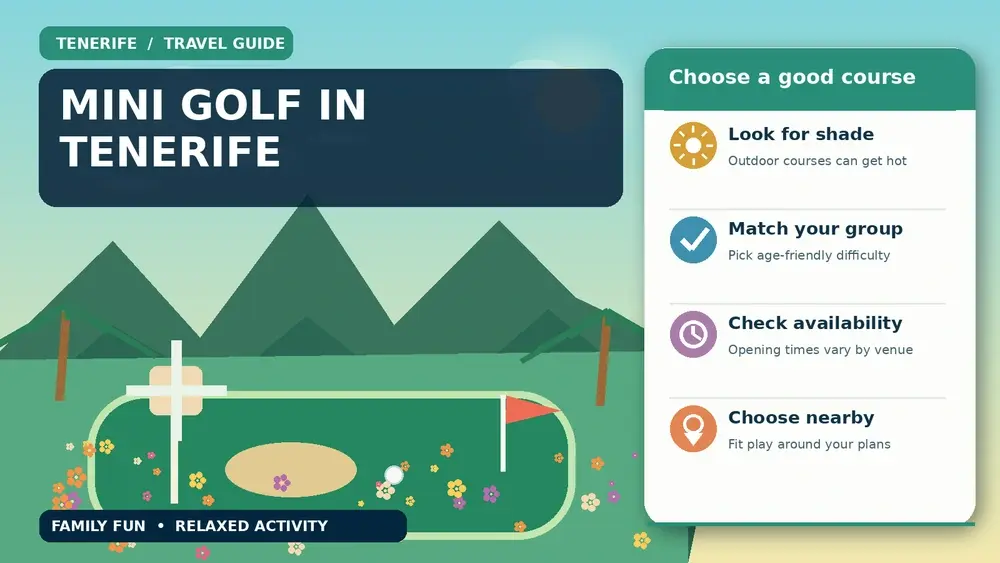
    Quick summary: Mini golf is not the reason I fly to Tenerife, but it is one of the easiest low-stress family activities to fit between beach time and dinner. It works especially well with mixed ages because nobody needs specialist fitness, a session is usually short and the rules can be simplified for younger children. I choose a course by location, shade, walking surface, opening hours and how busy it is rather than by the number of decorative obstacles. Outdoor courses can be hot in the afternoon; indoor or glow-style courses are better weather backups, but availability changes, so I check the current venue before travelling.

    Situation My mini-golf choice
    Young children Short course, simple layout, toilets and easy exit
    Teenagers/adults More technical course or evening session
    Very hot day Shade, later start or indoor option
    Rain/wind Indoor or sheltered course if available
    Mixed-age group Flexible pace and nearby food/transport

    Why mini golf works well on a Tenerife holiday

    A Tenerife itinerary can become overambitious quickly: Teide one day, Siam Park the next, a boat trip, a long drive to Anaga. Mini golf is the opposite. It gives the group something to do without turning the day into another major excursion. I use it when everyone wants an activity but nobody wants another queue-heavy attraction.

    It is also easy to combine with dinner, shopping or a promenade. My indoor family entertainment guide has similar low-commitment ideas when the weather or energy level changes.

    Outdoor versus indoor mini golf

    Outdoor courses can feel more “holiday” because they use gardens, lights and open air, but Tenerife sun can make a midday round uncomfortable. I prefer late afternoon or evening unless there is strong shade. Indoor courses are more reliable in rain or heat and can use glow lighting, but they may be noisier and more stimulating for young children.

    I check whether the venue is fully indoors, partially covered or simply advertised as all-weather. Wind can still affect an exposed course even when rain is not a problem.

    How long I allow

    A typical round is easy to fit into 45–90 minutes depending on holes, group size and queues. With small children I allow more time because they want second attempts and may lose interest halfway through. I do not schedule a restaurant reservation five minutes after the theoretical finish.

    For a group of six or more, I ask whether we should split into smaller groups. One huge group blocks the course and makes everyone wait. Two groups of three or four usually move more smoothly.

    Rules I simplify for children

    I keep the core idea—fewest strokes wins—but I do not turn a family game into tournament administration. For young children I cap the number of attempts on one hole, let them place the ball in an easier position and focus on taking turns. The goal is to finish smiling, not to establish a precise handicap.

    Older children often enjoy keeping the official score, especially if adults play seriously enough to make the result meaningful. I agree the house rule for maximum strokes before starting so there is no argument on hole 14.

    Safety sounds obvious, but clubs can hurt

    I explain that the putter stays low and is not a baseball bat. Children wait until the previous player has moved away before swinging. On busy courses I keep bags and strollers out of the playing path. If the surface is wet, I slow down because decorative bridges and artificial turf can become slippery.

    For toddlers, I prefer a venue where one adult can stop easily without holding up a large queue. My Tenerife with toddlers guide covers the bigger planning picture.

    Choosing an area

    The south—Playa de las Américas, Los Cristianos and Costa Adeje—is the easiest place to combine mini golf with tourist infrastructure, restaurants and evening transport. That does not mean every course is in the south or that one venue is permanently “best.” I choose the course that fits the day’s location so I am not driving an hour for a 60-minute activity.

    If I am already in Playa de las Américas, I combine the game with the promenade or dinner using my Playa de las Américas guide. For a family base elsewhere, I search closer before adding traffic to the day.

    Accessibility and stroller questions

    Mini golf courses often include small slopes, steps, narrow bridges and decorative features. “Family friendly” does not automatically mean wheelchair or stroller accessible. I ask whether all holes are step-free, whether there is space to manoeuvre and whether I can skip inaccessible holes without leaving the course.

    If a child is in a stroller, I also check whether it can stay beside the playing area or must be parked. That one question can decide whether the activity is relaxing or frustrating.

    Heat, sun and evening play

    Outdoor mini golf on black or artificial surfaces can feel hotter than the air temperature. I bring water, use sun protection and avoid the strongest midday sun. Evening sessions are often more comfortable and can be more atmospheric when courses are lit.

    If strong wind or rain is affecting the resort, I check that the venue remains open before walking over. My rainy-day Tenerife guide gives other backups if the course closes.

    Price and ticket expectations

    Prices, family deals and replay offers change, so I do not publish one permanent number as if it applies everywhere. I check the current official venue page and whether payment is per round or per person. If a package combines mini golf with arcade credits, bowling or food, I decide whether we would buy those extras anyway.

    For a large family, the cheapest option is not always the best value if the course is too difficult for the youngest child. A slightly shorter, easier course near the hotel can save transport and arguments.

    Combining mini golf with other low-effort activities

    Mini golf pairs well with an ice cream, early dinner, shopping centre, seafront walk or arcade. It does not pair well with an already exhausting day if the group is visibly finished. I use it to fill a gap, not because an itinerary spreadsheet says we still need another attraction.

    My Tenerife with kids guide has broader ideas for pacing family days so every afternoon does not become another major ticketed experience.

    My checklist before we play

    • Check the venue is currently operating and its actual opening hours.
    • Decide whether outdoor, indoor or glow-style suits the day.
    • Check shade and temperature for an outdoor afternoon round.
    • Ask about stroller or wheelchair access if needed.
    • Confirm whether booking is required for a large group.
    • Wear shoes that are secure on ramps and artificial surfaces.
    • Agree simple scoring rules before starting with children.
    • Keep clubs low and wait for the previous player to clear the hole.
    • Allow extra time before dinner or another reservation.
    • Choose a course near the rest of the day rather than crossing the island for it.

    FAQ: mini golf in Tenerife

    Is mini golf suitable for toddlers?

    It can be, but I look for short holes, space for a stroller and a group willing to simplify the rules. Very young children may enjoy only part of the round.

    Do I need to book?

    Often not for a small group, but busy evenings and large groups can be different. I check the current venue policy.

    What if it rains?

    An indoor course is the safest backup. A partially covered outdoor course may still close or become slippery.

    How long does a round take?

    I normally allow around an hour, with more time for queues, larger groups or young children.

    Is mini golf worth planning in advance?

    I only pre-plan it when it solves a specific gap—family evening, bad-weather backup or nearby activity. Otherwise I keep it as a flexible option.

    Noise, lighting and sensory considerations

    Glow mini golf and arcade-style venues can use dark rooms, UV lighting, loud music and flashing effects. That can be fun for teenagers and overwhelming for younger children or travellers with sensory sensitivities. I ask whether the course is dark, whether music is loud and whether there is an easy exit halfway through. Outdoor courses are often calmer but may have strong sun, heat or wind instead. For a mixed group I choose the environment that causes the fewest problems, not the one that looks most spectacular online. If someone needs a quieter experience, an early session before the evening crowd can make a large difference. I also avoid assuming that “indoor family attraction” means low stimulation; the design can be the opposite.

    I also keep one simple rule for mixed-age groups: the person having the least fun decides when we stop. Finishing after twelve enjoyable holes is better than forcing everyone through eighteen.

    Final practical advice

    Mini golf works in Tenerife because it asks very little from the day. I keep it local, choose the format that suits the weather and avoid overcomplicating the score. For families and mixed-age groups, that simplicity is exactly the point.
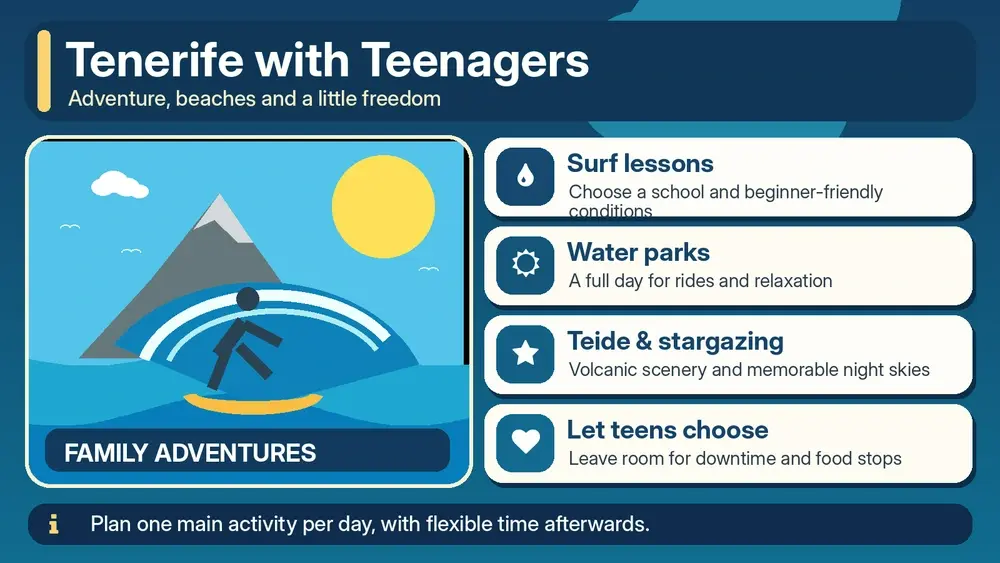
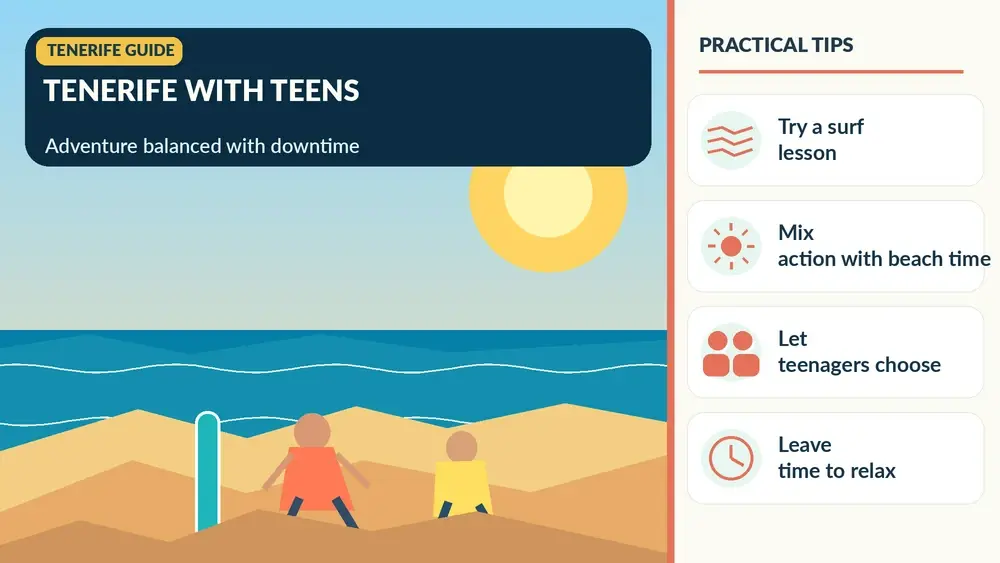
  • Tenerife with Teenagers: Adventure, Beaches, Water Parks, Food and Evening Plans

    Tenerife with Teenagers: Adventure, Beaches, Water Parks, Food and Evening Plans

    Quick summary: The best Tenerife trip with teenagers mixes autonomy, adrenaline and downtime. I avoid filling every day with “family attractions” and instead combine one high-energy experience—Siam Park, surfing, bodyboarding, snorkelling, karting or a boat trip—with beaches, good food, a city evening and at least one landscape that feels genuinely different from home.

    Good baseSouth for easy beaches/activities; north for greener towns and variety
    High-energy ideasWater park, surf, bodyboard, karting, biking
    Low-cost balanceBeach, promenade, viewpoints, sunset, markets
    Key planning ruleLet teenagers choose part of the itinerary

    What teenagers usually want from Tenerife

    Teenagers are old enough to notice when every activity has been designed for small children but young enough that transport, booking and safety still depend on the adults. I give them real choices: pick the beach, choose between surf and karting, decide which restaurant looks good, or take responsibility for navigating one bus journey.

    That small amount of ownership changes the mood of the trip. Tenerife has enough variety that the holiday can feel active without becoming a compulsory sports camp.

    Water parks and adventure

    Siam Park is an obvious anchor for many families because older children and teens can use the more thrilling slides while adults choose their own pace. I check height restrictions and current opening information directly before buying tickets.

    Surf and bodyboarding around suitable schools in El Médano or other established areas can be excellent for a first lesson. For water sports, I use qualified operators and let conditions decide whether the session happens. The Atlantic is not a swimming pool, and confidence on a board is not the same as ocean experience.

    Illustrated guide: Tenerife with Teenagers, with practical visitor tips
    Illustrated guide: Tenerife with Teenagers.

    Teide without turning it into a lecture

    Teide works best with teenagers when the day has a purpose: cable car, stargazing, a short trail, photography or a road trip with music and food stops. A long sequence of viewpoints chosen only by adults can feel repetitive.

    I build in the altitude and temperature difference. Even when the coast is hot, the national park can be cold or windy. I also confirm permits and access rules for any trail that requires them.

    Beaches, snorkelling and independence

    A resort beach or natural pool can give teenagers a sense of freedom while adults stay nearby, but I set clear water-safety rules. Flags, waves and rocky entries matter. For snorkelling, a guided first session can be more useful than buying equipment and assuming every cove is suitable.

    I choose accommodation within walking distance of food and a promenade when teens want some independence. A safe, well-lit route to an ice-cream shop or café can make evenings much easier for the whole family.

    Food that works

    I mix familiar options with local food rather than turning every meal into a cultural test. Arepas, bocadillos, papas arrugadas, grilled fish, burgers and tapas-style sharing can give everyone choice. Markets are useful because each person can try something different without committing to a long formal lunch.

    Mother And Son Walking In Los Cristianos Tenerife

    For older teens, I involve them in the budget. Giving them a daily snack allowance or letting them compare activity prices makes the trip feel less like being managed.

    Evenings and age limits

    Nightlife rules and venue age policies matter. A family can enjoy a busy promenade, live music, cinema or late dinner without treating adult clubs as a teenage attraction. I check the specific venue rather than assuming that a tourist area is automatically suitable for under-18s late at night.

    Siam Night and seasonal events can be attractive to older teens, but current dates and age/accompaniment rules should be checked before planning the holiday around them.

    Build one teen-choice day

    I let the teenager choose the main activity, lunch and one evening plan within a budget. It creates ownership without giving up the practical framework.

    I would verify this point close to the travel date because a small operational change can affect the whole day. My preference is to keep one workable backup rather than build a complicated Plan B: a second document copy, another transport option, a nearby supermarket, a lower-effort activity or enough time to ask staff for help. That approach is especially useful in Tenerife because the island offers many alternatives within a relatively short distance.

    Use bad-weather backups

    Cinema, escape rooms, shopping centres, bowling and city cafés keep a cloudy or windy day from becoming a family argument.

    I would verify this point close to the travel date because a small operational change can affect the whole day. My preference is to keep one workable backup rather than build a complicated Plan B: a second document copy, another transport option, a nearby supermarket, a lower-effort activity or enough time to ask staff for help. That approach is especially useful in Tenerife because the island offers many alternatives within a relatively short distance.

    How I would use this guide on a real Tenerife trip

    I treat Tenerife with teenagers as a practical layer of the holiday rather than something that should dominate every day. I verify the few details that can create a real problem—documents, opening times, transport, medical or legal requirements—and keep the rest flexible. Tenerife changes quickly between the south coast, the north, the metropolitan area and the high mountains, so geography and timing are often more important than adding more activities.

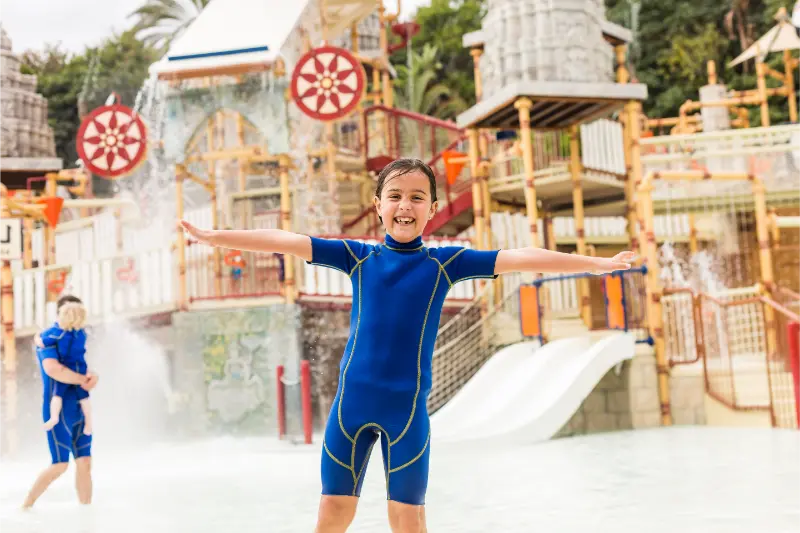
    Childrens Play Area At Siam Park Tenerife

    I also save the key official link, booking reference or emergency contact offline before I leave the hotel. Mobile data is generally easy to arrange, but the moment I most need a detail is often when I am at an airport counter, inside a police station, on a mountain road or trying to make a connection. A screenshot and a small time buffer are simple habits that make the trip calmer.

    Useful related guides on My Tenerife Experience

    Where I would stay

    I choose a base according to the hardest part of the itinerary. Costa Adeje and Los Cristianos are convenient for many family and resort services, Puerto de la Cruz works well for the greener north, while Santa Cruz and La Laguna are useful for city services and public transport. I compare accommodation in Tenerife and then read the newest reviews for details that matter to this specific trip rather than relying only on the headline score.

    Official information to recheck

    Frequently asked questions

    Is Tenerife good for teenagers?

    Yes. The island combines beaches, water parks, outdoor sports, cities, volcano scenery and easy casual food, which makes it flexible for different interests.

    Where should a family with teenagers stay?

    The south is easiest for concentrated activities and beaches; Puerto de la Cruz gives a greener, more local-feeling base. Choose around the activities your family values most.

    Can teenagers go out alone?

    That depends on age, maturity, location and family rules. I prefer walkable, well-lit resort or town areas and clear check-in times.

    Final thoughts

    The aim is not to entertain teenagers every minute. Give them a few memorable activities, some real decision-making power and enough unstructured time, and Tenerife becomes much easier for everyone.

    Practical planning checkpoint 1

    Before I lock this part of the trip in, I check the exact date, location and operator rather than relying on a screenshot from months earlier. Tenerife is easy to travel around, but opening hours, transport frequency, weather, service availability and access conditions can change between municipalities and seasons. I keep one alternative in the same area so a small change does not force a cross-island detour.

    Exploring Tenerife With Kids

    I also think about who is actually travelling. A plan that works for a solo adult can be poor for a toddler, a teenager, a pregnant traveller, an older relative or someone working remotely. The useful question is not “Is Tenerife suitable?” but “What would make this particular day comfortable and realistic?” That usually produces better choices about timing, accommodation, food stops and transport.

    Practical planning checkpoint 2

    Before I lock this part of the trip in, I check the exact date, location and operator rather than relying on a screenshot from months earlier. Tenerife is easy to travel around, but opening hours, transport frequency, weather, service availability and access conditions can change between municipalities and seasons. I keep one alternative in the same area so a small change does not force a cross-island detour.

    I also think about who is actually travelling. A plan that works for a solo adult can be poor for a toddler, a teenager, a pregnant traveller, an older relative or someone working remotely. The useful question is not “Is Tenerife suitable?” but “What would make this particular day comfortable and realistic?” That usually produces better choices about timing, accommodation, food stops and transport.

    Practical planning checkpoint 3

    Before I lock this part of the trip in, I check the exact date, location and operator rather than relying on a screenshot from months earlier. Tenerife is easy to travel around, but opening hours, transport frequency, weather, service availability and access conditions can change between municipalities and seasons. I keep one alternative in the same area so a small change does not force a cross-island detour.

    I also think about who is actually travelling. A plan that works for a solo adult can be poor for a toddler, a teenager, a pregnant traveller, an older relative or someone working remotely. The useful question is not “Is Tenerife suitable?” but “What would make this particular day comfortable and realistic?” That usually produces better choices about timing, accommodation, food stops and transport.

  • Best Playgrounds & Family Parks in Tenerife: La Laguna, Santa Cruz and Resort Play

    Best Playgrounds & Family Parks in Tenerife: La Laguna, Santa Cruz and Resort Play

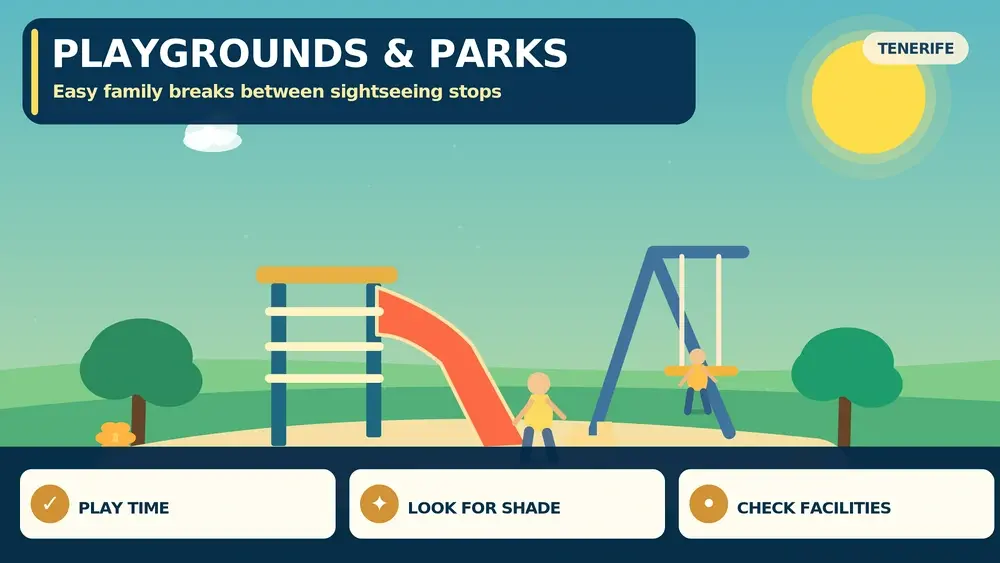
    Playgrounds can be surprisingly important on a Tenerife family holiday. A six-year-old may enjoy Teide, a boat trip and a historic town, but still need an ordinary hour to climb, swing and run without being asked to appreciate another viewpoint. Building that unstructured play into the itinerary often makes the more ambitious parts of the day easier.

    The island has urban parks with children’s areas, sports facilities and shaded walking space, plus resort promenades where smaller play areas appear near beaches and cafés. I would not choose accommodation solely by one playground pin because equipment can close for maintenance, but I would definitely consider nearby parks when travelling with young children.

    The strongest family parks are not theme parks. They are free local spaces where residents exercise, walk dogs and take children after school. That local atmosphere can be a useful break from paid attractions.

    Family parks in Tenerife at a glance

    Best large urban family parkParque Pedro González / Parque La Vega, La Laguna
    Best Santa Cruz exercise-and-play parkParque de La Granja
    Good central La Laguna stopParque de la Constitución
    Best strategy in resortsCombine playground time with beach or promenade time
    Main practical issueSun-heated equipment and limited shade at some locations

    Parque La Vega in La Laguna

    Parque Pedro González, commonly known as Parque La Vega, is one of the most useful family parks in the La Laguna area. The official Tenerife tourism page describes more than 22,000 square metres with children’s recreation areas, sports facilities, a climbing wall, skate park, basketball, table tennis and a BMX circuit.

    That mix is excellent when siblings have different ages. A small child can use the play area while an older child or teenager has something more active nearby. The park also works as a decompression stop after the historic centre.

    Use the La Laguna guide to combine the park with a realistic half-day in the city.

    Parque de La Granja in Santa Cruz

    Parque de La Granja is another strong family option. Official tourism information describes a large urban green space with a children’s area, places for physical activity, picnic tables and services for pets. It is more of a neighbourhood exercise park than a tourist attraction, which is part of its appeal.

    I would use it in the morning or late afternoon, then continue into central Santa Cruz. The Santa Cruz guide helps you build the rest of the day without unnecessary driving.

    Parque de la Constitución in La Laguna

    This smaller park is useful when you want something close to the city rather than a destination in itself. The official tourism page notes two children’s play areas, gardens and a pond area. It can be combined with a short walk through the centre and works especially well when children need a break from churches and historic streets.

    Resort playgrounds and promenades

    In Costa Adeje, Los Cristianos and other major resorts, family life often happens along the promenade. Small play spaces, beaches, ice-cream stops and easy toilets can be more useful than a single large park far from accommodation. I would walk the area around a hotel on a map before booking and check whether a playground is reachable without crossing several busy roads.

    My Tenerife with kids guide is the better resource for the wider family holiday, including beaches, transport and paid attractions.

    Playgrounds for toddlers

    For toddlers, I care more about fencing, shade and surface than impressive equipment. A simple small play area beside a café can be better than a giant park with older children moving quickly. Bring a hat and check slide surfaces with your hand before a child uses them in strong sun.

    If you are travelling with a baby as well, use the Tenerife with babies and toddlers guide for practical packing and transport advice.

    What older children and teenagers need

    Older children often outgrow standard playgrounds but still want somewhere active. Parks with skate facilities, basketball or climbing are more useful. La Vega is a good example because several sports can happen in one place.

    For teenagers, the Tenerife with teenagers guide covers adventure activities and attractions beyond parks.

    Shade and heat

    Playground equipment can become very hot, especially dark plastic, rubber and metal exposed to afternoon sun. I would avoid the hottest part of the day in summer and use parks as morning or early-evening stops. Even in winter, sun protection matters because children may stay active for much longer than adults expect.

    A lightweight picnic blanket can also be useful when benches are full or when a younger child needs a quiet snack break away from equipment.

    Toilets, snacks and practical family logistics

    Do not assume every park has public toilets or a café inside. Before settling children into a long play session, locate the nearest toilet and water option. In city parks, a bakery or café nearby can be more reliable than expecting park facilities.

    I carry wipes, water, one simple snack and a small first-aid kit for grazes. That is enough for most ordinary playground stops without turning the family day bag into expedition luggage.

    Use playgrounds as itinerary tools

    A playground is most valuable when it improves the rhythm of a day. In La Laguna, I might visit the historic centre, have lunch, then give the children an hour at La Vega before driving elsewhere. In Santa Cruz, a park break can separate a museum visit from a later waterfront walk.

    Santa Cruz De Tenerife Colorful Architecture

    This works better than promising children a playground only at the very end of a long day when everyone is already tired.

    Official park information

    Useful official examples include Parque Pedro González / La Vega and Parque de La Granja. Equipment and maintenance status can change, so treat any individual feature as something to recheck close to the visit.

    Frequently asked questions

    Are playgrounds in Tenerife free?

    Public municipal playgrounds and parks are normally free to use.

    Which park is best for mixed ages?

    Parque La Vega is a strong option because it combines children’s areas with several sports facilities.

    Are playgrounds shaded?

    Some have tree cover and others are exposed. I would plan morning or late-afternoon visits and check equipment temperature.

    Is there a good park in Santa Cruz?

    Parque de La Granja is a useful large urban option with play and exercise space.

    Should I rent a car just for playgrounds?

    No. Choose playgrounds that fit naturally into the area you are already visiting rather than driving across Tenerife for ordinary play time.

    How I would plan this experience

    I would first decide whether this is the main purpose of the day or one element in a wider itinerary. Tenerife is compact on a map but travel time can grow quickly because of mountain roads, parking, one-way streets and the temptation to combine places that sit on opposite sides of the island. A realistic plan usually groups two or three stops in the same area rather than chasing a long checklist.

    Santa Cruz De Tenerife Skyline And Auditorium

    I save the exact parking point or bus stop, the return route and one nearby alternative before leaving accommodation. That simple preparation matters on Tenerife because coast, forest and highland weather can differ dramatically on the same day. It also makes it easier to abandon a plan without wasting the whole day if wind, cloud, traffic or access rules change.

    For any activity that involves a provider, I read the cancellation terms, language, meeting point and what is included before paying. For self-guided days, I download offline maps and avoid relying on a single social-media pin. The island is easy to enjoy independently, but many of the best landscapes are protected places where access, parking and behaviour matter.

    What to bring

    • Water and a small snack, even for a short outing.
    • Sun protection; UV exposure can be strong in every season.
    • A light layer for wind, cloud, air-conditioned interiors or higher elevations.
    • A charged phone with offline maps and screenshots of reservations or directions.
    • Footwear suited to the real surface rather than only to resort walking.
    • A little flexibility: weather, traffic and local events can change the best order of the day.

    Where to stay

    For a first Tenerife trip, I choose accommodation according to the activities I will do most rather than only the lowest room price. Costa Adeje and Los Cristianos are convenient for the south; Puerto de la Cruz and La Orotava work well for the north; Santa Cruz and La Laguna are stronger for an urban and cultural stay. Compare accommodation across Tenerife on Booking.com and then check actual road or bus times to the places you expect to visit.

    Final planning advice

    My main rule is to leave space between activities. Tenerife rewards travellers who allow time for an unplanned viewpoint, a long lunch, a swim, a change in cloud cover or simply a slower road than expected. A slightly shorter itinerary often produces a better day because you can adapt instead of spending the holiday watching the clock.

    Find current tours and experiences

    For bookable Tenerife experiences, I use the widget below to compare current options, meeting points and cancellation conditions rather than relying on an old price or timetable.

  • Tenerife with Babies and Toddlers: Beaches, Transport, Hotels and Practical Tips

    Tenerife with Babies and Toddlers: Beaches, Transport, Hotels and Practical Tips

    Tenerife can work extremely well with a baby or toddler when I build the trip around routine, shade and short transfers rather than trying to prove that family travel changes nothing. The island has warm-weather resorts, promenades, apartments, supermarkets and family attractions, but it also has steep towns, strong Atlantic beaches and winding mountain roads. I choose the base first, then let the child’s normal sleep and meal pattern shape the itinerary. A relaxed family week with fewer long day trips is usually more enjoyable than a checklist designed for adults.

    The easiest bases for very young children

    For a first family stay, I like areas where the beach, supermarket, pharmacy and restaurants are reachable without using the car for every small task. Costa Adeje and Los Cristianos are practical in the south, while Puerto de la Cruz can work for families who prefer the greener north and accept a higher chance of cloud.

    My where to stay guide compares the regions. With a toddler, I give extra weight to walkability and the exact slope between the accommodation and the seafront.

    Hotel versus apartment

    An apartment gives me a fridge, simple meal preparation and a separate sleeping area if the layout is good. A hotel can reduce chores and make pool days easier. The best choice depends on whether the child sleeps better with a separate room and how much self-catering I actually want to do.

    Illustrated guide: Tenerife with Babies and Toddlers, with practical visitor tips
    Illustrated guide: Tenerife with Babies and Toddlers.

    I read room descriptions carefully because “family room” does not always mean a separate bedroom. I compare family accommodation in Costa Adeje only after deciding which layout matters.

    Choosing beaches for toddlers

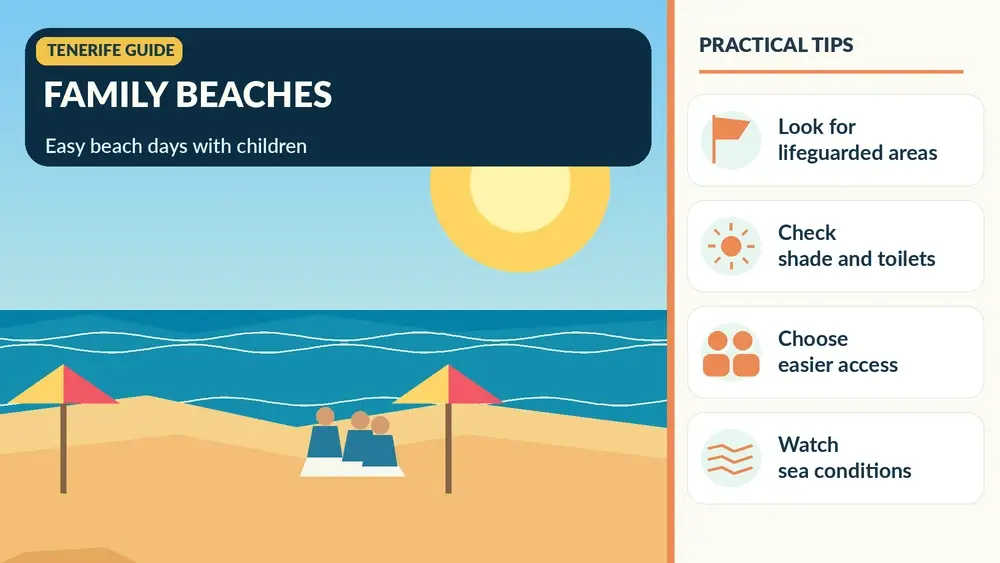
    I prioritise managed beaches with easy access, nearby toilets and conditions that are suitable on the day. No Tenerife beach is guaranteed calm every day, so I still follow flags and lifeguard instructions even at family-oriented bays.

    My family beaches guide is more useful than a list based only on sand colour because it considers facilities and practical access.

    Sun, shade and the middle of the day

    Young children are one reason I avoid building the entire day around noon. I use mornings for beaches or outings, return for lunch and rest, then go out again later when the light and temperature are softer.

    I bring strong sun protection, a hat, shade solution and more water than I think we need. Cloud does not remove UV exposure, especially on open promenades and at altitude.

    Car seats and rental cars

    If I rent a car, I arrange an appropriate approved child restraint in advance and confirm what the rental company actually supplies. I do not assume “child seat” means the correct size or configuration for every child.

    Mother And Child On A Tenerife Beach

    I also avoid excessive mountain driving on consecutive days. Winding roads to Masca, Anaga or Teide can be tiring for small children even when adults enjoy the scenery.

    Pushchairs and carriers

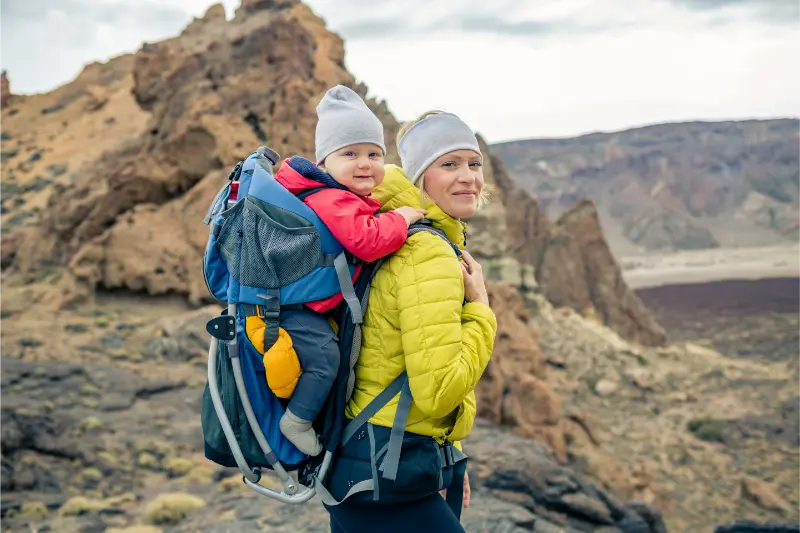
    A lightweight pushchair is useful on resort promenades and in flatter towns. A baby carrier is much more practical for steps, old-town paving and short nature walks. I choose one based on the day rather than trying to push a stroller onto terrain it was never designed for.

    For accessible promenades and easier attractions, my accessible Tenerife guide can also help because many of the same surface and gradient details matter to pushchairs.

    Food, nappies and supermarket basics

    I buy bulky everyday items locally instead of filling luggage with a week of nappies or snacks. Large supermarkets in resort areas stock the basics, though specific brands or formulas may differ from home.

    For anything medically necessary or highly specific, I bring enough supply rather than assuming an identical product will be available. My grocery shopping guide covers the supermarket side.

    Attractions with very young children

    Large attractions can still work, but I do not expect a toddler to experience them like an older child. I choose a few sections, build in shade and food breaks, and leave before everyone is exhausted.

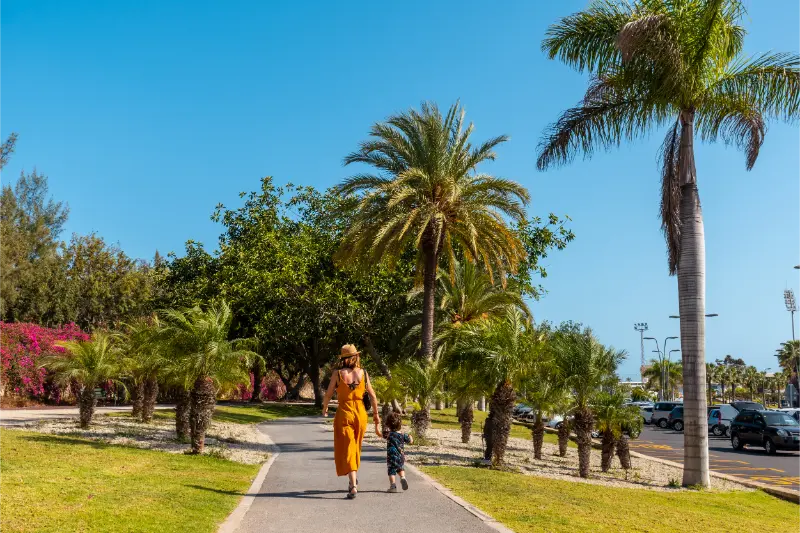
    Mother And Son Walking In Los Cristianos Tenerife

    My Tenerife with kids guide covers the broader family attraction options for different ages.

    How I would prepare before the trip

    For travelling in Tenerife with a baby or toddler, I make the important decisions before leaving home rather than trying to solve everything after landing. I save the addresses, official links and booking references I may need, take screenshots of anything that could matter without mobile data, and keep one simple alternative in mind. Tenerife is easy to travel around when the basic logistics are organised, but the island becomes less relaxing if every small choice has to be researched from a pavement or airport queue.

    What I would keep flexible

    I do not over-plan travelling in Tenerife with a baby or toddler. Opening hours, weather, traffic, family energy and local conditions can change the shape of a day. My preference is to fix the essentials and leave the rest adjustable. That means I know where I am sleeping, how I am moving between regions and which bookings are time-sensitive, while meals, beach stops and minor attractions can move according to how the day actually feels.

    The small mistakes that create unnecessary stress

    The mistakes I see most often around travelling in Tenerife with a baby or toddler are rarely dramatic; they are usually small assumptions that accumulate. Relying on one payment method, arriving with no offline information, packing for the resort but not the mountains, or assuming every service follows the same hours as at home can all turn into wasted time. I prefer simple redundancy: two ways to pay, a little cash, a charged phone, a backup layer of clothing and a second plan for anything weather-dependent.

    How this fits into a first Tenerife holiday

    On a first trip, I would use this guide together with my first-trip Tenerife guide and my getting around Tenerife guide. The first gives the island-wide context and the second solves the transport side. Together they make travelling in Tenerife with a baby or toddler much easier to place inside a realistic itinerary instead of treating it as an isolated checklist.

    Why I still check official information

    Rules and services connected with travelling in Tenerife with a baby or toddler can change after any travel article is published. I therefore use this page to understand the practical framework, then verify anything operational shortly before the trip. That is especially important for legal requirements, healthcare arrangements, transport rules, emergency information, tax procedures and opening times. A five-minute final check is usually more useful than relying on a screenshot saved months earlier.

    My practical rule for a calmer holiday

    My rule for travelling in Tenerife with a baby or toddler is to optimise for a calm trip, not for theoretical perfection. I would rather carry one extra useful item, choose a slightly easier base or pay for a service that genuinely removes friction than spend valuable holiday time fixing avoidable problems. Tenerife rewards spontaneity, but spontaneity works best when the essentials underneath it are reliable.

    Childrens Play Area At Siam Park Tenerife

    How I would use this advice

    I would choose one walkable family base, plan one meaningful outing per day at most, and protect nap and meal times instead of treating them as obstacles.

    For accommodation I focus on room layout, shade, lift access and walking distance to daily essentials before comparing pools or decorative extras.

    A note for repeat visitors

    Repeat visitors can simplify travelling in Tenerife with a baby or toddler because they already know which parts of Tenerife suit them. I still review the basics before each trip, especially if I am changing season, travelling with different companions or staying in another part of the island. A winter stay in Puerto de la Cruz and a summer week in Costa Adeje can require different clothing, transport habits and daily rhythms even though the destination is the same.

    What I would write down before departure

    I keep a short travel note for travelling in Tenerife with a baby or toddler with only information I may genuinely need: accommodation address, insurance or health details, emergency contact information, important booking numbers and one or two official websites. I do not save twenty pages of travel advice. The point is to make critical information easy to find when I am tired, offline or dealing with a change of plan.

    Why location matters

    Where I stay changes how I handle travelling in Tenerife with a baby or toddler. A central resort can put supermarkets, pharmacies, restaurants and transport within walking distance, while a rural house may require more advance shopping and a car. Neither is better in itself. I choose the base that matches the trip and then adapt the practical preparation to that location rather than expecting every part of Tenerife to offer the same level of services on the doorstep.

    One final planning check

    The day before travelling, I review travelling in Tenerife with a baby or toddler once more and remove anything that has become unnecessary. Good preparation should make luggage, decisions and schedules lighter, not heavier. If I can explain my plan in a few sentences and know what I would do if one part changes, I consider the practical side ready and stop researching.

  • Best Family Beaches in Tenerife: Calm Water, Facilities and Practical Tips

    Best Family Beaches in Tenerife: Calm Water, Facilities and Practical Tips

    A good family beach in Tenerife is not simply the prettiest beach on a map. When I travel with children, I care more about the combination of manageable water, easy access, toilets or nearby cafés, room for a stroller, shade options, and a simple escape plan if the wind or waves suddenly change. Tenerife has spectacular wild beaches, but some of the most photogenic ones are not the places I would choose for a relaxed day with small children.

    This guide focuses on beaches that make family logistics easier. It complements my broader Tenerife with kids guide and best beaches in Tenerife guide. Conditions are never guaranteed on an Atlantic island, so I still check the sea, flags and lifeguard instructions when I arrive. A beach that feels gentle in the morning can be less comfortable later in the day.

    What I look for in a family beach

    My first filter is water entry. Sheltered bays, breakwaters and gradual shorelines are usually easier with younger children than exposed surf beaches. The second filter is practical: parking, bus access, a promenade, toilets, showers, food and somewhere to buy water. None of these details sound exciting when planning a holiday, but they are exactly what turns a beach visit into an easy half-day rather than a logistical exercise.

    I also separate “good for paddling” from “safe without supervision.” No Atlantic beach is a substitute for close adult attention. I keep children within reach near the shoreline, respect warning flags and avoid rock pools or breakwaters when swell is pushing water over them. Tenerife offers many developed beaches with lifeguard services, but I still treat the ocean as the final authority.

    Illustrated guide: Best Family Beaches in Tenerife, with practical visitor tips
    Illustrated guide: Best Family Beaches in Tenerife.

    Las Teresitas: my easiest north-east family beach

    Las Teresitas is one of the beaches I recommend most often to families staying around Santa Cruz or La Laguna. The long strip of pale sand and the offshore protection usually create a calmer feel than many exposed beaches on the north coast. The beach is spacious enough for children to play, and its length makes it easier to find a comfortable section even when the central area is busy.

    The practical side is strong too: there is road access, parking, bus service from Santa Cruz and food options around the beach and San Andrés. I like arriving earlier in the day, especially on weekends. The mountain backdrop gives Las Teresitas much more character than a generic resort beach, while the easy setup keeps the day simple.

    Las Vistas: the convenient choice in Los Cristianos

    For families based in the south, Las Vistas is hard to beat for convenience. It sits between Los Cristianos and Playa de las Américas, with a long pedestrian promenade, restaurants, shops and easy links to the wider resort area. I cover the neighbourhood in more detail in my Los Cristianos guide.

    Las Vistas is especially useful when one family member wants the beach while another wants cafés, shopping or a walk. You are not committed to an isolated beach day. The broad sandy area also gives children room to play away from the waterline. In peak periods, I prefer walking or using public transport rather than circling for the closest parking space.

    Playa De Las Teresitas Sandy Beach Tenerife

    La Pinta: small, sheltered and close to Puerto Colón

    Playa de La Pinta, beside Puerto Colón in Costa Adeje, is a smaller beach that works well when I want a contained setting rather than a huge stretch of sand. The bay is sheltered by harbour infrastructure, and the surrounding promenade is packed with restaurants and services. That makes snacks, toilets and a quick change of plan easy.

    The location also lets a family combine beach time with a gentle harbour walk or a boat excursion on another day. My Costa Adeje guide explains the wider area. Because watersports and harbour activity are nearby, I still keep an eye on designated swimming areas and on the daily sea conditions.

    El Camisón: a useful middle ground in Playa de las Américas

    El Camisón is the beach I often suggest to families who want to stay near the energy of Playa de las Américas without choosing the most exposed surf sections. It is backed by the promenade and has plenty of cafés and restaurants within a short walk.

    The beach is relatively compact, which can be useful with children because the walk from towel to water is not endless. As elsewhere, I pay attention to flags and conditions. If the family wants a quieter atmosphere, I would compare El Camisón with Las Vistas rather than assume one is always better; they are close enough to try both during the same holiday.

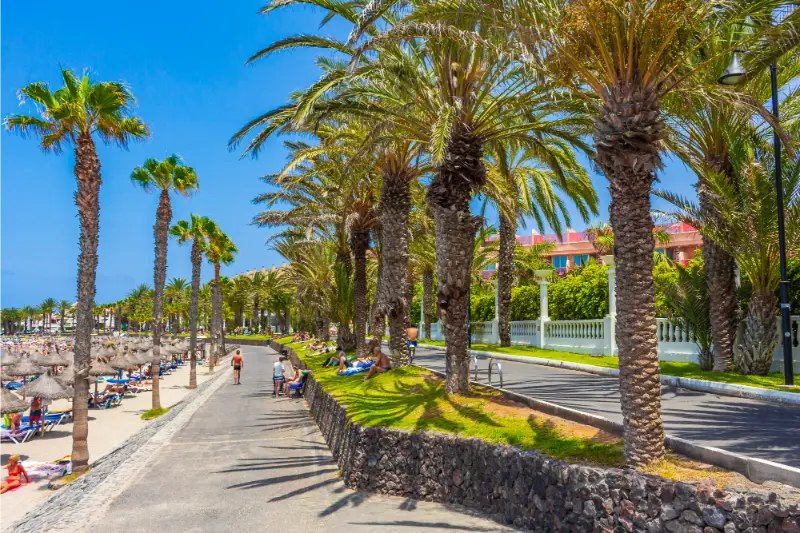
    Palm-lined promenade beside Playa del Camisón

    Playa del Duque: polished, comfortable and easy to pair with lunch

    Playa del Duque is one of the most polished beach environments in Costa Adeje. The promenade is attractive, there are restaurants and higher-end hotels nearby, and access is straightforward. For a family that values comfort over a wild setting, it is an easy option.

    I would not choose it because it is “safer” in an absolute sense; sea conditions still matter. I choose it because the infrastructure makes the whole day easier. It can also work well with grandparents or mixed-age groups, where not everyone wants to spend hours in the sand. A beachfront lunch or promenade walk gives the day more flexibility.

    Playa de Fañabé and Torviscas: good for a classic resort day

    Fañabé and the adjacent Torviscas area are practical choices for families who want a traditional resort beach day. The seafront is lively, accommodation is plentiful and almost every basic service is nearby. These beaches are particularly convenient if you are staying in Costa Adeje without a car.

    The trade-off is that they can feel busy and commercial. I see that as an advantage for some families and a disadvantage for others. If I want quiet scenery, I go elsewhere. If I want a beach where lunch, ice cream, a pharmacy and the walk back to the hotel are all easy, this part of the south performs very well.

    Exploring Tenerife With Kids

    Playa de San Juan and Alcalá: a slower family atmosphere

    Families who prefer a smaller coastal-town rhythm should look at Playa San Juan and Alcalá. These places feel less dominated by large resort infrastructure than Costa Adeje, while still offering promenades, swimming areas and restaurants.

    I like them for families that enjoy a morning swim followed by a long lunch and an evening walk rather than a schedule of attractions. The coastline is volcanic and some entries are rockier than a classic sandy beach, so I choose the exact bathing area according to the children’s ages and current sea conditions.

    Beaches I admire but would not pick first with small children

    Benijo is one of Tenerife’s most dramatic beaches, but it is exposed to Atlantic swell and involves steps. El Bollullo and El Socorro can also have strong waves. I visit places like these for scenery, photography or experienced swimming only when conditions are appropriate, not because a “best beaches” list tells me they are unmissable.

    The same applies to natural pools. They can be wonderful, but ocean swell can make them dangerous even when the pool itself looks protected. For younger children I prefer developed pools or beaches with lifeguards and simple access. My rule is to match the place to the family rather than force the family to match the place.

    How I plan a family beach day

    I pack sun protection, hats, more water than I think we need, simple snacks, a dry layer and a small first-aid kit. Dark volcanic sand can become surprisingly hot, so beach shoes are useful even on days when the air temperature feels mild. I also bring a lightweight towel or cover that can create shade over a stroller for short periods without blocking ventilation.

    Timing matters. An early beach session followed by lunch often works better than arriving at midday and trying to keep everyone comfortable through the hottest hours. If the forecast is windy in El Médano or rough on the north coast, I choose a more sheltered beach rather than treating the original plan as fixed.

    Choosing a base for a family beach holiday

    If beach convenience is the priority, I compare Costa Adeje, Los Cristianos and Puerto de la Cruz rather than choosing Tenerife as one undifferentiated destination. Costa Adeje has the widest resort infrastructure; Los Cristianos has a walkable harbour-and-beach setup; the north offers greener scenery but more variable Atlantic conditions.

    Accommodation location matters more than hotel star rating when travelling with children. I check the real walking route to the beach, slopes, road crossings and supermarket access. Families can compare family accommodation across Tenerife and then verify the neighbourhood before committing.

    Beach safety details I never skip

    I teach children that a green flag is not permission to run into the sea without an adult. I identify the lifeguard point, agree where our towels are, and avoid inflatables that can drift in wind. After swimming, I rinse salt and reapply sunscreen rather than assuming morning protection will last all day.

    On black-sand beaches I test the surface with my own feet before letting a child walk barefoot. On rocky entries, simple water shoes can prevent cuts. These small habits matter more to me than finding the beach with the most impressive social-media photo.

    Mother And Child On A Tenerife Beach

    Final thoughts

    Tenerife gives families far more choice than one “best” beach. Las Teresitas is my favourite easy option near the capital, Las Vistas works brilliantly around Los Cristianos, and Costa Adeje offers several beaches where services are almost effortless.

    The important part is matching beach style to the day: sheltered and serviced when everyone needs an easy outing, wilder scenery when children are older and conditions are suitable. That flexibility is one of the reasons Tenerife works so well for family trips.

  • Tenerife with Teenagers: Adventure, Beaches, Parks and a Realistic Family Plan

    Tenerife with Teenagers: Adventure, Beaches, Parks and a Realistic Family Plan

    Travelling with teenagers changes what “family-friendly” means. A shallow beach and playground may no longer be enough, but a holiday packed with adult sightseeing can fail just as quickly. Tenerife works well because it mixes adrenaline, independence and genuinely unusual landscapes: surfing, water parks, whales, volcanoes, stargazing, kayaking and towns where older children can explore a promenade without feeling supervised every second. I plan teenage trips around shared headline experiences, then leave pockets of choice. This guide complements my Tenerife with kids guide but focuses on older children who want more challenge and autonomy.

    Start with one high-energy anchor activity

    I choose one activity that everyone is excited about and use it as the anchor for the day. Siam Park is the obvious example because older children can spend hours on major slides while adults still have space to relax. Surf lessons in El Médano or Playa de las Américas can work just as well. The key is not stacking a second demanding excursion afterwards. Teenagers may have energy, but queues, sun and swimming can make a full activity day genuinely tiring.

    This is the point where I slow the itinerary down. I leave enough time for parking, a short walk and a change of plan if weather or opening conditions are different from what I expected. Tenerife rewards flexibility, and I would rather enjoy one place properly than rush through three stops because they looked close together on a map.

    Surfing and bodyboarding: a useful way to create independence

    A supervised surf lesson gives teenagers a challenge that feels like their own activity rather than another family excursion. I choose a recognised school, match the beach to experience and let the instructor decide whether conditions are suitable. My surfing in Tenerife guide explains the main areas. I also avoid assuming that a beach with surfers is automatically safe for beginners; reef, current and local wave patterns matter more than how inviting the water looks from shore.

    Illustrated guide: Tenerife with Teenagers, with practical visitor tips
    Illustrated guide: Tenerife with Teenagers.

    In practical terms, I check this again on the morning of the visit. Opening hours, sea state, wind and local access can change, especially on an island where coast, forest and high ground behave very differently. I also keep one nearby alternative so a small change never means crossing Tenerife unnecessarily.

    Teide without turning it into a forced hike

    Teide can be spectacular for teenagers if I avoid presenting it as a compulsory educational outing. Cable-car views, volcanic formations and the abrupt change from coast to high altitude provide enough drama without a long summit hike. For active families, a permitted trail can add challenge, but I check restrictions carefully. My Mount Teide guide and trail permit guide cover the practical side.

    I would build the rest of the day around this stop rather than squeeze it between two distant attractions. That usually means choosing a nearby lunch, beach, viewpoint or town and accepting that driving time is part of the experience. The result is a calmer day and a much better sense of place.

    Stargazing: the evening activity that feels different from home

    A clear night above the cloud layer can be one of the strongest memories of a Tenerife family trip. Stargazing works particularly well with teenagers because it feels more adventurous than an ordinary evening walk and connects naturally with science, photography and the volcanic landscape. I bring warm layers even when the coast is hot and avoid scheduling a very early start the next morning. My Tenerife stargazing guide explains locations and planning.

    For first-time visitors, the useful question is not only whether this is worth seeing, but whether it fits the base and transport plan. I compare the route with my Tenerife transport guide and avoid creating a day with repeated north-south crossings just to tick off one more place.

    Whale watching and kayaking instead of another sightseeing bus

    The sea is a useful reset after town visits. A responsible whale-watching trip can hold attention because wildlife is unpredictable, while guided kayaking gives older children more physical involvement. I choose operators based on safety, group size and environmental practice rather than the loudest sales desk. Seasickness matters too: if someone is prone to it, a shorter morning trip may be much more enjoyable than a long afternoon cruise.

    I also think about the time after the main activity. A museum, flight, paddle or village visit is more enjoyable when I have not booked a rigid dinner on the opposite side of the island. I keep the final hours loose enough for an unexpected viewpoint, traffic, changing weather or simply staying longer somewhere I like.

    Give teenagers some choice over food and evening plans

    I usually let teenagers choose at least one meal or evening area. Playa de las Américas offers busier nightlife and shopping, Costa Adeje is polished and easy, while Puerto de la Cruz gives a more urban north-coast atmosphere. The choice creates ownership without handing over the entire itinerary. I still set clear meeting points and transport plans, especially after dark, but I avoid turning every hour into a scheduled family activity.

    My planning rule here is simple: use current information rather than copying an itinerary from an older trip report. Tenerife manages natural areas, sports zones and public facilities actively, so the best plan is the one that can absorb a closure or timetable change without becoming stressful.

    A day without a major attraction is useful

    After two or three headline days, I deliberately schedule a lighter one: beach, promenade, market, café and perhaps a short easy hike. This is not wasted time. Teenagers often need space to message friends, sleep later or simply do very little. Tenerife’s resort promenades and town centres make that easy without leaving the family stuck in a hotel room. My coastal walks guide has several low-pressure options.

    If I am travelling with children or a mixed-age group, I shorten the visit before anyone gets tired. That is particularly useful in Tenerife, where a sunny morning can turn into a windy afternoon at altitude or a rougher sea on the coast. I prefer leaving with energy for the next stop.

    Where I would stay with teenagers

    For a first trip I usually choose the south if water parks, beaches, surf and evening atmosphere are priorities. Costa Adeje is convenient, Playa de las Américas is livelier and Los Cristianos has a practical harbour and transport connections. Families who value hiking, culture and a less resort-focused feel may prefer Puerto de la Cruz. My north versus south guide helps decide based on actual interests rather than stereotypes.

    Mother And Son Walking In Los Cristianos Tenerife

    I treat this as part of a wider area rather than an isolated attraction. Linking places geographically creates better travel days: less driving, more time on foot and more chances to notice the cafés, promenades, architecture and landscapes that never make a top-ten list.

    My final planning advice

    The best teenage itinerary has negotiation built into it. I choose the non-negotiable family experiences, let older children influence the rest and keep enough downtime that nobody starts treating the holiday as a school timetable.

    For accommodation I compare pools, room layout, Wi-Fi, walkable food options and transport before star rating alone. You can compare current Tenerife accommodation prices once you know which side of the island fits the family best.

    How I keep this day realistic

    I do not turn this guide into a checklist. I choose the two or three elements that matter most, leave the rest optional and build in time for a proper meal or a slower walk. Tenerife often looks compact on a map, but elevation changes, winding roads and parking can make a short distance consume more of the day than expected. A realistic plan also makes it easier to respond to cloud, wind or heat without feeling that the trip has gone wrong.

    Childrens Play Area At Siam Park Tenerife

    What I check before leaving accommodation

    Before heading out I check the exact destination, current weather at that location rather than at the hotel, and any notice from the official operator or municipality. I also carry water, sun protection and a light layer because conditions change quickly between the coast and higher ground. If the activity is time-sensitive, I save the booking confirmation offline and keep enough battery for maps and transport information.

    Why I leave a backup option nearby

    A backup does not need to be another major attraction. It can be a beach, historic centre, market, café or viewpoint in the same part of Tenerife. That small amount of preparation prevents a closure or rough sea from turning into a long cross-island drive. It is one of the habits that makes independent travel here much easier, especially when several people have different interests and energy levels.

    The pace I would choose

    I would rather finish this day feeling that I could have stayed longer than arrive back exhausted. Many of Tenerife’s best experiences depend on atmosphere: sitting by the sea after an activity, walking a town at dusk, watching cloud move across a ridge or finding a local restaurant without a schedule. Leaving space for those moments is more valuable than adding another stop simply because it appears in a guidebook.

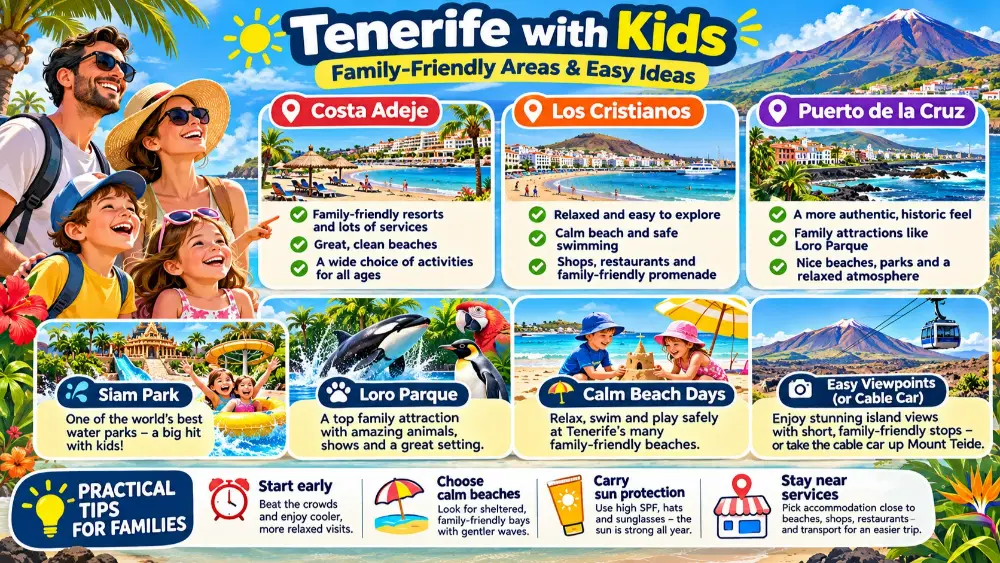
  • Tenerife with Kids: A Practical Family Travel Guide

    Tenerife with Kids: A Practical Family Travel Guide

    Tenerife can be an excellent family destination, but the best trip with children is rarely the one that tries to fit every famous attraction into a week. Distances, altitude, heat, wind and winding mountain roads affect children more than adults, and the difference between a relaxed family holiday and an exhausting one is often the pace. I plan one big activity day, then one easier day.

    This guide is designed for families who want beaches, nature and memorable experiences without treating children like miniature adults. It covers where to stay, beaches, Teide, water parks, boat trips, food, driving and the practical details I would consider before booking.

    Best areas to stay with children

    For a first family trip, Costa Adeje is the simplest all-round choice. It offers family-oriented accommodation, promenades, restaurants, beaches and easy access to major attractions. Los Cristianos is also practical because much of the central area is walkable and the harbour adds ferry and excursion options. Families who prefer a greener, more traditional atmosphere may enjoy Puerto de la Cruz, but the north’s weather is less consistently sunny.

    I choose accommodation by daily convenience rather than the number of pools. Look at walking gradients, supermarket access, room layout, kitchen facilities if useful, blackout quality, parking and the actual distance to the beach. My detailed where to stay in Tenerife guide compares the main bases.

    The easiest family beaches

    With young children, I prioritise beaches with straightforward access, lifeguard presence, toilets and nearby food. Las Vistas and several Costa Adeje beaches are generally easier than remote coves. The sea is still the Atlantic, so no beach should be considered automatically safe. Check flags and keep small children within immediate reach.

    Illustrated guide: Tenerife with Kids, with practical visitor tips
    Illustrated guide: Tenerife with Kids.

    A beach with dramatic cliffs but difficult access is not automatically a better family experience. Save wild beaches such as Benijo for a scenic stop if the children are old enough to handle steps and a longer drive. See the Tenerife beaches guide for a practical comparison.

    Mount Teide with children

    Teide is unforgettable for families because the volcanic landscape feels almost like another planet, but altitude changes the rules. The cable-car upper station is around 3,555 metres, temperatures can be much lower than on the coast and some activities have age or health restrictions. I would never promise children a summit experience before checking current official requirements.

    For many families, the best version is a scenic drive, viewpoints, Roques de García and perhaps the cable car if everyone meets the conditions and is comfortable at altitude. Keep the day shorter than an adult hiking itinerary, take warm layers and water, and watch for headache, nausea or unusual tiredness. My Mount Teide guide covers permits and current access planning.

    Water parks and big-ticket attractions

    Tenerife is known for major water and animal attractions, particularly in the south and Puerto de la Cruz area. These can be expensive, so I would choose based on the child’s age and interests rather than assuming every family must visit everything. A full water-park day can be physically tiring; place it between quieter days and arrive with a clear plan for sun protection, lockers and meal breaks.

    For very young children, a hotel pool plus beach may be just as successful as an all-day attraction. The goal is not to maximise ticket value by staying until closing if everyone is exhausted.

    Mother And Child On A Tenerife Beach

    Whale watching with children

    The waters off southwest Tenerife are well known for cetacean excursions. A shorter trip is often better with children than the longest cruise available. Choose an operator that follows responsible wildlife-observation standards and explains how it minimises disturbance. The Tenerife tourism authority maintains a sustainability framework for participating whale-watching companies.

    Seasickness is the practical issue families often forget. Bring sun protection, a light layer and any appropriate motion-sickness strategy recommended for your child. Never guarantee sightings; wildlife is not a theme-park schedule.

    Anaga and nature days

    Anaga can be magical for children who enjoy forests and viewpoints. The laurel forest feels completely different from the southern coast, but roads are winding and the weather can be misty or cool. I would select one short, age-appropriate walk and a few viewpoints rather than spend six hours driving through every corner.

    Trail access can change, and some natural areas require reservations. Check Tenerife ON before a nature day. Closed trails, barriers and warnings apply to families just as much as serious hikers.

    A family-friendly weekly rhythm

    Day typeExampleWhy it works
    EasyBeach + promenadeLow logistics
    BigTeide scenic dayMemorable but tiring
    EasyPool / local townRecovery
    BigLa Laguna + AnagaCulture and nature
    MediumBoat tripOne focused activity
    EasyBeach / water park depending ageFlexible
    FlexibleRepeat favourite or weather backupReduces pressure

    This rhythm is deliberately slower than my general 7-day Tenerife itinerary. With children, the value of a flexible afternoon is much higher than squeezing in one more village.

    Driving with children

    A rental car is useful because you can carry spare clothes, snacks, water and beach equipment. Mountain roads can cause motion sickness, so keep meals light before winding routes and allow stops. Reserve the correct car seat or booster in advance and check that the vehicle has enough luggage room once the seat is installed.

    If nobody wants to drive, stay in a well-connected resort and use organised excursions for Teide or Anaga. My Tenerife transport guide explains TITSA buses, taxis and airport transfers.

    Food with children

    Canarian food is usually easy to introduce gradually. Papas arrugadas, grilled fish, chicken, simple meats, cheese and bread can work well for less adventurous eaters, while adults can add stronger mojos, goat dishes, octopus or gofio-based recipes. Resort areas also have international options, so there is no need to turn every meal into a cultural challenge.

    I prefer lunch as the main local-food exploration with children, then keep dinner flexible. A long rural meal can be enjoyable when everyone is fresh and frustrating after a full day in the mountains. See what to eat in Tenerife for more ideas.

    Sun, heat and hydration

    Tenerife’s mild reputation can make families underestimate the sun. UV exposure is strong, and wind can make hot conditions feel deceptively comfortable. Use sunscreen, hats and regular water breaks. Dark volcanic sand can become very hot. In the mountains, the problem can be the opposite: cooler temperatures and wind despite intense sun.

    Strollers and walking

    A stroller is useful on promenades and resort areas, but historic streets, steps, volcanic paths and mountain trails are a different story. If your trip depends on a stroller, research access for each activity rather than assuming ‘easy walk’ means smooth pavement. A lightweight carrier can be more practical for some viewpoints and short trails, depending on the child’s age and the adult’s ability.

    Mother And Son Walking In Los Cristianos Tenerife

    Family travel in north versus south

    The south usually wins for easy sunshine, resort facilities and major family attractions. The north wins for gardens, traditional towns and a greener environment. A first family trip does not need to choose one side exclusively: stay in the south for convenience and make one or two northbound day trips.

    If the family prefers cooler scenery and urban walking to beaches, Puerto de la Cruz can be a great base. Match the base to the children you actually have, not to a generic ‘family hotel’ label.

    What I pack in the family day bag

    • Water for everyone
    • High-SPF sunscreen and hats
    • Light warm layer for Teide or Anaga
    • Snacks that work during drives
    • Spare clothes for younger children
    • Basic first-aid items and any regular medication
    • Motion-sickness supplies if relevant
    • Small towel or swimwear on mixed sightseeing days
    • Offline copy of bookings and identification when required

    What I would skip with very young children

    I would skip a strenuous Teide summit hike, overly long boat trips, cliffside routes that require constant supervision and itineraries with multiple hotel changes. Tenerife will still be there when the children are older. The best family memories are often simple: a safe beach, a volcanic viewpoint, a banana plantation seen from the road, ice cream in a plaza and a sunset walk.

    How to save money without making the trip harder

    A family apartment with a small kitchen can reduce breakfast and snack costs. Renting a car only for exploration days can be cheaper than keeping it all week. Choose one expensive attraction rather than three. Buy supermarket water and picnic items for mountain days, but still budget for local restaurants because food is part of the experience.

    Woman Swimming In A Tenerife Pool

    For accommodation, compare family-friendly accommodation in Tenerife and then verify the exact room configuration, not just the advertised maximum occupancy.

    My family rule for Tenerife

    Plan around energy, not around the number of attractions. If the morning goes well, you can always add a stop. If it goes badly, a beach or pool afternoon can rescue the day. Building that flexibility into the itinerary from the start is more useful than finding the ‘perfect’ family schedule online.

    Tenerife gives families an unusual combination of easy resort infrastructure and genuinely impressive nature. Use the first for comfort and the second in measured doses. That balance is what makes the island work so well with children.