
Tenerife Road Trip Guide is the kind of practical Tenerife topic that can change the shape of an entire trip. I prefer to make the key decisions before arrival, then keep the daily plan flexible enough for weather, local rules and the way the island actually feels once I am there.
This guide separates stable planning advice from details that can change. Where rules, access or services matter, I rely on official Tenerife or Canary Islands information and recommend checking again shortly before travel. I do not invent opening hours, prices or permissions when the current source does not guarantee them.
At a glance
| Topic | Planning a road trip around tenerife without spending the holiday inside the car |
|---|---|
| Best planning approach | Decide the non-negotiables early, verify current rules, and leave room for Tenerife’s microclimates and local conditions. |
| Who this guide helps | First-time visitors, repeat travellers and anyone whose accommodation, food, transport or trip style depends on this topic. |
| My rule | Use official information for rules and safety; use travel advice for route order, convenience and trade-offs. |
What current official information confirms
- Turismo de Tenerife publishes official driving routes for different stay lengths, including 1-day, 3-day and 8-day ideas.
- Official route themes include Teide, Isla Baja, wine country, La Laguna and Anaga, the south coast and Santa Cruz.
- The tourism board says most highlighted routes use paved roads suitable for a conventional car, while some secondary or unpaved sections may justify a more capable vehicle.
- Teide can be approached by several roads from north, south and west, making loop itineraries possible instead of repeating the same road.
- Tenerife’s microclimates mean a road trip can cross sunny coast, cloud forest and high-altitude conditions in a single day.
The best Tenerife road trip is a sequence of regions, not a lap of the motorway
It is possible to drive around much of Tenerife quickly on the motorway, but that is not the road trip I recommend. The island becomes interesting when I treat Teide, Anaga, Isla Baja, the Orotava Valley and the south as distinct landscape days. Turismo de Tenerife’s own driving-route collection follows the same logic, offering themed itineraries rather than one endless coastal circuit.
I build the week so each day has a clear geographic centre. That reduces backtracking and makes it easier to stop spontaneously at viewpoints or villages. The island is compact enough to change base only once or twice, so I do not need a different hotel every night to enjoy a genuine road trip.
My seven-day road-trip structure
Day one is a gentle south-coast orientation after the airport. Day two is Teide via one access road and down another. Day three is the Orotava Valley and Puerto de la Cruz. Day four moves west through Icod, Garachico and Isla Baja. Day five is Teno or Masca with a conservative schedule. Day six is La Laguna and Anaga. Day seven is Santa Cruz, Candelaria or an easier coastal day depending on the departure airport.
I deliberately leave space. A road trip becomes frustrating when every scenic stop has a reservation attached. Teide permits, cable-car times or protected trails may be fixed, but the rest of the day should absorb weather, traffic and the inevitable unplanned viewpoint.
Teide works best as a one-way mountain crossing
One of my favourite planning tricks is to climb toward Teide from one side and descend another. Official tourism information explicitly notes the multiple access roads. That gives a stronger sense of the island’s north-south contrast and avoids repeating scenery.
I still check weather and road conditions before leaving. Coastal sunshine tells me little about high-altitude temperature, wind or visibility. I keep a warm layer in the car year-round and never let a tight dinner booking pressure me into descending mountain roads faster than I want.
Anaga and Masca require a different driving mindset
These are not days for chasing mileage. Both areas contain narrow, winding roads where buses, cyclists and local traffic need space. I choose fewer stops, use official parking where possible and turn around if a route feels uncomfortable for my vehicle or experience level.
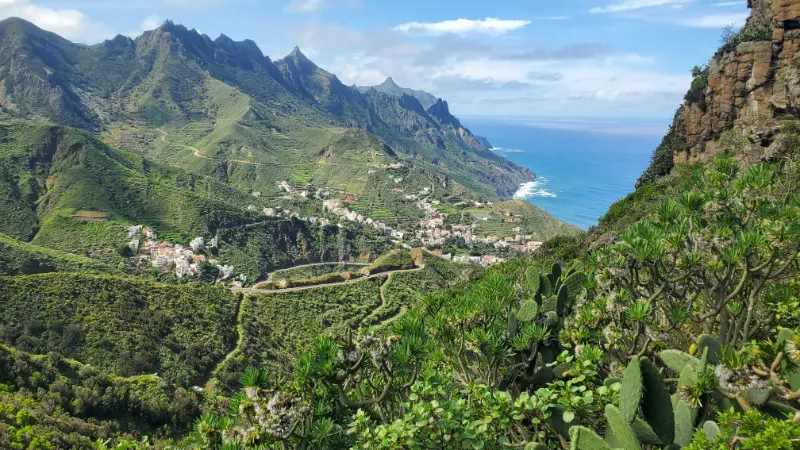
In Anaga, I like combining La Laguna with Cruz del Carmen and one village or coast section rather than trying to reach every beach. Around Masca, I plan transport and parking around the specific hike or viewpoint rather than expecting to improvise in the tiny village core.
Parking and fuel are easier when I think ahead by one stop
I fuel before mountain days instead of waiting for a warning light in a remote area. For historic towns I aim for larger edge-of-centre parking and walk the final streets. That is usually faster than circling narrow lanes hoping for a space beside the main square.
At beaches and viewpoints, I never create an unofficial parking space that blocks visibility, buses or emergency access. Popular locations can fill early, especially at weekends. A road trip should make the island easier to explore, not turn every stop into a parking battle.
When I would skip the rental car altogether
A car is not mandatory for Tenerife. If I stay mainly in Costa Adeje, Los Cristianos, Santa Cruz or Puerto de la Cruz and plan organised excursions, public transport can be more relaxing. The car becomes most valuable when I want rural villages, multiple viewpoints, flexible hiking starts or sunrise/sunset timing.

I therefore rent for the part of the holiday that needs it. A seven-night trip can work well with four car days and three no-car days. That reduces parking stress and lets me enjoy a wine tasting, boat trip or city day without thinking about the vehicle.
Useful related guides already on this site
I would plan this topic together with Tenerife by Car, Tenerife 7-Day Itinerary, Mount Teide Guide. For a broader second layer, I also use Best Viewpoints in Tenerife. Those pages cover the transport, location or activity details that would make this article unnecessarily repetitive.
How I turn this advice into an actual trip
I start with the parts that are difficult to change: airport, accommodation area, any permit or reservation, and the days that depend on weather. Then I place planning a road trip around Tenerife without spending the holiday inside the car inside that framework instead of allowing one concern to dominate the whole holiday. Tenerife is compact, but mountain roads, microclimates and busy resort zones make over-planning surprisingly easy.
I keep one flexible half-day in every week. If Teide is cloudy, a trail closes, the sea is rough or a restaurant cannot accommodate what I need, I want a backup that still feels worthwhile. Santa Cruz, La Laguna, Puerto de la Cruz, local markets, museums and coastal promenades can all work as alternatives depending on the base.

Choosing where to stay
Location often solves more problems than an extra hotel star. The south gives the widest resort infrastructure and generally drier coastal weather; the north gives greener landscapes and easier access to many historic towns; Santa Cruz and La Laguna work well for urban travellers. I compare current accommodation on Booking.com, checking the exact map position rather than relying on the destination name.
I read recent reviews for the detail that matters to this specific trip: parking, dietary handling, pet policy, noise, accessibility, kitchen facilities or transfer convenience. A high average score does not answer those questions.
Practical habits I use on Tenerife
I save official pages offline or bookmark them before a mountain or rural day. Mobile coverage is generally good in populated areas, but I do not want a rule, reservation or trail map to depend on perfect reception. I also carry water, sun protection and a light layer because the island can change temperature quickly with altitude.
I avoid building a schedule around exact driving times from a map. Parking, viewpoints, buses, roadworks and slow mountain traffic can add time. If I have a fixed booking, I arrive early and make the stop before it optional rather than after it.
How I handle information that changes
Travel blogs are good for explaining choices; they are not the final authority for a current permit, temporary closure, health notice, hotel inclusion or municipal rule. I use the official source linked below close to the travel date and follow on-site instructions. This is especially important for protected natural areas, water, animals, dietary safety and camping.
I also distinguish between a documented rule and my own preference. When I recommend a route, base or meal strategy, that is planning advice. When I state that a reservation is required or a facility has specific services, that should come from the current official information.
Activities and tours
I use organised tours selectively—mainly when they solve transport, permits, guiding or a safety/logistics problem. I compare current options below, but I do not book an excursion simply to fill every day.
Frequently asked questions
How many days do I need for a Tenerife road trip?
Seven days gives a comfortable first loop, while official tourism also publishes shorter 1- and 3-day driving ideas and longer routes.
Do I need an SUV in Tenerife?
Most main tourist driving routes are paved and suitable for a normal car. Choose a larger or more capable vehicle only if your specific route and rental conditions justify it.
Can I drive up Teide from one side and down another?
Yes. Teide has road access from multiple directions, which makes a one-way mountain crossing an excellent road-trip day.
Is Tenerife difficult to drive?
Motorways are straightforward, but Anaga, Masca and some village roads are narrow and winding. Drive conservatively and do not over-schedule those days.
Official information to check before travelling
For the current rules or background used in this article, I check the relevant official Tenerife or Canary Islands information. I would recheck it close to departure because access conditions, hotel products, local regulations and public notices can change after an article is published.

Final thoughts
Tenerife Road Trip Guide is most useful when it helps me make a few better decisions rather than adding another layer of complexity. Tenerife rewards flexible planning: choose the right base, respect current local rules, give mountain and ocean conditions room to change, and leave enough unscheduled time to enjoy the island rather than only manage it.
That is the approach I would use for planning a road trip around Tenerife without spending the holiday inside the car: verify the facts that matter, keep the itinerary realistic and let the rest of the holiday stay pleasantly adaptable.