
Tenerife Campervan and Motorhome Guide is the kind of practical Tenerife topic that can change the shape of an entire trip. I prefer to make the key decisions before arrival, then keep the daily plan flexible enough for weather, local rules and the way the island actually feels once I am there.
This guide separates stable planning advice from details that can change. Where rules, access or services matter, I rely on official Tenerife or Canary Islands information and recommend checking again shortly before travel. I do not invent opening hours, prices or permissions when the current source does not guarantee them.
At a glance
| Topic | Travelling around tenerife by campervan or motorhome |
|---|---|
| Best planning approach | Decide the non-negotiables early, verify current rules, and leave room for Tenerife’s microclimates and local conditions. |
| Who this guide helps | First-time visitors, repeat travellers and anyone whose accommodation, food, transport or trip style depends on this topic. |
| My rule | Use official information for rules and safety; use travel advice for route order, convenience and trade-offs. |
What current official information confirms
- Tenerife ON is the Cabildo de Tenerife’s official platform for routes, protected natural areas, facilities, alerts and reservations.
- Official caravan-camping areas include high-altitude sites such as Chío and Las Lajas, where advance reservation is required.
- At Chío and Las Lajas, official information warns that water points are not suitable for drinking and that there are no black/grey-water dumping points, electric hookups or drinking-water refill stations.
- The official campsite conditions distinguish authorised camping pitches from ordinary parking areas; at these facilities, overnight stays in the parking area are forbidden.
- Mountain campsites can sit above 1,500 metres, so temperatures can be very different from the coast even on the same day.
Campervan freedom is real, but “park anywhere” is the wrong mindset
A campervan can be one of the most flexible ways to explore Tenerife, especially if I want to combine sunrise in the pine forest, a village lunch and a coastal sunset without returning to the same hotel every night. What I would not do is treat the island as an unrestricted wild-camping destination. Protected landscapes, municipal rules, road-safety rules and specific campsite conditions all matter. The practical difference between parking a vehicle and establishing a campsite is important, but the safest planning approach is to use authorised overnight facilities and check the current rules for the exact place where I intend to stay.
Tenerife ON is the resource I keep open throughout the trip because it combines official facilities, reservations and alerts. That matters more than old forum posts or a pin on a camper app. A place that was tolerated two years ago can be regulated differently today, and a legal parking space does not automatically give me permission to put out chairs, an awning or cooking equipment.
What the official mountain areas are actually like
The official Chío and Las Lajas motorhome areas are not resort-style campsites. They are mountain facilities in Canary pine forest, both at roughly 1,500 metres or higher. That is part of their appeal: dark skies, forest atmosphere and immediate access to the highlands. It also means colder nights, wind and large day-to-night temperature changes. I pack for altitude even if the coast is warm enough for shorts.

I also plan around limited services. The official information for these sites states that there is no black- or grey-water disposal, no electrical charging point and no potable-water filling point. Nearby recreational areas may provide toilets, tables and other facilities, but opening times and conditions vary. I arrive self-sufficient rather than assuming a European full-service motorhome aire.
A route that works better than circling the island every day
For a campervan road trip, I divide Tenerife into zones. I might spend one night around the south or southwest, move through Teide or the western highlands, then continue to Isla Baja or the north. That reduces repeated motorway kilometres and lets the landscape change naturally. The island looks small on a map, but mountain roads and viewpoint stops stretch driving time considerably.
I avoid planning Teide, Anaga and Masca in one aggressive loop. A van is larger than a normal rental car, and narrow village roads, steep gradients and limited turning space can make ambitious routing tiring. My best days are the ones with one major road segment and several small stops, not six hours of moving the vehicle.
Waste, water and cooking are the details that decide whether the trip feels easy
Before each overnight stop, I know where I can legally deal with fresh water and waste. I never empty tanks outside authorised facilities, and I do not assume a forest-area tap is drinking water. Tenerife ON explicitly labels non-potable water at some official camping areas, so I carry a separate drinking-water supply and refill only where potable water is confirmed.
Cooking rules can also be strict in natural areas because of wildfire risk. The official campsite conditions prohibit portable barbecues at the cited mountain areas and regulate gas use. Seasonal fire restrictions can become even tighter. I treat food preparation as a safety issue, not a lifestyle accessory, and I check current alerts before driving into forest zones.
Where campervans are easy and where I would be cautious
Wide coastal roads, motorway links and many rural routes are straightforward, but historic centres and mountain hamlets can be awkward in a larger vehicle. I would park outside compact centres such as Garachico, La Orotava or La Laguna and walk in. I also think twice before entering a road simply because a navigation app says it is technically possible.
Masca and some Anaga roads demand particular concentration because of bends, buses, cyclists and limited space. If I am not comfortable with the vehicle dimensions, I use a safer parking point and public transport or walk for the final section. The goal is not to prove that the van can reach every viewpoint; it is to travel without blocking roads or turning a scenic day into a stressful one.
My campervan checklist before each overnight stop
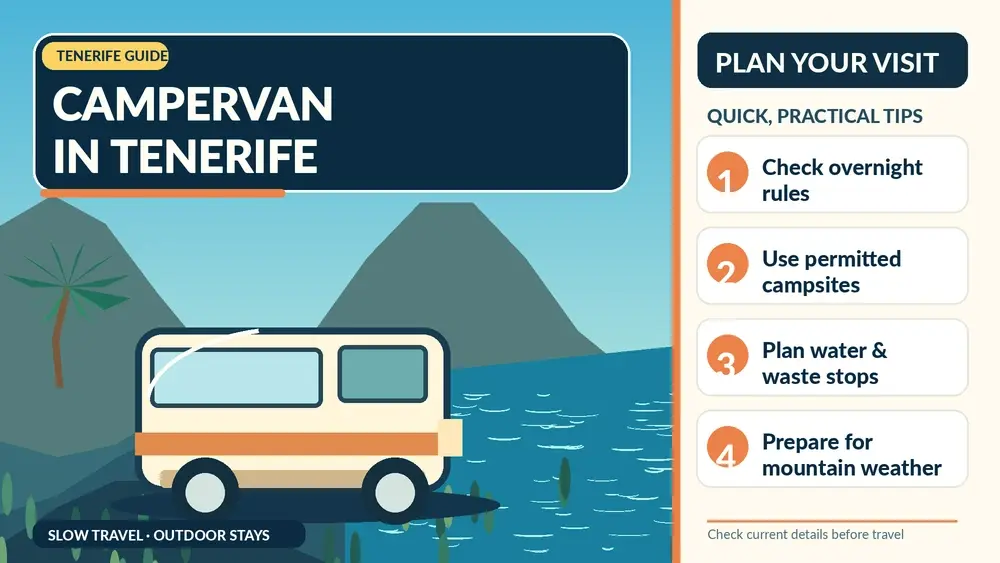
I check four things: whether the overnight stay is authorised, whether a reservation is needed, whether I have enough potable water, and what the weather will do at that elevation. Then I confirm waste facilities and the next fuel stop. I also keep food sealed and the exterior tidy; wind in exposed areas can turn loose objects into litter quickly.
Finally, I keep a conventional accommodation option in mind for one or two nights. A hotel or apartment can be useful after several days on the road, especially for laundry, a proper shower, charging equipment and a break from changing mountain weather. Campervan travel works best for me when flexibility includes the option not to sleep in the van every single night.
Useful related guides already on this site
I would plan this topic together with Camping in Tenerife, Tenerife by Car, Tenerife Hiking Permits and Trail Rules. For a broader second layer, I also use Chío Recreation Area. Those pages cover the transport, location or activity details that would make this article unnecessarily repetitive.
How I turn this advice into an actual trip
I start with the parts that are difficult to change: airport, accommodation area, any permit or reservation, and the days that depend on weather. Then I place travelling around Tenerife by campervan or motorhome inside that framework instead of allowing one concern to dominate the whole holiday. Tenerife is compact, but mountain roads, microclimates and busy resort zones make over-planning surprisingly easy.
I keep one flexible half-day in every week. If Teide is cloudy, a trail closes, the sea is rough or a restaurant cannot accommodate what I need, I want a backup that still feels worthwhile. Santa Cruz, La Laguna, Puerto de la Cruz, local markets, museums and coastal promenades can all work as alternatives depending on the base.
Choosing where to stay
Location often solves more problems than an extra hotel star. The south gives the widest resort infrastructure and generally drier coastal weather; the north gives greener landscapes and easier access to many historic towns; Santa Cruz and La Laguna work well for urban travellers. I compare current accommodation on Booking.com, checking the exact map position rather than relying on the destination name.
I read recent reviews for the detail that matters to this specific trip: parking, dietary handling, pet policy, noise, accessibility, kitchen facilities or transfer convenience. A high average score does not answer those questions.
Practical habits I use on Tenerife
I save official pages offline or bookmark them before a mountain or rural day. Mobile coverage is generally good in populated areas, but I do not want a rule, reservation or trail map to depend on perfect reception. I also carry water, sun protection and a light layer because the island can change temperature quickly with altitude.
I avoid building a schedule around exact driving times from a map. Parking, viewpoints, buses, roadworks and slow mountain traffic can add time. If I have a fixed booking, I arrive early and make the stop before it optional rather than after it.
How I handle information that changes
Travel blogs are good for explaining choices; they are not the final authority for a current permit, temporary closure, health notice, hotel inclusion or municipal rule. I use the official source linked below close to the travel date and follow on-site instructions. This is especially important for protected natural areas, water, animals, dietary safety and camping.
I also distinguish between a documented rule and my own preference. When I recommend a route, base or meal strategy, that is planning advice. When I state that a reservation is required or a facility has specific services, that should come from the current official information.
Activities and tours
I use organised tours selectively—mainly when they solve transport, permits, guiding or a safety/logistics problem. I compare current options below, but I do not book an excursion simply to fill every day.
Frequently asked questions
Can I wild camp anywhere in Tenerife?
No. Do not assume roadside parking or a scenic pull-off allows camping or an overnight stay. Use official facilities and check current local and protected-area rules.
Do official motorhome areas need booking?
Some official Tenerife ON caravan-camping areas require an advance reservation; the current facility page is the place to check.
Do Chío and Las Lajas have electric hookups and waste dumping?
Their official facility pages state that they do not provide electrical charging or black/grey-water disposal.
Is a campervan practical for Teide?
It can be, but altitude, wind, temperature changes and vehicle size matter. Plan conservative routes and check alerts before entering mountain areas.
Official information to check before travelling
For the current rules or background used in this article, I check the relevant official Tenerife or Canary Islands information. I would recheck it close to departure because access conditions, hotel products, local regulations and public notices can change after an article is published.
Final thoughts
Tenerife Campervan and Motorhome Guide is most useful when it helps me make a few better decisions rather than adding another layer of complexity. Tenerife rewards flexible planning: choose the right base, respect current local rules, give mountain and ocean conditions room to change, and leave enough unscheduled time to enjoy the island rather than only manage it.
That is the approach I would use for travelling around Tenerife by campervan or motorhome: verify the facts that matter, keep the itinerary realistic and let the rest of the holiday stay pleasantly adaptable.