Tag: Tenerife travel tips

  • Santa Cruz Low-Emission Zone (ZBE): What Tenerife Drivers Need to Know in 2026

    Santa Cruz Low-Emission Zone (ZBE): What Tenerife Drivers Need to Know in 2026

    Quick summary: Santa Cruz de Tenerife completed approval of its low-emission-zone ordinance in August 2026. The city says the regulation takes effect after the legal publication period but begins with an 18-month information phase in which the ZBE restrictions and sanctions are not yet applied. That makes 2026 a transition period rather than a reason to avoid driving into Santa Cruz. I still watch signs and official updates because the system is designed to move from information toward later enforcement.

    SituationPractical approach
    Driving in 2026 information phaseFollow normal traffic rules and official ZBE signs; current city guidance says no ZBE restrictions or sanctions during the information phase.
    Rental carKeep the contract and registration details available and check the latest city guidance before entering.
    Future tripRecheck the ZBE status because restrictions are intended to change after the information period.
    Parking in the centrePlan a specific car park or use public transport rather than circling narrow streets.

    What changed in August 2026

    Santa Cruz published the definitive ZBE ordinance in the provincial bulletin on 24 August 2026. The city stated that, after the legal 15-day period, an 18-month phase would begin that is exclusively informational, without ZBE circulation restrictions or sanctions.

    For a visitor travelling in September 2026, that means the existence of a ZBE should not be confused with active penalty enforcement. I would still use the official municipal page because this is exactly the kind of rule that changes over time and old driving guides can become misleading.

    Why I still learn the boundary

    Even during an information phase, I want to recognise the signs and understand where the system applies. That prevents surprise if cameras, road markings or information panels appear while I am driving. It also helps me plan for a later trip when restrictions may be active.

    I save the municipal ZBE map or page before entering the city. I do not rely on a rental-car employee remembering every current municipal traffic rule, because the driver remains responsible for following signs and restrictions.

    Rental cars and registration questions

    A rental car is usually Spanish-registered, but that does not automatically mean every future ZBE access requirement will be handled without action. Different Spanish cities use different systems for exemptions, labels and foreign vehicles. I check the Santa Cruz rules that are actually in force on my travel date.

    I keep the rental agreement in the vehicle and know the registration number. If a future registration or exemption process applies, those are the details likely to matter. I never pay an unofficial website simply because it claims every Tenerife rental must buy a ‘ZBE permit’.

    Parking can be the bigger issue than the ZBE

    For many tourists, central Santa Cruz parking is more practically relevant than the low-emission rules in 2026. I choose a specific car park near the area I want to visit and navigate directly to it rather than circling the centre while reading signs.

    Santa Cruz De Tenerife Skyline And Auditorium

    TITSA and the tram can also remove the parking problem. If I am staying in La Laguna or arriving from another area with a convenient connection, I sometimes leave the car outside the most congested part of the city and use public transport for the final leg.

    Future enforcement: check again before the next trip

    The 18-month information period means a 2027 or 2028 article can easily be wrong if it repeats the September 2026 situation. I therefore date this advice mentally: it is a current snapshot, not a permanent exemption.

    Before a future road trip I check the Santa Cruz municipal ZBE page for the enforcement date, vehicle categories, exemptions, registration requirements and sanctions. That five-minute update is more useful than memorising a rule that has not yet entered its restrictive phase.

    How I would prepare before travelling

    I save the official municipal ZBE page and a central car park before driving into Santa Cruz. That is enough for a 2026 visit because the city has announced an information phase without ZBE sanctions.

    For a future trip I recheck the rules a few days before arrival and again if my rental company sends a notice about environmental restrictions.

    What I would verify instead of assuming

    I verify the date of any article I read. ZBE rules are time-sensitive, and a statement that is correct in September 2026 can become wrong later.

    I verify whether a website asking for payment is an official municipal service. I do not buy an environmental sticker or registration from an unknown intermediary unless the official rules require it.

    A Tenerife-specific detail that matters

    Santa Cruz is the island capital and has dense central streets, tram corridors and busy parking. Even without active ZBE sanctions, parking strategy can determine whether the drive feels easy or frustrating.
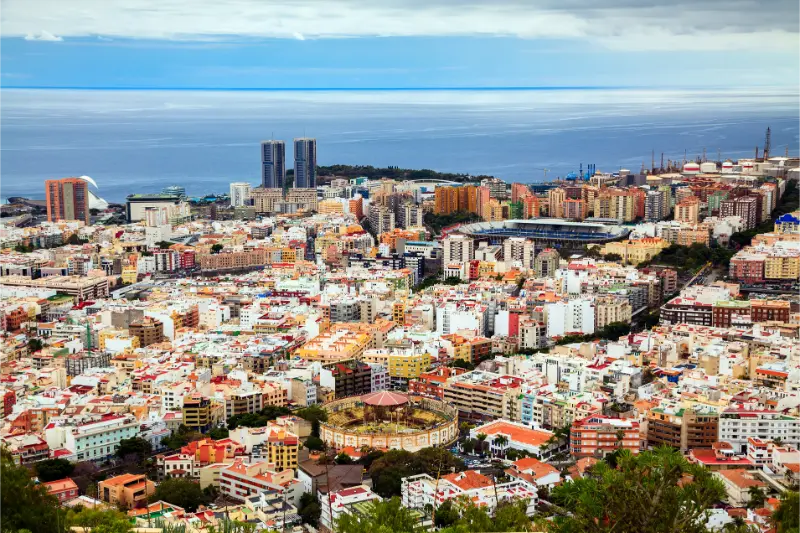
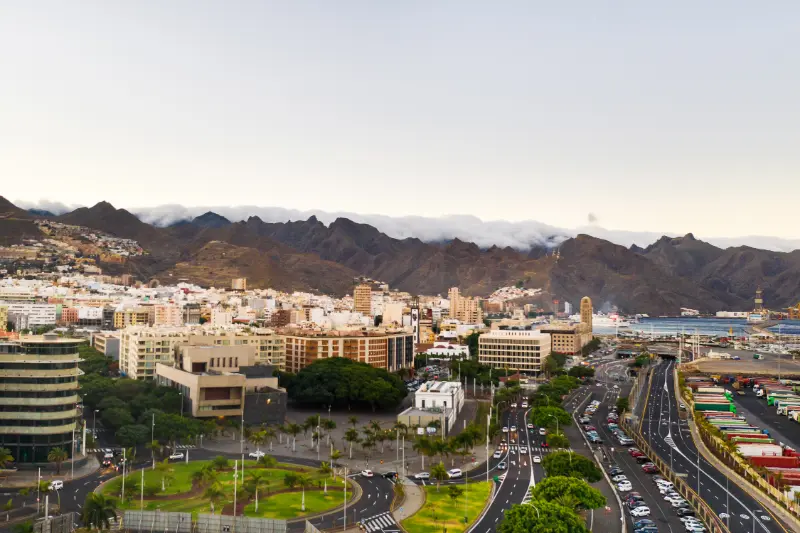
    Aerial View Of Santa Cruz De Tenerife

    The Tenerife road network itself has no general island-wide low-emission system. This article concerns the municipal Santa Cruz ZBE rather than a rule for every road on the island.

    Mistakes I would avoid

    I would not tell a 2026 visitor that the ZBE is already fining normal tourist traffic when the city has explicitly announced an 18-month information period.

    I would not assume that the information phase lasts forever. I recheck before any later trip.

    Useful related guides on My Tenerife Experience

    Useful official resources

    My practical checklist

    • Check the official ZBE page close to travel.
    • Know that 2026 is an information phase under current city guidance.
    • Keep rental-car registration details handy.
    • Plan a central car park before entering.
    • Follow road signs even if a navigation app disagrees.
    • Recheck future enforcement dates for later trips.

    Frequently asked questions

    Is the Santa Cruz ZBE fining drivers in September 2026?

    The city says the definitive regulation enters an 18-month information phase without ZBE restrictions or sanctions.

    Do rental cars need a special permit in 2026?

    Under the current information-phase announcement, ZBE restrictions are not being enforced. Future requirements should be checked on the official city page.

    Does the ZBE cover all of Tenerife?

    No. It is a municipal Santa Cruz de Tenerife measure, not an island-wide low-emission zone.

    Should I avoid Santa Cruz by car?

    Not necessarily. In 2026 the bigger practical issue for many visitors is central parking and congestion rather than ZBE enforcement.

    Final thoughts

    For a 2026 Tenerife trip, I treat the Santa Cruz ZBE as a rule to understand and monitor, not as a current barrier to visiting the city by car. The important habit is checking the official page again when enforcement moves beyond the information phase.

    How I would visit Santa Cruz by car with minimum stress

    I choose the attraction or neighbourhood first, then pick a car park that lets me walk between several stops. I enter that car park directly into navigation before leaving the motorway. This avoids last-minute lane changes and unnecessary loops through one-way streets.

    Auditorio De Tenerife Santa Cruz Coastline

    If traffic is heavy, I consider parking farther out and using the tram or bus for the centre. A hybrid plan can be faster than insisting on parking beside every attraction.

    One more practical point

    I also keep enough time for the return because city traffic at commuting hours can affect the drive back to the south or north.

    How I would apply this on a real Tenerife trip

    The way I would use this advice is to make the decision before it becomes urgent. I would save the relevant documents and official contacts offline, tell any travelling companion what the plan is, and build one realistic fallback into the day. In Tenerife, a short distance on the map can still involve motorway traffic, mountain roads, strong sun or a change of altitude, so I avoid leaving an important medical, transport or administrative question until the final hour. I also keep receipts, confirmations and screenshots together in one folder because the most useful evidence is usually created before a problem occurs, not after it.

    I would also review the plan after the first day rather than treating it as fixed. If the accommodation, weather, transport or my own comfort is different from what I expected, I adjust the remaining itinerary. That might mean moving an outdoor activity to the morning, choosing a different restaurant, using a taxi instead of driving, or contacting an official service earlier. This kind of small correction is more valuable than trying to follow a perfect schedule. The goal is a Tenerife trip that stays practical when real conditions replace assumptions.

    Final practical scenario

    If something still does not go to plan, I would simplify rather than improvise with incomplete information. I would use the official contact listed above, explain the exact situation, note the name or reference number I receive, and make the smallest change that keeps the trip safe and workable. In practice that could mean changing a booking, delaying a drive, choosing a simpler meal, visiting a pharmacy or clinic, or moving one activity to another day. Tenerife gives enough flexibility that one changed plan rarely ruins the holiday, but delaying a necessary decision can turn a small issue into a larger one.

    For longer stays I would repeat the same check halfway through the trip: medication or supplies remaining, transport plans, weather-sensitive bookings and any administrative deadlines. That small review is especially useful when the holiday lasts two weeks or more, because assumptions made before departure may no longer match the reality on the island.
  • Bicycle Repair in Tenerife: Punctures, E-Bikes, Workshop Help and Cycling Breakdowns

    Bicycle Repair in Tenerife: Punctures, E-Bikes, Workshop Help and Cycling Breakdowns

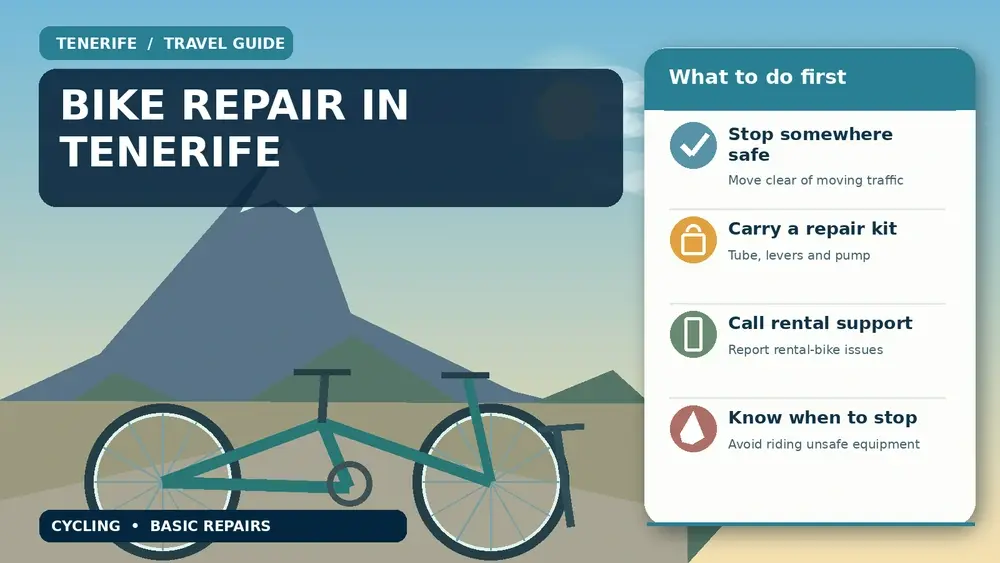
    Quick summary: Tenerife is an outstanding cycling island, but the same climbs and remote roads that make it memorable can turn a small mechanical problem into a long walk. I distinguish between a rental-bike issue, which I report to the rental company first, and a problem on my own bike, which I can take to a local workshop. For road rides I carry the minimum tools I know how to use: tube or tubeless repair, inflation, tyre levers and a small multitool. For e-bikes I add battery planning and avoid opening electrical systems on the roadside. The goal is not to become a mechanic on holiday; it is to solve simple failures and know when to stop riding.

    SituationWhat I would do
    Rental bike punctureI follow the rental company’s instructions and use the supplied repair kit if allowed. For major damage, I call rather than fitting expensive parts without approval.
    Own road bike with flat tyreI repair or replace the tube/tubeless puncture if safe, then inspect the tyre for the cause before inflating fully.
    Broken chain or derailleur issueI move off the road, assess whether a simple roadside fix is within my skills and otherwise arrange pickup or workshop help.
    E-bike motor/battery faultI check simple external connections and display messages but do not dismantle high-voltage components. I contact the rental shop or an e-bike-qualified workshop.
    Mechanical failure on a remote climbI focus on location, phone battery, water and safe pickup. Walking a bike for kilometres on a steep shoulder can be worse than waiting for help.

    Why Tenerife needs a repair plan

    Popular cycling routes can climb from resort areas toward Teide, cross exposed ridges or pass through rural zones with long gaps between workshops. A puncture near a town is easy; the same puncture late in a high-altitude ride can become a temperature, hydration and daylight problem. I plan for where the route goes, not only its distance.

    I save the rental shop number and my accommodation contact before leaving. On my own bike, I also note the nearest practical town along the route. Mobile coverage is generally good but not uniform in mountains, so I do not make a single app my only rescue plan.

    • Carry enough water and one extra layer on high routes, even when the coast is warm.
    • Start long climbs with a charged phone and, for e-bikes, realistic battery reserve.
    • Tell someone the broad route when riding alone.
    • Know whether the rental company offers roadside pickup, mobile assistance or only workshop service.

    The puncture kit I actually carry

    For a tubed setup I carry at least one compatible tube, tyre levers and a reliable pump or inflator. For tubeless tyres I add plugs appropriate to the system and still consider a backup tube for damage that sealant cannot close. A repair kit is useless if the valve length, tube size or pump head does not match the bike.

    I practice at home before the trip. Tenerife is not the place to discover for the first time that I cannot remove a tight tyre bead or reinstall a thru-axle correctly. When renting, I ask what the shop supplies and what it expects me to do after a puncture.

    • Tube or tubeless repair compatible with the exact wheel and tyre setup.
    • Pump or inflator that fits the valve type, plus enough cartridges if relying on CO2.
    • Small multitool with the fasteners used on the bike.
    • A boot or robust temporary tyre patch for a cut casing, plus gloves or wipes for messy repairs.

    Rental-bike mechanical problems

    A rental bike is not my equipment to modify freely. If gears skip, brakes rub badly, a wheel develops play or an electronic system shows an error, I contact the shop. Good rental companies would rather solve a developing fault than receive a damaged bike after I continue riding it.

    I photograph visible damage when I notice it and explain whether the problem appeared gradually or after an impact. If I crash, I prioritise health and safety before the bicycle. I do not conceal damage and hope the shop will miss it; clear reporting usually makes the return process easier.

    • Ask at pickup what roadside repairs I am expected or allowed to perform.
    • Keep the rental agreement and emergency number on the phone.
    • Do not swap expensive components or tyres without authorisation.
    • Report brake, steering or wheel faults immediately because they can become safety-critical on long descents.

    E-bike problems in Tenerife

    E-bikes add range and open steep routes to more riders, but they also add electronics, heavier wheels and battery constraints. I treat the battery percentage as part of route planning, especially on sustained climbing. A display estimate can change dramatically when gradients increase, headwind strengthens or assistance mode stays high.

    If an error appears, I check the obvious external points the manufacturer allows: battery seating, visible connectors, display messages and whether the system restarts normally. I do not open battery packs, motors or sealed electronics. A specialist workshop or the rental company should handle those systems.

    • Start with a fully charged battery and the correct charger if the trip is multi-day.
    • Do not expose removable battery contacts to sand or water while troubleshooting.
    • Remember that a heavy e-bike may be difficult to push uphill if the motor stops.
    • Tell a pickup service that the bicycle is electric and give approximate weight/size if transport equipment matters.

    Finding a workshop and explaining the fault

    Cycling-focused towns and resort areas have bike shops, but stock is not unlimited. A rare tyre size, proprietary derailleur hanger or unusual e-bike component may need ordering. I bring a small critical spare when travelling with a high-end or unusual bike, especially a derailleur hanger that is specific to the frame.

    At the workshop I explain the symptom rather than diagnosing aggressively: “the chain skips under load in these gears” is more useful than insisting that a cassette must be replaced. I ask for an estimate and timeframe, particularly if I have a flight or event approaching.

    • Know tyre dimensions, axle standard and drivetrain speed before looking for parts.
    • Bring or photograph the exact e-bike error code.
    • Ask whether same-day service is realistic rather than assuming holiday urgency moves the queue.
    • Keep removed specialty parts if they are yours and may be needed for warranty evidence.

    Breakdowns on climbs and descents

    Mechanical judgement matters most on Tenerife’s long descents. A marginal brake, loose wheel or damaged tyre may feel tolerable at walking speed but become dangerous at 50 km/h. I do not “test it on the way down” if the safety of the bike is uncertain. I arrange pickup or descend only after a competent repair.

    On a remote roadside I move myself and the bicycle away from traffic where possible. I use a map pin plus road name/direction to describe the location. If the problem coincides with injury, severe weather or another genuine emergency, the human situation takes priority over recovering the bike.

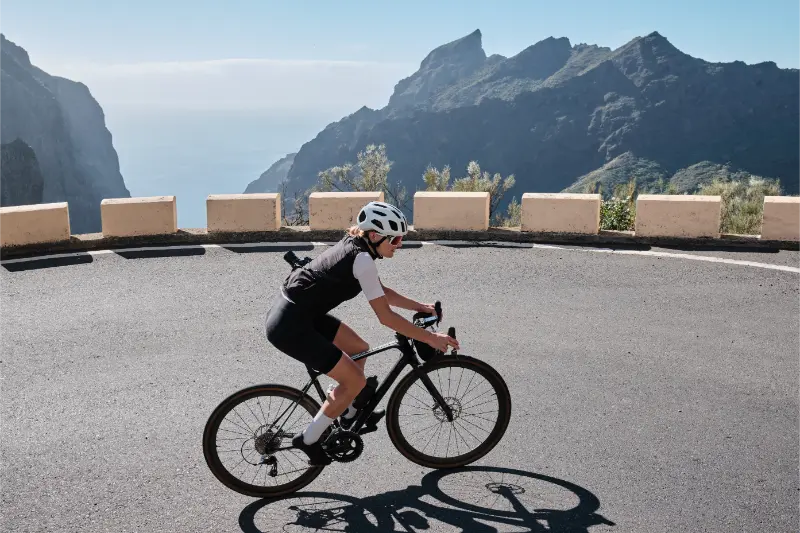
    A road cyclist riding past a viewpoint on a winding mountain road
    • Do not continue a descent with uncertain brakes or a compromised tyre sidewall.
    • Move off blind bends and narrow carriageways before starting repairs.
    • Protect phone battery while waiting; constant screen use can waste the resource needed for pickup calls.
    • Carry some cash/card flexibility in case a taxi or transport solution is needed and allowed for the bike.

    Useful related guides on My Tenerife Experience

    Useful official resources

    My final checklist

    • Save the rental shop or workshop number before a long ride.
    • Carry a tube/tubeless solution that actually matches the bike.
    • Carry working inflation equipment, not only repair patches.
    • Start high routes with water, a layer and enough phone battery for a delayed return.
    • Stop riding if brakes, wheel retention or tyre sidewalls are unsafe.
    • For e-bikes, protect battery reserve and do not dismantle sealed electrical systems.
    • Bring a frame-specific derailleur hanger if travelling with an unusual personal bike.
    • Describe the fault and ask for an estimate before authorising major workshop work.

    Frequently asked questions

    Are bicycle repair shops easy to find in Tenerife?

    There are bike shops and workshops in the main cycling and population areas, but not on every mountain road. I solve this by carrying basic puncture tools and having a pickup/contact plan for faults I cannot repair.

    Should I repair a rental bike myself?

    Only within the rental company’s instructions. Basic puncture repair may be expected, while brake, drivetrain, wheel or electronic work should normally be reported to the provider first. I avoid unauthorised parts replacement.

    What spare is most useful for my own bike?

    Beyond puncture supplies, a derailleur hanger specific to the frame can be valuable because workshops may not stock every proprietary shape. The exact best spare depends on the bike and trip.

    Cycling Around Tenerife

    Can I ride an e-bike home if the battery dies?

    Most e-bikes can still be pedalled, but they are heavier and climbing can become extremely hard. I do not plan a remote route on the assumption that an empty battery will be an easy inconvenience.

    Final thoughts

    A Tenerife cycling repair plan is really a return-home plan. I carry the small items that solve common punctures, know who to call for everything else and refuse to ride a mechanically unsafe bike down a long descent. That approach keeps tools and spares proportional to the holiday while still respecting the island’s steep, exposed and sometimes remote riding environment.

  • MAIT La Orotava Guide: Ibero-American Crafts Museum, Hours and Tickets

    MAIT La Orotava Guide: Ibero-American Crafts Museum, Hours and Tickets

    The Museo de Artesanía Iberoamericana de Tenerife (MAIT) is one of the La Orotava museums I would choose when I want the town’s historic architecture and its craft traditions to reinforce each other. The museum occupies the former Dominican convent of San Benito Abad, now commonly referred to as the former Santo Domingo convent, and its permanent collections connect Canary Islands crafts with wider Ibero-American traditions.

    The La Orotava tourism website lists the museum at Calle Tomás Zerolo 34. At the time of this update, official municipal pages are not fully consistent on opening hours: the tourism page lists Monday to Friday 10:00–15:00 and Saturday 10:30–13:30, while the municipality’s facility page lists Monday to Friday 09:00–15:00. Both indicate a €2 general ticket and free admission for Tenerife residents. I therefore verify the timetable directly before travelling rather than presenting one listing as guaranteed.

    Quick visit facts

    LocationCalle Tomás Zerolo 34, La Orotava
    BuildingFormer Dominican convent, 17th century
    HoursOfficial municipal pages currently show differing schedules; verify before visiting
    Current listed general price€2; Tenerife residents free
    Collection focusCanarian and Ibero-American crafts
    Time I allow60–90 minutes
    Best pairingLa Orotava historic centre and Casa de los Balcones

    The building is part of the reason to visit

    I would not separate the collection from the former convent. The municipal museum description highlights the stone entrance arch, cloister, timber ceilings and stone staircase, with work associated with Canarian architect, sculptor and gilder Antonio de Orbarán. Those spaces give handmade objects a setting that feels appropriate rather than neutral.

    If architecture is my priority, I compare this building with the patios and balconies elsewhere in town. My La Orotava travel guide provides a walking route through the historic centre.

    What the collection covers

    The permanent exhibition is designed to represent Ibero-American craft traditions, including practices that continue today and others that have disappeared. The museum gives special attention to Canary Islands craftsmanship but also includes material from America, the Philippines and Spain. This broader context helps me see Canarian crafts as part of long networks of exchange rather than an isolated folk style.

    La Orotava Historic Center And Mountains Tenerife

    Highlighted collections include popular art from America and the Philippines, regional Canarian craft design awards, traditional musical instruments and Spanish popular pottery. I would choose a few themes and follow them rather than try to memorise every object label.

    What I look for in the Canarian craft rooms

    In the Canary Islands sections I slow down for techniques that are easy to overlook when they are reduced to souvenir labels. Openwork embroidery, or calado, depends on removing selected threads from fabric and rebuilding decorative patterns with careful hand stitching. Traditional pottery, basketry, woodwork and textile work are equally useful because they show how local materials, household needs and trade shaped everyday objects. I pay attention to labels explaining where an object was made, what raw materials were used and whether the piece was intended for daily work, dress, storage or decoration. That context matters more to me than simply deciding which object looks prettiest. It also helps later when I browse shops: I can ask how something was made and avoid assuming that every item marketed as Canarian represents the same craft tradition. MAIT works best when I use the collection as a vocabulary lesson before looking for contemporary artisan work elsewhere on the island.

    Illustrated guide: MAIT La Orotava, with practical visitor tips
    Illustrated guide: MAIT La Orotava.

    Why it complements Casa de los Balcones

    Casa de los Balcones is more immediately visual, with its architecture, courtyards and strong association with traditional crafts. MAIT is more museum-like and comparative. Visiting both can work well because one gives a domestic-architectural setting and the other provides a broader interpretive framework.

    My Casa de los Balcones guide explains the practical details of that second stop. I would normally leave time for a café between the two rather than turn La Orotava into a museum marathon.

    Crafts as living culture, not only souvenirs

    The museum is a useful reminder that “craft” can mean technique, design, social history and skilled labour—not simply an object bought at the end of a holiday. Lace, pottery, basketry, woodwork, textiles and musical instruments all carry information about materials, trade and everyday life.

    That changes how I shop later. I am more likely to ask who made an item, what material was used and whether the design belongs to a local tradition. The Tenerife food souvenirs guide covers edible products, but I apply the same principle to non-food crafts: fewer, better-documented objects are more meaningful than generic souvenirs.

    Official source I check

    For current visitor information I compare La Orotava tourism’s official MAIT page with the municipality’s current MAIT facility listing. Because those official pages can show different opening times, I treat the museum’s own contact details as the final check before travelling. Both sources are still useful for the address, ticket information and collection overview.

    How much time I would allow

    I would normally allow between one and two hours for MAIT – Museo de Artesanía Iberoamericana, then keep the rest of the day for the surrounding historic centre. Museums and interpretation centres are most useful when I do not rush through every panel. I choose the sections that interest me, read enough context to understand what I am looking at and then continue outside with a clearer sense of place.

    This is why I combine the visit with my La Orotava travel guide rather than treating the museum as an isolated stop. A coffee, market visit or short walk afterwards gives the information from the displays somewhere to “land” in the real city.

    Opening hours and tickets: what I verify

    Hours, temporary exhibitions and ticket systems can change, especially around public holidays, Carnival, Christmas and local events. I therefore use the official website as the final source on the day before visiting. If free timed entry or advance booking is offered, I reserve it rather than assume I can walk in at the busiest hour.

    I also check whether bags, tripods, food, flash photography or large groups have specific rules. These small details are easy to overlook and can matter more than the headline ticket price.

    Who I think gets the most from the visit

    MAIT – Museo de Artesanía Iberoamericana works best for travellers who want context, not only a list of sights. It is particularly useful on a cloudy day, for repeat visitors, for families with older children who like interactive or visual displays, and for anyone trying to understand Tenerife beyond beaches and viewpoints. I would not force a museum into every itinerary, but I think one or two well-chosen cultural visits make the rest of the island easier to read.

    Accessibility and comfort

    Before travelling with a wheelchair, stroller or limited mobility, I confirm the current accessibility information directly with the venue because historic buildings can have level changes, lifts or temporary restrictions. I also check nearby parking or the walking distance from a bus/tram stop. My broader accessible Tenerife guide is useful for planning the whole day rather than only the museum entrance.

    A realistic La Orotava cultural half-day

    I would start in the historic centre while the streets are quiet, visit MAIT near opening time, continue through the main squares and traditional houses, and choose one second interior such as Casa de los Balcones. Lunch then becomes the pause before deciding whether to continue to Puerto de la Cruz or drive toward the Orotava Valley viewpoints.

    Frequently asked questions

    Is MAIT only about Canarian crafts?

    No. The permanent exhibition is Ibero-American in scope, with a strong Canary Islands component but collections that also connect Spain, America and the Philippines.

    Is the building historic?

    Yes. The museum occupies a seventeenth-century former Dominican convent, and the architecture is a major part of the visit.

    Is it expensive?

    Official municipal information currently lists a €2 general ticket and free admission for Tenerife residents. I confirm both price and opening time before arrival, especially because official pages can be updated on different schedules.

    Final thoughts

    MAIT is a good example of the smaller Tenerife museum that becomes more valuable when placed in context. I would not visit only to “see crafts”; I would use it to understand the materials and techniques that appear elsewhere in La Orotava and then notice those details differently as I walk through the town.

    How I prepare before entering

    I read just enough before the visit to know the basic story, but I do not try to learn the entire collection online. A museum is more engaging when I recognise a few themes and still have room to discover something new. I save the official page and any digital guide, then put my phone away for parts of the visit.

    Fountain and gardens in front of the pink Liceo de Taoro building in La Orotava

    I also check the last admission time, not only the closing time. Some venues stop entry before the doors close, and temporary events can affect normal access. If I am building the day around a specific exhibition, I verify that it is still running.

    Photography without missing the museum

    If photography is permitted, I take a few images that help me remember an object or display and then keep moving. Photographing every label usually means I read nothing properly. For historic interiors I avoid blocking narrow passages, leaning on cases or using flash unless it is explicitly allowed.

    What I do after the visit

    I give myself ten minutes afterwards to walk without another objective. Museums can be dense, and the transition back into the city is often when the information becomes useful. I notice architecture, shop signs, festival posters or craft objects differently because I now have a context for them.

    This is also when I decide whether I need another museum. Often I do not. One strong visit plus a market, neighbourhood or historic street produces a more varied day than moving from ticket desk to ticket desk.

  • Casa del Carnaval Santa Cruz Guide: Free Museum, Costumes and Visit Tips

    Casa del Carnaval Santa Cruz Guide: Free Museum, Costumes and Visit Tips

    Casa del Carnaval is the place I would visit in Santa Cruz when I want to understand the Carnival outside the few intense weeks when the city is actually celebrating it. Instead of seeing the event only as parades and nightlife, the museum explains costumes, music, groups, posters and the creative work that keeps the festival alive throughout the year.

    The official Casa del Carnaval website describes a permanent exhibition with multimedia displays, Carnival posters, costumes and interactive elements. The current contact information lists Calle Aguere 19 in Santa Cruz and opening hours from 10:00 to 18:30 Monday to Sunday. Recent official notices also state that admission is free, with free tickets available through the website. Because exhibitions and access systems can change, I confirm those details before travelling.

    Quick visit facts

    LocationCalle Aguere 19, Santa Cruz de Tenerife
    Current listed hoursMonday–Sunday, 10:00–18:30
    AdmissionFree according to recent official notices; check current booking
    Best forCarnival history, costumes, posters, music and multimedia
    Time I allow60–90 minutes
    Combine withHistoric centre, market, TEA or Auditorio

    Why I think it is more useful than a simple Carnival photo stop

    Santa Cruz Carnival can be overwhelming if I encounter it only through images of the main gala. Casa del Carnaval gives names and roles to the different communities involved: murgas, comparsas, rondallas, musical groups, designers and Carnival characters. That context makes the live festival much easier to understand later.

    It is also valuable outside Carnival season. If my trip is in May, September or November, I can still see elaborate costumes and learn how the annual event changes. My Santa Cruz Carnival guide then becomes more useful because the terminology is no longer abstract.

    What the permanent exhibition includes

    The official description mentions the current Carnival Queen costume as a central display, along with posters, audiovisual material and screens explaining different aspects of the festival. Displays are designed to change, so I do not arrive expecting one specific costume from an old social-media post.

    There are also interactive elements associated with costumes, masks, wigs and musical instruments. I see these as an opportunity to understand the craftsmanship behind Carnival, not just as a place for novelty photographs.

    Carnival vocabulary I learn before a live event

    A short museum visit is much more useful when I use it to decode the vocabulary I will hear during Carnival. Murgas are satirical singing groups whose performances mix music, costumes and topical humour; comparsas place much more emphasis on dance, percussion and spectacular street presentation; rondallas bring a different musical tradition; and the Carnival Queen gala highlights enormous wearable designs that are closer to mobile stage architecture than ordinary clothing. I also pay attention to posters, costume sketches and references to designers because they reveal how much work happens months before a parade. I do not try to memorise every category in one visit. Instead, I leave with a few names and roles that help me recognise what I am seeing later in the streets or on television. That small amount of context turns Carnival from a colourful spectacle into a cultural event with distinct communities, competitions and creative traditions.

    Temporary exhibitions and why I check them

    The museum has a multipurpose space used for temporary exhibitions, talks, workshops and presentations. This is one of the reasons I always check the official site a few days before visiting. A temporary show on rondallas, murgas, posters or design can change the balance of the visit and may be the most interesting part for a repeat visitor.

    Best time to visit

    On a normal sightseeing day I would place Casa del Carnaval in the hotter middle part of the afternoon, then return outside for Santa Cruz’s plazas and pedestrian streets. During Carnival or major city events, I expect transport and opening arrangements to be less predictable and I verify everything again.

    Panoramic View Of Santa Cruz De Tenerife

    If I am visiting the city for the first time, my Santa Cruz de Tenerife guide helps connect the museum with Mercado Nuestra Señora de África, TEA, Parque García Sanabria and the Auditorio.

    Getting there

    The central location makes the museum practical without a car. I prefer public transport when spending a full day in Santa Cruz because parking can add unnecessary time. If I drive, I choose a legal public car park and walk rather than circle the centre looking for the closest street space.

    Official information to check

    I use the official Casa del Carnaval website for current hours, ticket reservations, contact details and temporary activities. The site lists Calle Aguere 19 and the 10:00–18:30 daily schedule at the time of this update, but I always recheck around holidays and festival dates.

    How much time I would allow

    I would normally allow between one and two hours for Casa del Carnaval, then keep the rest of the day for the surrounding historic centre. Museums and interpretation centres are most useful when I do not rush through every panel. I choose the sections that interest me, read enough context to understand what I am looking at and then continue outside with a clearer sense of place.

    This is why I combine the visit with my Santa Cruz de Tenerife guide rather than treating the museum as an isolated stop. A coffee, market visit or short walk afterwards gives the information from the displays somewhere to “land” in the real city.

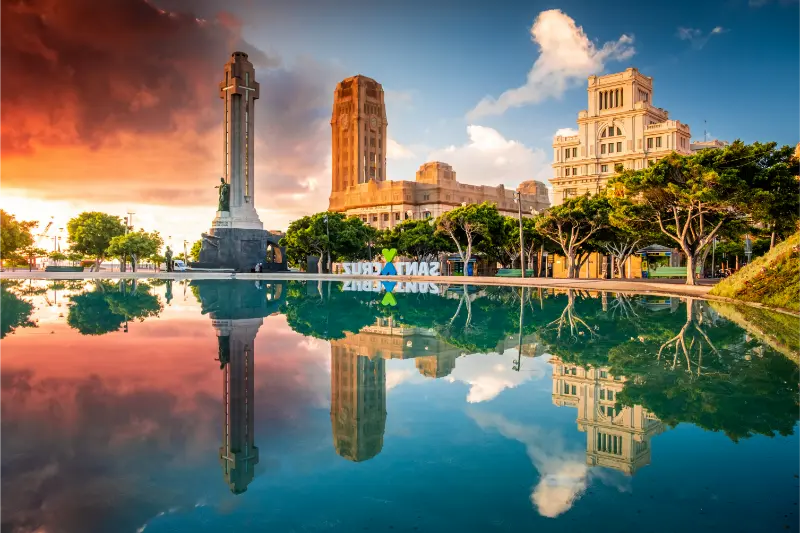
    Plaza de España reflecting pool and civic buildings in Santa Cruz de Tenerife
    Plaza de España, Santa Cruz de Tenerife.

    Opening hours and tickets: what I verify

    Hours, temporary exhibitions and ticket systems can change, especially around public holidays, Carnival, Christmas and local events. I therefore use the official website as the final source on the day before visiting. If free timed entry or advance booking is offered, I reserve it rather than assume I can walk in at the busiest hour.

    I also check whether bags, tripods, food, flash photography or large groups have specific rules. These small details are easy to overlook and can matter more than the headline ticket price.

    Who I think gets the most from the visit

    Casa del Carnaval works best for travellers who want context, not only a list of sights. It is particularly useful on a cloudy day, for repeat visitors, for families with older children who like interactive or visual displays, and for anyone trying to understand Tenerife beyond beaches and viewpoints. I would not force a museum into every itinerary, but I think one or two well-chosen cultural visits make the rest of the island easier to read.

    Accessibility and comfort

    Before travelling with a wheelchair, stroller or limited mobility, I confirm the current accessibility information directly with the venue because historic buildings can have level changes, lifts or temporary restrictions. I also check nearby parking or the walking distance from a bus/tram stop. My broader accessible Tenerife guide is useful for planning the whole day rather than only the museum entrance.

    A good cultural cluster in Santa Cruz

    My preferred sequence is Mercado Nuestra Señora de África in the morning, TEA or MUNA around late morning, lunch, Casa del Carnaval in the afternoon and a walk through the centre or García Sanabria afterwards. I do not try to visit every museum. Two cultural stops with time for the city outside usually feel richer than five rushed interiors.

    Frequently asked questions

    Is Casa del Carnaval only worth visiting during Carnival?

    No. Its main purpose is to make Carnival accessible throughout the year, and exhibitions are updated to reflect the festival’s continuing history.

    Is admission free?

    Recent official museum notices describe free admission with online free tickets. Because ticket procedures can change, I confirm on the official site immediately before visiting.

    How long do I need?

    I would allow about an hour for a focused visit and up to 90 minutes if temporary exhibitions or multimedia displays interest me.

    Final thoughts

    Casa del Carnaval is small compared with a national museum, but it adds something important to a Tenerife trip: cultural context for a festival that shapes Santa Cruz far beyond the parade route. I would visit before Carnival if possible, then watch the live event with a much better understanding of the groups, costumes and traditions involved.

    How I prepare before entering

    I read just enough before the visit to know the basic story, but I do not try to learn the entire collection online. A museum is more engaging when I recognise a few themes and still have room to discover something new. I save the official page and any digital guide, then put my phone away for parts of the visit.

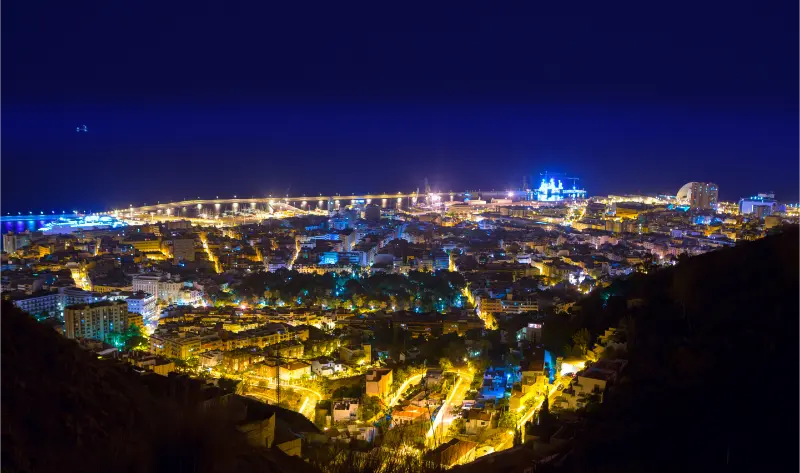
    Santa Cruz De Tenerife At Night

    I also check the last admission time, not only the closing time. Some venues stop entry before the doors close, and temporary events can affect normal access. If I am building the day around a specific exhibition, I verify that it is still running.

    Photography without missing the museum

    If photography is permitted, I take a few images that help me remember an object or display and then keep moving. Photographing every label usually means I read nothing properly. For historic interiors I avoid blocking narrow passages, leaning on cases or using flash unless it is explicitly allowed.

    What I do after the visit

    I give myself ten minutes afterwards to walk without another objective. Museums can be dense, and the transition back into the city is often when the information becomes useful. I notice architecture, shop signs, festival posters or craft objects differently because I now have a context for them.

    This is also when I decide whether I need another museum. Often I do not. One strong visit plus a market, neighbourhood or historic street produces a more varied day than moving from ticket desk to ticket desk.

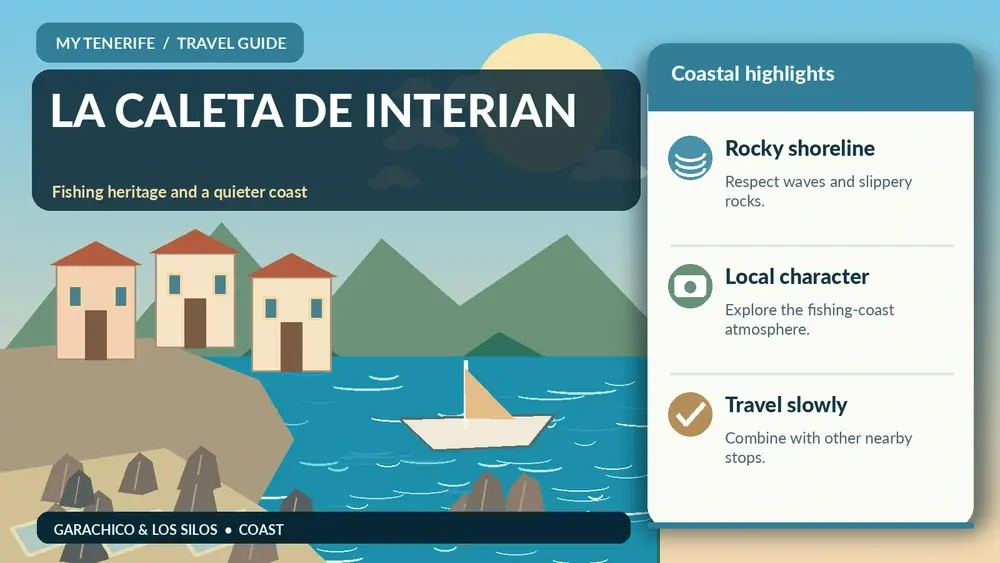
  • La Caleta de Interián Guide: Quiet Coast Between Garachico and Los Silos

    La Caleta de Interián Guide: Quiet Coast Between Garachico and Los Silos

    La Caleta de Interián is a useful stop for travellers who want to see the northwest coast between Garachico and Los Silos at a slower, more local scale. The settlement is unusual because it is administratively shared by the municipalities of Los Silos and Garachico. It has a fishing-coast character, a compact street grid, a beach area and access to a rocky shoreline where traditional domestic salt-making has survived.

    The Los Silos municipality describes La Caleta as a seafaring neighbourhood between the two municipalities. Its coastal information highlights a roughly five-kilometre Los Silos shoreline of rocky points, small beaches and natural pools, with traditional salt pans around La Caleta de Interián where salt is still produced using natural rock depressions.

    Quick planning facts

    LocationNorthwest Tenerife, between Garachico and Los Silos
    MunicipalitiesShared by Garachico and Los Silos
    CharacterLocal coastal neighbourhood
    Best forSeafront walking, local atmosphere, salt-making heritage, quiet coast
    Nearby anchorsGarachico, Los Silos, Buenavista del Norte
    SwimmingCondition-dependent Atlantic coast
    Ideal visit1–3 hours, longer with the coastal walk

    What I come here for

    I do not come to La Caleta expecting a polished resort. I come for the relationship between streets, fishing history and a rugged lava coast. The neighbourhood works especially well as a pause between the major historic centre of Garachico and the quieter Isla Baja landscapes around Los Silos and Buenavista.

    That contrast is useful in a road trip. Garachico has major architecture and the famous El Caletón pools; La Caleta de Interián feels more everyday. My Garachico guide and Los Silos guide show how I would build the wider day.

    The coastal walk

    Los Silos promotes walking along its coast from La Caleta de Interián toward Buenavista del Norte. I like this as an alternative to driving between every small stop. The shoreline is mostly volcanic and rocky, with natural pools and small bathing areas appearing between points and inlets.

    I keep the sea on the safe side of any barriers and do not climb wet rocks for a photograph. North-coast swell can be powerful even when the weather is calm. The Tenerife safety guide explains the ocean rules I use around charcos and open coast.

    Traditional salt pans

    One of the most distinctive details is the presence of domestic salt pans. The municipality explains that salt is made traditionally using natural hollows in the coastal rock. I treat these as cultural heritage rather than props: I do not step into working pans, move stones or touch salt unless invited by someone responsible for the site.

    This small-scale practice connects the neighbourhood to a long history of making use of coastal resources. It is exactly the kind of detail that can disappear if visitors see the coast only as somewhere to swim.

    San Andrés and local history

    On the Garachico side, the Parish of San Andrés Apóstol reflects the settlement’s long history. Municipal tourism information traces an earlier hermitage to 1582, with later enlargements and a twentieth-century tower. I would treat the church as a place of worship first and a visitor sight second, checking whether it is open rather than assuming access.

    Garachico Coast Aerial View Tenerife

    Swimming: my conservative approach

    I never generalise north-coast swimming conditions. A bay that looks calm in a photograph can be rough on a different tide or swell. I look for designated access, local signage and the behaviour of the water over several minutes. If waves are washing over rocks or people are standing too close to surge zones, I keep the visit to the promenade and views.

    For a more structured swimming option nearby, Garachico’s El Caletón is easier to understand when it is officially open and conditions permit, but even natural pools require caution.

    Where to eat and how long to stay

    I would allow time for a coffee or simple meal rather than schedule La Caleta as a five-minute photo stop. Small coastal places often make more sense when I sit down long enough to watch the working rhythm of the neighbourhood. Opening times vary, so I do not arrive late assuming every kitchen will still be serving.

    Official sources I use

    For the neighbourhood background I check Los Silos municipality’s La Caleta de Interián page. For the coastal route, natural pools and salt-pan context I use the municipal Los Silos coast guide. These local pages are more useful than generic resort descriptions because they explain the specific character of the area.

    How I fit it into a Tenerife itinerary

    I would not cross the island just to collect a quick photograph of La Caleta de Interián. I place it inside a coherent Isla Baja and northwest Tenerife day, give it enough time to understand the setting and then add only one or two nearby stops. This approach matters in Tenerife because mountain roads, parking and microclimates can turn a short distance into a slow journey. It also makes small villages and local neighbourhoods feel less like attractions and more like places with their own rhythm.

    A sensible cluster is Garachico, Los Silos and Buenavista del Norte. I check the route before leaving, save the main parking or bus information offline and keep one optional stop that can be removed. For the wider area, I use my Los Silos guide so the day has a clear geographic logic instead of zig-zagging across the island.

    Garachico Historic Town Tenerife

    Driving, buses and parking strategy

    On rural roads I assume the final kilometres will take longer than navigation apps suggest. I keep to my lane, use safe pull-outs only, and never stop on a bend simply because a viewpoint looks attractive. If the destination has limited parking, arriving earlier is usually more useful than trying to find a “secret” space. I also avoid blocking house entrances, agricultural tracks, bus stops and emergency access.

    Public transport can be a good option for some Isla Baja and northwest Tenerife days, but I verify the current TITSA timetable rather than relying on an old screenshot or blog. I identify the final practical return service before starting a walk. My Tenerife bus guide explains the ten+ system and the planning habits I use when I travel without a car.

    Weather and what I carry

    I pack for the exact environment rather than for the temperature at my hotel. In the north and in Anaga, cloud, wind and light rain can appear even when the south is sunny. On the coast, the Atlantic can be rough despite warm air temperatures. My basic kit is water, sun protection, a charged phone, a light layer and footwear appropriate to the surface. For rural walks I add a thin waterproof layer and a little more water than I think I will need.

    The island-wide forecast is only a starting point. I compare the coast, the hills and higher elevations separately and use my Tenerife weather by month guide to understand why the same day can feel very different across the island.

    Responsible travel in a lived-in place

    La Caleta de Interián is not a theme park. I keep noise low near homes, stay on marked paths, take rubbish away and ask before photographing people at close range. In agricultural areas I never enter terraces or fields to improve a photograph. Small decisions like buying a coffee, lunch or local product from an open business can also make the visit more connected to the community without turning local life into a performance for visitors.

    I also treat closures and temporary restrictions as part of the destination, not an inconvenience to bypass. Fire risk, storm damage, rockfall or maintenance can change access. If a road, beach or trail is closed, I use the backup plan and move on.

    Where I would stay nearby

    I would normally stay in Garachico, Los Silos or Buenavista rather than choose La Caleta solely for accommodation. Those bases give more restaurant and sightseeing options while keeping the coast close. For availability I would compare accommodation around Garachico or check places to stay in Los Silos.

    Frequently asked questions

    Is La Caleta de Interián in Garachico or Los Silos?

    Both. The settlement is shared administratively between the two municipalities, which is one of its unusual features.

    Is it worth a dedicated day?

    For most first-time visitors, I would include it in a northwest day rather than spend an entire day only here. Slow travellers staying in Isla Baja may happily return for coastal walks.

    Can I walk toward Buenavista?

    Los Silos promotes a coastal walking route from La Caleta toward Buenavista del Norte. I still check current path conditions and daylight before setting out.

    Final thoughts

    La Caleta de Interián is not trying to compete with Tenerife’s headline attractions. That is exactly why I like it in a balanced itinerary. It gives the northwest coast a human scale: streets, a parish church, a rugged shore, salt pans and a long walk toward quieter parts of Isla Baja.

    A slower way to experience the area

    I leave room for unplanned time because the best part of rural Tenerife is often not the named attraction. A cloud opening over a ridge, a short conversation in a bar, a view from a legal pull-out or the smell of wet forest can become the memory of the day. If every fifteen minutes is assigned to a stop, I end up watching the clock instead of the place.

    I also avoid building two demanding mountain objectives into the same day. Even if each route looks short, the combination of driving, elevation, parking and changing weather creates fatigue. One main walk plus one village or viewpoint is usually my preferred balance.

    Navigation and phone coverage

    I download the route and essential map area before leaving accommodation. Mountain valleys can have patchy mobile coverage, and battery drains faster when a phone searches constantly for signal. I carry a power bank on longer days and keep the official trail name or destination written down so I can ask for help clearly if needed.

    For hikes, I use official signed routes as the primary reference and treat community GPX tracks as secondary information. A line on a mapping app may cross private land, an old path or a closed section. If signage and the downloaded track disagree, I stop and reassess rather than force the digital route.

    Food, water and toilets

    Small villages are not guaranteed service stations. I carry enough water to complete the main activity even if the local bar is closed, and I use toilets when I have a legitimate opportunity rather than assuming the next viewpoint will have facilities. I also bring a small rubbish bag because bins are limited on many rural routes.

    When a village restaurant is open, I prefer to eat there rather than carry an elaborate picnic into a fragile landscape. It supports a local business and gives the day a natural pause. I still carry emergency snacks so a closed kitchen never becomes a safety problem.

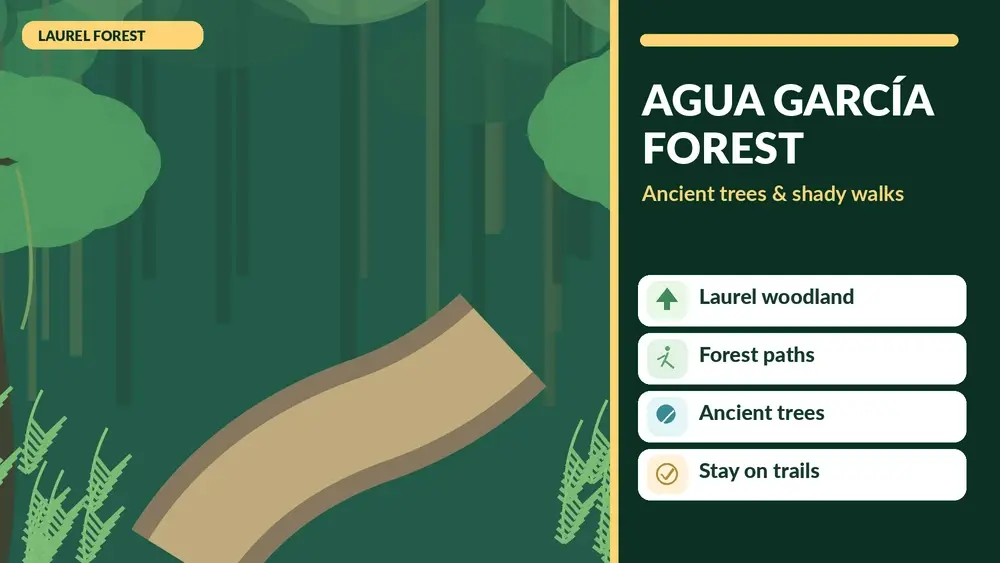
  • Agua García Forest Guide: Ancient Laurisilva and Easy Walks in Tacoronte

    Agua García Forest Guide: Ancient Laurisilva and Easy Walks in Tacoronte

    Agua García is one of the easiest places in north Tenerife to experience monteverde without committing to a long mountain hike. The forest lies in Tacoronte, within the protected Las Lagunetas landscape, and combines laurel-forest vegetation, short interpreted paths, old water infrastructure and the unusual Cuevas de Toledo. It is a very different experience from the dramatic ridges of Anaga: quieter, softer and more focused on the relationship between forest and water.

    Turismo de Tenerife describes Agua García as one of the important surviving areas of laurisilva in the Canary Islands and notes its Heritage Information Centre. Tacoronte’s tourism site adds two especially useful routes: an accessible 500-metre trail and the circular Route of the Centennial Guardians, with short and long options of 1 km and 2 km.

    Quick planning facts

    Municipality Tacoronte
    Protected landscape Las Lagunetas
    Main habitat Monteverde / laurisilva
    Accessible trail 500 m on the current Tacoronte tourism page
    Centennial Guardians route 1 km short option / 2 km long option
    Difficulty Low on the municipal route descriptions
    Interesting feature Cuevas de Toledo and ancient viñátigo trees
    Best for Families, easy walking, forest atmosphere, natural history

    Why the forest matters

    Monteverde is an evergreen cloud-forest system that depends on humid trade winds. The forest catches moisture from passing cloud and creates a cool environment of laurels, viñátigos, ferns, mosses and other species adapted to relatively stable moisture. In practical terms, this means Agua García can feel damp and fresh when the coast is bright and warm.

    The forest is also culturally important because water shaped settlement and agriculture in the north. The Madre del Agua and old galleries remind me that the landscape is not only “natural”; it has been used, managed and negotiated by communities for centuries.

    The Route of the Centennial Guardians

    Tacoronte’s official tourism site lists a short 1 km and long 2 km version, both circular and low difficulty. The name refers to old viñátigo trees along the route. One of the best-known specimens is the Viñátigo de la Cuna, which the municipal site says may be between 800 and 1,000 years old.

    I take the age estimate as a reason to slow down, not as an invitation to touch roots or climb around the tree. Ancient trees survive because people give them space. The route also reaches the Cuevas de Toledo, excavated from the sixteenth century for trachyte extraction associated with glass production.

    The accessible path

    The current Tacoronte Travel page describes the accessible Agua García trail as 500 metres long with four interpreted stops. That makes it useful for travellers who want a short forest experience without the climbs found in many Tenerife walks. “Accessible” still does not mean every mobility need is identical, so I verify surface conditions and facilities if travelling with a wheelchair or mobility device.

    For a broader island overview, my accessible Tenerife guide helps compare beaches, attractions and transport as well as trails.

    Cuevas de Toledo: history inside the forest

    The Cuevas de Toledo, sometimes called glass caves, add an unexpected historical layer. The municipal tourism site explains that they were excavated in the sixteenth century to obtain trachyte. I would not enter any unapproved cavity or leave the signed route; the interest is in understanding how extraction and water management once shaped this forest.

    Best conditions for a visit

    I actually like Agua García when there is light cloud because the forest looks more atmospheric and the vegetation benefits from that humidity. Heavy rain is different: paths can become slippery and visibility on the approach can worsen. I check local conditions, not the forecast for Costa Adeje, before leaving.

    Morning is my preferred time if I want quiet paths. The forest can also be a good backup when higher mountains are windy or the coast is too hot, provided there are no weather warnings affecting the north.

    How to combine Agua García with Tacoronte

    The easiest pairing is with Tacoronte’s historic centre, agricultural market or the Tacoronte-Acentejo wine landscape. This creates a day that connects forest, farming and food without long drives. My Tacoronte and El Sauzal guide gives the wider context.

    I would not combine Agua García with a full Anaga hike on the same day unless hiking is the main objective. The forest deserves enough time to walk slowly and notice details rather than being treated as a 20-minute roadside stop.

    Official information I check

    For the protected forest overview I use Turismo de Tenerife’s Agua García page. For the Centennial Guardians and accessible routes, Tacoronte Travel provides the current municipal descriptions. I recheck them because trail maintenance can change short-route access.

    How I fit it into a Tenerife itinerary

    I would not cross the island just to collect a quick photograph of Agua García. I place it inside a coherent north Tenerife day, give it enough time to understand the setting and then add only one or two nearby stops. This approach matters in Tenerife because mountain roads, parking and microclimates can turn a short distance into a slow journey. It also makes small villages and local neighbourhoods feel less like attractions and more like places with their own rhythm.

    A sensible cluster is Tacoronte historic centre, the farmers’ market and El Sauzal. I check the route before leaving, save the main parking or bus information offline and keep one optional stop that can be removed. For the wider area, I use my Tacoronte and El Sauzal guide so the day has a clear geographic logic instead of zig-zagging across the island.

    Driving, buses and parking strategy

    On rural roads I assume the final kilometres will take longer than navigation apps suggest. I keep to my lane, use safe pull-outs only, and never stop on a bend simply because a viewpoint looks attractive. If the destination has limited parking, arriving earlier is usually more useful than trying to find a “secret” space. I also avoid blocking house entrances, agricultural tracks, bus stops and emergency access.

    Public transport can be a good option for some north Tenerife days, but I verify the current TITSA timetable rather than relying on an old screenshot or blog. I identify the final practical return service before starting a walk. My Tenerife bus guide explains the ten+ system and the planning habits I use when I travel without a car.

    Weather and what I carry

    I pack for the exact environment rather than for the temperature at my hotel. In the north and in Anaga, cloud, wind and light rain can appear even when the south is sunny. On the coast, the Atlantic can be rough despite warm air temperatures. My basic kit is water, sun protection, a charged phone, a light layer and footwear appropriate to the surface. For rural walks I add a thin waterproof layer and a little more water than I think I will need.

    The island-wide forecast is only a starting point. I compare the coast, the hills and higher elevations separately and use my Tenerife weather by month guide to understand why the same day can feel very different across the island.

    Responsible travel in a lived-in place

    Agua García is not a theme park. I keep noise low near homes, stay on marked paths, take rubbish away and ask before photographing people at close range. In agricultural areas I never enter terraces or fields to improve a photograph. Small decisions like buying a coffee, lunch or local product from an open business can also make the visit more connected to the community without turning local life into a performance for visitors.

    I also treat closures and temporary restrictions as part of the destination, not an inconvenience to bypass. Fire risk, storm damage, rockfall or maintenance can change access. If a road, beach or trail is closed, I use the backup plan and move on.

    Frequently asked questions

    Is Agua García suitable for children?

    For families comfortable on forest paths, the short interpreted routes can be an excellent choice. I still supervise children around slopes, roots and any historic cavities.

    Is it the same as Anaga?

    No. Both contain monteverde vegetation, but Agua García is in Tacoronte within the Las Lagunetas protected landscape. It offers a quieter, compact forest experience compared with Anaga’s larger mountain network.

    How long should I stay?

    For the short route and a relaxed look around, I would allow 60–90 minutes. A longer visit can include both loops, the information centre and time in Tacoronte.

    Final thoughts

    Agua García is one of my favourite types of Tenerife stop: small in distance but rich in context. A few kilometres of forest reveal ancient trees, water history, old extraction sites and the cloud-dependent ecology of the north. I would come for the cool air and easy walking, then stay long enough to understand why the forest exists at all.

    A slower way to experience the area

    I leave room for unplanned time because the best part of rural Tenerife is often not the named attraction. A cloud opening over a ridge, a short conversation in a bar, a view from a legal pull-out or the smell of wet forest can become the memory of the day. If every fifteen minutes is assigned to a stop, I end up watching the clock instead of the place.

    I also avoid building two demanding mountain objectives into the same day. Even if each route looks short, the combination of driving, elevation, parking and changing weather creates fatigue. One main walk plus one village or viewpoint is usually my preferred balance.

    Navigation and phone coverage

    I download the route and essential map area before leaving accommodation. Mountain valleys can have patchy mobile coverage, and battery drains faster when a phone searches constantly for signal. I carry a power bank on longer days and keep the official trail name or destination written down so I can ask for help clearly if needed.

    For hikes, I use official signed routes as the primary reference and treat community GPX tracks as secondary information. A line on a mapping app may cross private land, an old path or a closed section. If signage and the downloaded track disagree, I stop and reassess rather than force the digital route.

    Food, water and toilets

    Small villages are not guaranteed service stations. I carry enough water to complete the main activity even if the local bar is closed, and I use toilets when I have a legitimate opportunity rather than assuming the next viewpoint will have facilities. I also bring a small rubbish bag because bins are limited on many rural routes.

    When a village restaurant is open, I prefer to eat there rather than carry an elaborate picnic into a fragile landscape. It supports a local business and gives the day a natural pause. I still carry emergency snacks so a closed kitchen never becomes a safety problem.

  • Tenerife Travel Guide: Everything I Would Know Before a First Trip

    Tenerife Travel Guide: Everything I Would Know Before a First Trip

    Tenerife is one of those islands that looks simple on a map and becomes much more varied as soon as you start exploring it. The sunny resorts of the south, the green valleys of the north, the volcanic highlands around Mount Teide, historic towns such as La Laguna and small coastal villages can feel like different destinations within the same holiday. That contrast is exactly why I think a first trip works best when you plan around experiences rather than trying to stay in one resort for the entire time.

    This guide is the starting point I would use for a first Tenerife holiday. It covers where to base yourself, how long to stay, the places that deserve priority, transport choices, beaches, food, weather and the practical details that make the island easier to enjoy. For deeper planning, I have linked the specialist guides throughout the article so you can build a trip that suits your pace rather than follow a rigid checklist.

    Tenerife at a glance: what kind of destination is it?

    Tenerife is the largest of the Canary Islands and its appeal goes well beyond winter sun. The south is generally drier and sunnier, which helps explain the popularity of Costa Adeje, Playa de las Américas and Los Cristianos. The north is greener, more humid and often feels more local, with Puerto de la Cruz, La Orotava and the fertile Orotava Valley as natural bases. Higher up, the landscape changes completely: pine forest gives way to the extraordinary volcanic scenery of Teide National Park.

    For most travellers, the island is best understood as a combination of four experiences: coast, volcano, historic towns and nature. If you include all four, Tenerife feels much richer than a standard resort break. Families can add water parks and easy beaches, hikers can spend several days in Anaga or Teno, and food-focused travellers can build days around guachinches, markets, wineries and traditional Canarian dishes.

    How many days do you need in Tenerife?

    A long weekend is enough for sunshine and one or two highlights, but it is not enough to understand the island. For a first visit I would aim for seven days. That gives you time for a Teide day, an Anaga or La Laguna day, at least one north-coast excursion, several beach periods and a flexible day for weather changes. With ten to fourteen days you can slow the pace, add Teno, Garachico, whale watching, more hiking and a day trip to another Canary Island.

    Trip lengthWhat it suitsSuggested priorities
    3–4 daysShort escapeSouth coast, Teide, one scenic day
    7 daysFirst complete visitSouth + Teide + north + Anaga + beaches
    10–14 daysSlow travelAdd Teno, hiking, villages, food and boat trips

    If you already know you want a balanced first week, use my 7-day Tenerife itinerary as a practical day-by-day framework.

    Where to stay on a first trip

    Choosing the right base matters more in Tenerife than many first-time visitors expect. If reliable beach weather, restaurants and easy tourist services are the priority, Costa Adeje is the safest all-round choice. Los Cristianos works well for a walkable resort atmosphere and ferry connections, while Playa de las Américas is better if nightlife matters. For a more traditional city-and-sea combination, Puerto de la Cruz is attractive, especially if you plan to explore the north.

    I would not choose accommodation only by hotel rating. Look at the exact neighbourhood, gradient, parking situation and walking distance to the places you will actually use. Tenerife has steep areas, and a property that seems close to the sea on a map can involve a demanding uphill return. My detailed where to stay in Tenerife guide compares the main bases by travel style. You can also check current hotel prices in Tenerife once you have chosen the right area.

    The places I would prioritise

    1. Teide National Park

    Mount Teide is not just a single viewpoint. The whole high-altitude landscape is one of Tenerife’s defining experiences: lava fields, strange rock formations, immense caldera scenery and rapidly changing light. Even if you do not hike to the summit, driving through the park and stopping at viewpoints is worth the journey. The cable car can take visitors to La Rambleta at about 3,555 metres, but summit access and some high-mountain trails have separate reservation requirements. Always check the current rules before travelling.

    View Across Tenerife Valley Toward Mount Teide

    2. San Cristóbal de La Laguna and Anaga

    La Laguna is one of the island’s best cultural stops and combines naturally with Anaga Rural Park. I like this pairing because the day moves from colourful historic streets and cafés to laurel forest, ridges and remote coastal scenery. Weather can change quickly in Anaga, so carry a light layer even when the coast is warm.

    3. The north coast: La Orotava, Garachico and Puerto de la Cruz

    The north offers some of the strongest contrasts with the resort south. La Orotava has historic architecture and hillside views; Garachico is known for its volcanic coastline and natural pools; Puerto de la Cruz mixes an older resort tradition with gardens, seafront walks and easy access to the Orotava Valley. These places are especially rewarding if you enjoy wandering rather than moving from attraction to attraction.

    4. Los Gigantes and Teno

    The cliffs of Los Gigantes create one of Tenerife’s most dramatic coastal landscapes. The western side of the island also gives access to Teno, Masca and several viewpoints where the terrain feels rugged and remote. Roads can be slow and winding, so I treat this as a full excursion rather than something to squeeze into a beach afternoon.

    Beaches: do not expect only golden sand

    Tenerife’s volcanic origin is visible on the coast. Some of its most memorable beaches have dark sand or pebbles, while several popular tourist beaches have lighter sand and extensive services. Playa de Las Teresitas near Santa Cruz is very different from Playa del Duque in Costa Adeje, El Médano in the southeast or the wild northern beaches beneath Anaga. The best beach depends on whether you want calm water, family facilities, surf, scenery or a local atmosphere.

    Ocean conditions matter. The Atlantic can be powerful, and a beach that looks inviting may have currents or waves that make swimming unsafe. Respect flags and local warnings, especially at less-developed beaches. I compare the most useful options in the best beaches in Tenerife guide.

    Getting around: car or public transport?

    A rental car gives the most flexibility, especially for Teide, viewpoints, small villages and multi-stop days. It also lets you change plans when cloud covers one side of the island. The downside is parking in busy resorts, historic centres and popular natural areas. If you do not want to drive, Tenerife’s TITSA bus network is extensive and connects the airports, major towns and tourist areas. The ten+ system includes tourist travelcards and stored-value options; current fares should always be checked on the official TITSA website.

    Aerial View Of Tenerife Resort Coast

    For a first trip, I often think the best solution is hybrid: use a car for a few exploration days and walk, bus or taxi on resort days. My getting around Tenerife guide explains the practical differences, including the two airports.

    Weather and the north–south difference

    Tenerife’s famous mild climate is real, but ‘eternal spring’ can be misunderstood. The island has strong microclimates. The south generally gets more sunshine and is drier, while the north is greener and more humid. In the mountains, conditions can be dramatically colder than at sea level. Official tourism information describes average conditions as mild year-round, with coastal temperatures roughly in the high teens in winter and the mid-to-high twenties in the warmest months.

    Pack for layers rather than one climate. Beachwear can be perfect in Costa Adeje while a fleece or windproof layer is useful near Teide. If you are choosing travel dates, see my best time to visit Tenerife guide for seasons, crowds and trip styles.

    What to eat in Tenerife

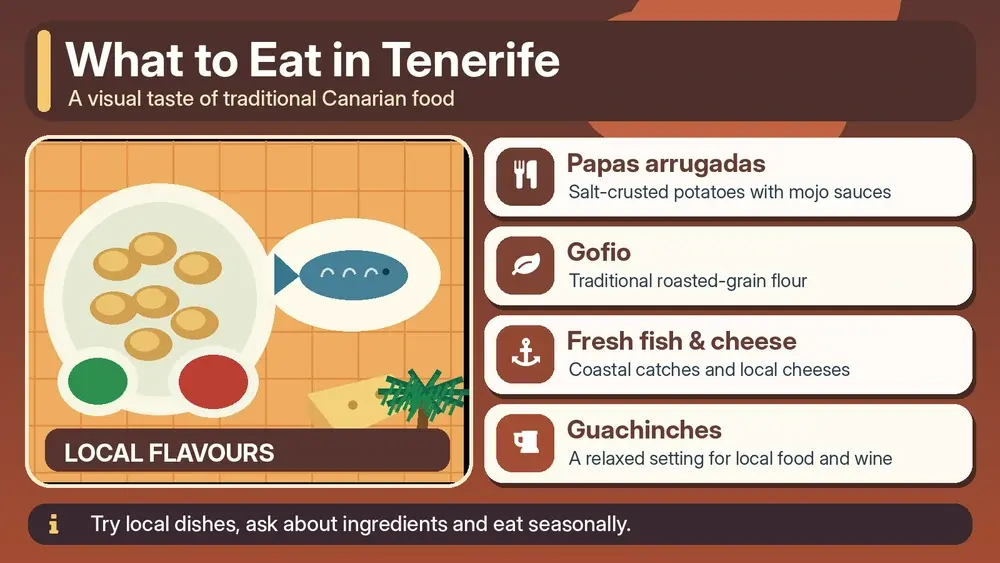
    Do not spend the whole holiday inside international resort menus. Traditional food is one of the easiest ways to make a Tenerife trip feel more distinctive. Look for papas arrugadas with mojo, grilled fish, octopus, goat dishes, Canarian cheeses, gofio-based recipes and local wines. Guachinches—traditionally simple establishments associated with local wine—are especially linked with the north, although the term is now used more broadly.

    A good strategy is to keep resort meals convenient when you need them, then deliberately plan two or three food-focused stops elsewhere. The Tenerife food guide explains dishes, ordering tips and the kinds of places I look for.

    Illustrated guide: What to Eat in Tenerife, with practical visitor tips
    Illustrated guide: What to Eat in Tenerife.

    Tenerife for families, couples and active travellers

    Families usually appreciate the south because of the concentration of accommodation, beaches and attractions, but the island also offers easy nature walks, botanical gardens, boat trips and volcanic landscapes that work well with children. Couples can mix resort comfort with sunsets, wine country and quieter northern towns. Active travellers have hiking, cycling, diving, surfing, paragliding and high-altitude routes. The important point is not to assume one part of the island has to provide everything.

    For parents, my Tenerife with kids guide focuses on realistic driving times, beach choices, altitude, heat and balancing big attractions with easier days. Hikers should continue with the hiking and nature guide.

    My practical planning rules for a smoother first trip

    • Do not schedule Teide on the only day you can visit: mountain weather and cable-car operations can change.
    • Keep at least one flexible day so you can follow the better weather between north and south.
    • Download offline maps before mountain drives and hikes.
    • Book high-demand activities and regulated hiking access in advance, but avoid overbooking every day.
    • Carry water, sun protection and a warm layer in the car; altitude changes the conditions quickly.
    • Treat driving times on mountain roads as estimates, not promises.
    • Choose accommodation for location first and hotel facilities second.
    • Respect beach flags, protected areas and trail closures even when other visitors appear to ignore them.

    Useful official resources

    For changing conditions, I rely on official sources rather than old screenshots or social-media comments. Check Tenerife ON for regulated nature access and trail information, TITSA for buses, and the official Tenerife tourism website for destination information. For flights, Aena operates both Tenerife South (TFS) and Tenerife North–Ciudad de La Laguna (TFN).

    A simple first-trip formula

    If I were building a first Tenerife holiday from zero, I would choose one convenient base, reserve a full day for Teide, one day for La Laguna and Anaga, one north-coast day, one west-coast day and keep the remaining time for beaches, food and spontaneous stops. That is enough structure to see the island’s range without turning the holiday into a race. The biggest mistake is not missing a specific attraction; it is spending seven days in one resort and assuming you have seen Tenerife.

    Once you know the style of trip you want, move next to the 7-day itinerary, accommodation and transport guides linked above. Together, those three decisions—where you stay, how you move and which days you keep flexible—have a bigger effect on the quality of a Tenerife holiday than any long list of must-see places.