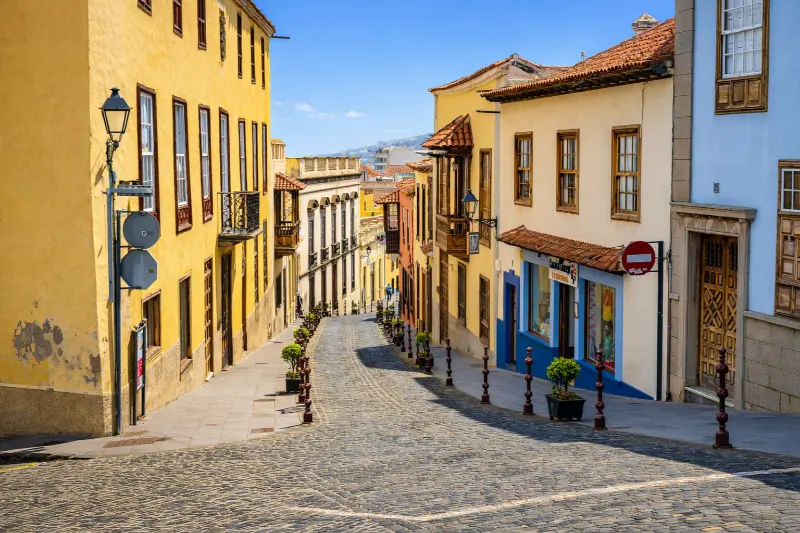
Iglesia de Santo Domingo is one of the La Orotava churches I would choose when I want to understand the town’s convent history rather than only its most famous façade. Municipal heritage information traces the Dominican complex to the seventeenth century, built over the earlier hermitage of San Benito Abad. The church expanded over time, while its tower was completed in 1794. The adjoining former convent now houses the Museo de Artesanía Iberoamericana, so this is an unusually efficient place to connect architecture, religious art and the town’s wider cultural collections.
Quick visit facts
| Location | La Orotava historic centre, beside MAIT |
|---|---|
| Origin | Dominican convent complex on the site of the earlier San Benito hermitage |
| Main period | 17th century with later additions |
| Tower | Completed in 1794 |
| Nearby museum | Former convent houses the Museo de Artesanía Iberoamericana (MAIT) |
A convent church that grew over time
The earliest seventeenth-century church had a simpler Latin-cross plan. Over the following decades additional naves and chapels expanded the building, creating the more complex interior seen today. This gradual growth is typical of successful religious institutions that accumulated patrons, confraternities and devotional needs.
The tower is especially important because local heritage material identifies it as the only surviving example of a tower associated with a convent church in this context. It also forms one of La Orotava’s recognisable skyline combinations with the towers of La Concepción.
Art inside the church
Municipal descriptions highlight devotional sculptures such as Jesús Nazareno, San Juan, La Dolorosa and the Virgen del Rosario. The carved and polychrome pulpit is attributed to Antonio de Orbarán, while important paintings include a Flemish panel of the Virgin of Consolation and works by Canarian artists.
I use those works to see the church as a collection built through centuries rather than a perfectly unified interior. Different styles and dates reflect changing tastes and the dispersal of art after the confiscation of religious property.
The connection with MAIT
The former Dominican convent is now home to the Museo de Artesanía Iberoamericana. That makes Santo Domingo one of the best places to build a thematic visit: first the church and convent history, then craft traditions and transatlantic cultural links inside the museum.
I would not rush both. If MAIT is open, I allow at least another hour so the museum does not become an afterthought.
Best way to include it
I place Santo Domingo on the lower side of a La Orotava historic-centre loop, then continue uphill toward La Concepción and the traditional houses. The slope is noticeable, so I build in a café or garden stop rather than schedule a continuous chain of interiors.
Because the church remains active, I check local access and respect services. The exterior and tower are still worth seeing even when the doors are closed.
How I plan this stop without overloading the day
I get more from small Tenerife attractions when I place them inside a compact area rather than drive across the island for a single doorway, garden or viewpoint. My rule is one anchor attraction, two nearby secondary stops and enough unscheduled time for a café, a market or an unexpected street. That is especially useful in historic towns, where the best details are often between the official sights.
I also separate permanent facts from operational information. Architecture, landscape and historical context change slowly; opening hours, ticket prices, access rules and temporary works can change quickly. I therefore recheck the official page close to the visit, particularly if entry to an interior is essential to the day.
Getting there and parking
In historic centres I normally park once and walk. Narrow streets, one-way systems and limited spaces can make repeated short car moves slower than simply continuing on foot. For rural or edge-of-town attractions I check the final approach on a map before leaving, because the closest bus stop or parking pin can still involve a short walk on uneven ground.
When I use public transport, I look at the return connection before I arrive rather than when the attraction closes. This matters most on weekends and around rural sites where frequency may be lower. I keep a little margin between the official closing time and the last practical connection.
Accessibility, children and pace
I never assume a heritage building is step-free because the entrance looks level in photographs. Old thresholds, internal staircases, steep garden terraces and cobbled streets can all matter. If wheelchair access or a pushchair route is essential, I confirm it directly with the venue. For families, I shorten the historical explanation to one strong story and alternate indoor stops with a garden, square or snack break.
What I bring
Even for an urban visit I carry water, sun protection and a light layer. North Tenerife can change from bright sun to cloud surprisingly quickly, while south-coast agricultural visits can feel hot even in winter. Comfortable footwear matters more than it seems because a day of short museum and church stops can still add up to several kilometres of walking.
Common mistakes I avoid
- Trusting an old review instead of the current official source.
- Assuming every protected historic building has regular interior access.
- Driving between attractions that are only a few minutes apart on foot.
- Scheduling too many similar interiors in a row.
- Arriving just before closing when the site needs at least 45–60 minutes.
- Forgetting that religious buildings remain active places of worship.
What I would combine nearby
These combinations keep the day geographically coherent and reduce unnecessary driving. I prefer a route where each stop adds a different layer—architecture, landscape, local food or everyday culture—rather than repeating the same type of attraction several times.
Where I would stay
If I wanted more than a quick day trip, I would compare accommodation in La Orotava. Staying locally is useful when I want early streets, a slower dinner and enough time to see several nearby places without turning the day into a motorway itinerary.

Official information
For current access, opening times, temporary closures and event information I check La Orotava municipal heritage page shortly before travelling. I treat this as the final word for operational details because schedules can change after publication.
Frequently asked questions
When was Santo Domingo built?
The convent church developed mainly during the seventeenth century, with later additions; the tower was completed in 1794.
What is in the former convent today?
The former convent houses the Museo de Artesanía Iberoamericana, MAIT.
Is it worth visiting if the church is closed?
Yes. The exterior, tower and relationship with the former convent still make sense as part of a historic-centre route.
How long should I allow?
Around 20–40 minutes for the church, plus at least an hour if I also visit MAIT.
How I photograph and observe the place
I try not to make photography the only purpose of the stop. I first walk through once without constantly raising the phone, then return to the details that best explain the site: a façade seen from across the street, a change of level in a garden, the relationship between a church and its square, or the working structure of an agricultural property. This usually produces better pictures and a better memory of the visit.
When people are worshipping, working or guiding a group, I give them priority. I do not use flash in religious interiors unless it is explicitly permitted, and on farms I stay on marked routes rather than stepping into planted areas for a cleaner composition.
How this stop fits different travel styles
For a first-time visitor, I would use the place as part of a broad introduction to the area rather than build an entire day around one small attraction. Repeat visitors can go deeper, pairing it with specialist museums, neighbourhood streets or local food. Travellers without a car should prioritise clusters where several worthwhile stops are reachable on foot, while drivers can use the attraction as a bridge between towns.
On a short Tenerife trip I keep the schedule selective. On a two-week stay I am much more willing to spend a morning on small museums, gardens and heritage buildings because they reveal the island beyond the headline sights. That slower layer is often what makes a second or third visit feel genuinely different.
Weather and seasonal considerations
Tenerife’s microclimates matter even for culture days. La Orotava, Icod and La Laguna can be cooler or cloudier than the southern resorts, so I carry a light layer. Outdoor gardens and viewpoints are more rewarding in clear weather, while museums and churches become useful alternatives when cloud or showers move in.
During local festivals, religious celebrations and school holidays, normal access can change. A closed street is not necessarily a problem—it may be part of a valuable local event—but I allow extra time and avoid assuming parking or interior access will work exactly as on an ordinary weekday.
Final thoughts
Iglesia de Santo Domingo La Orotava is most rewarding when I use it to understand a wider part of Tenerife rather than treat it as another box to tick. I would give the place enough time for its context to emerge, connect it with nearby stops and keep the practical plan flexible enough to respond to weather, access or local events.