
Tenerife is one of the best Canary Islands for building an island-hopping trip because ferries connect it directly with several neighbours. The important detail is that not every route uses the same Tenerife port. Los Cristianos is central for La Gomera and La Palma on major services, while Santa Cruz is important for Gran Canaria and longer connections.
Current Fred. Olsen route information lists direct fast-ferry links from Tenerife to La Gomera in about 50 minutes, Gran Canaria in about 80 minutes and La Palma in about 150 minutes. Schedules, ships and operators can change, so I treat those as current planning figures rather than permanent promises.
The two Tenerife ports I plan around
Los Cristianos
For travellers staying in the south, Los Cristianos is extremely convenient. Major fast-ferry services connect it with San Sebastián de La Gomera and Santa Cruz de La Palma. I still arrive early because the port area can be busy and boarding deadlines matter.
Santa Cruz de Tenerife
Santa Cruz is the main port for Gran Canaria fast-ferry services to Agaete and for some longer routes. If I am staying in Costa Adeje, I factor the cross-island transfer into the total journey rather than looking only at sailing time.
Tenerife to La Gomera
This is the easiest island-hopping add-on for many south-Tenerife visitors. Current Fred. Olsen information lists the direct Los Cristianos–San Sebastián crossing at around 50 minutes. That makes a day trip possible, although I prefer an overnight stay if I want to experience Garajonay and multiple parts of La Gomera without rushing.
My La Gomera day trip guide explains the trade-off between independent ferry travel and organised tours.
Tenerife to Gran Canaria
Current fast-ferry information lists Santa Cruz de Tenerife to Agaete at around 80 minutes. The sailing is short enough for island hopping, but a same-day sightseeing trip becomes less simple once I add transfers from Agaete to Las Palmas or other parts of Gran Canaria.
If I am moving hotels between islands, the ferry can be excellent because I can take more luggage and, on eligible sailings, a rental or private vehicle subject to the rental company’s rules. I never assume a rental car may leave Tenerife without explicit permission.
Tenerife to La Palma
Current Fred. Olsen route information lists Los Cristianos to Santa Cruz de La Palma at about 150 minutes. I see this as an overnight or multi-day connection rather than a casual day trip. La Palma deserves time, and the sailing itself uses a meaningful part of the day.
Tenerife to El Hierro and other islands
Connections to El Hierro and some farther islands can be direct or involve specific schedules and operators. I check both Fred. Olsen Express and Naviera Armas for the exact date. Routes and frequency can change seasonally, so I avoid publishing a rigid timetable inside my personal plan.
Ferry with a car
Taking a car can be useful for island hopping, but I check three separate things: ferry vehicle availability, rental-company permission and insurance conditions. A cheap rental rate means nothing if the contract prohibits inter-island transport.
I also arrive earlier with a vehicle because check-in and loading take more time than travelling as a foot passenger.
Foot passenger or car?
For La Gomera, a car is helpful if I want independent access to mountain roads, but an organised day tour can be easier for a single day. For Gran Canaria or La Palma, I decide based on where I will sleep and how much of the island I want to explore.
Seasickness
Fast ferries are comfortable for many people, but Atlantic conditions vary. If I am prone to motion sickness, I choose a seat where movement feels more manageable, avoid a heavy meal immediately before departure and ask a pharmacist or doctor about appropriate medication rather than relying on random travel advice.
How early I arrive
I follow the operator’s current check-in rules and add a buffer, especially with a car or during holiday periods. Port parking and traffic can be the real source of stress, not the sailing itself. I never schedule an airport arrival and ferry departure so tightly that a small flight delay ruins the connection.
Luggage
Ferries can be easier than flights for luggage, but each operator still has rules. I label bags, keep medicines and valuables with me and avoid packing something I cannot move comfortably through a terminal.
Booking strategy
- Check both main operators for the date and route.
- Compare the total door-to-door journey, not only sailing time.
- Book earlier if travelling with a vehicle or during busy holiday periods.
- Read fare-change and refund conditions before paying.
- Save the booking offline and verify the departure port carefully.
A common Tenerife port mistake
The biggest planning error is assuming every ferry leaves from Los Cristianos. A route to Gran Canaria may use Santa Cruz, while La Gomera services commonly use Los Cristianos. Those ports are far apart. I confirm the exact terminal before booking accommodation, buses or transfers.
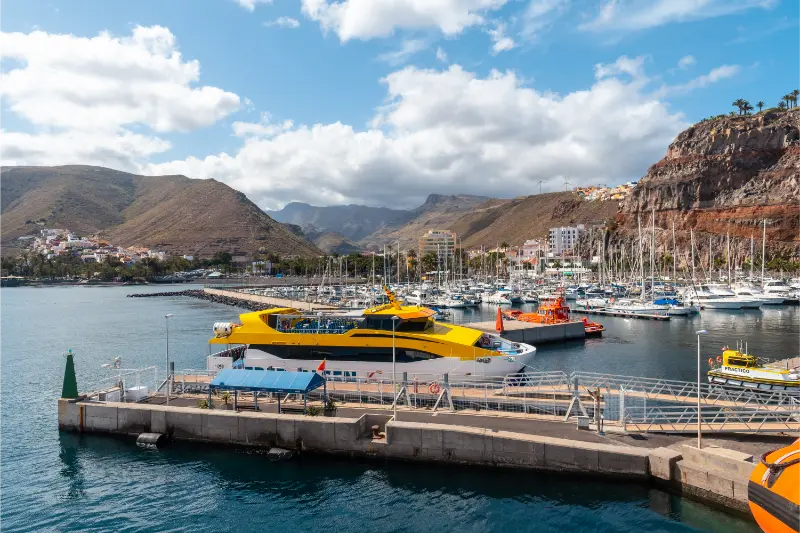
Combining ferry and airport travel
I leave a large margin if a ferry connects with a same-day flight. Wind, sea conditions, traffic and baggage all add uncertainty. If missing the flight would be expensive, an overnight buffer is often worth more than squeezing out one extra holiday evening.
Common mistakes
- Looking only at crossing time and ignoring transfer time.
- Going to the wrong Tenerife port.
- Assuming a rental car can travel between islands.
- Booking a very tight ferry-to-flight connection.
- Ignoring vehicle check-in deadlines.
- Treating a distant island as a comfortable day trip just because the sailing looks short.
Frequently asked questions
How long is Tenerife to La Gomera by fast ferry?
Current Fred. Olsen information lists the direct Los Cristianos to San Sebastián crossing at about 50 minutes.
How long is Tenerife to Gran Canaria?
Current Fred. Olsen information lists Santa Cruz de Tenerife to Agaete at around 80 minutes.
How long is Tenerife to La Palma?
Current route information lists Los Cristianos to Santa Cruz de La Palma at around 150 minutes.

Can I take a rental car?
Only if the rental contract allows it. I obtain explicit permission before booking a vehicle space on the ferry.
My final take
Ferries turn Tenerife from a single-island holiday into a flexible Canary Islands journey. I compare ports, schedules and total travel time, then choose the route that fits the trip. The key is simple: plan the ferry as a transport day, not just a crossing time.
Building margin into transport days
I leave more time than the timetable suggests whenever a connection matters. A bus can meet traffic, a ferry can board earlier than I expected, and finding the correct stop or terminal can take time in an unfamiliar place. Extra margin feels inefficient on paper but makes the day calmer and protects expensive connections.
When I would pay for a taxi instead
Public transport is excellent when it fits the route. I switch to a taxi or prebooked transfer when I arrive very late, have heavy luggage, travel with a tired child, need to reach a remote accommodation or face a connection whose cost is much higher than the taxi fare. The cheapest option is not always the best value when missed time and stress are included.
Tickets, screenshots and offline backups
I keep the booking reference, ticket or travelcard information available offline. Ports, airports and rural stops are exactly the places where I do not want my plan to depend on a weak signal. For bus days I save stop names and the latest return time; for ferries I save the terminal, check-in deadline and booking locator. A few screenshots remove a surprising amount of stress.
What I do when transport changes
If a service is delayed or cancelled, I first protect the most important connection rather than trying to preserve every sightseeing plan. I check the operator, identify the next realistic option and only then decide what to do with the spare time. This prevents a small disruption from becoming a chain of rushed decisions across the rest of the day.
Budgeting transport honestly
I compare total cost, not just the headline fare. A cheap ticket can require a taxi to the terminal, luggage storage, a long transfer or an extra hotel night. Sometimes public transport remains clearly cheaper; sometimes a direct taxi or organised excursion is better value for two or three people. I include time and convenience in the calculation because holiday hours have value too.
A final planning check before I leave
The evening before this day, I verify the weather, current access information, transport, opening details where relevant and the amount of daylight I have. I save essential information offline and tell someone in my group what the main plan is. I also decide in advance what would make me switch to the backup plan. That small amount of preparation lets me enjoy Tenerife more spontaneously once I am actually there, because the important risks and logistics have already been considered.
Practical details I confirm on the day
Before leaving my accommodation I recheck the latest official information that could affect the plan: weather, road conditions, trail or beach access, public-transport times and any temporary restrictions. Tenerife changes quickly between coast, forest and high mountains, so yesterday’s conditions are not enough. I also make sure the phone is charged, essential addresses are saved offline and everyone in the group knows the backup plan. If the main activity depends on sea state, cloud, wind or a connection, I keep one nearby alternative that does not require a complicated detour. This simple routine helps me avoid turning a small change into a stressful day and makes the itinerary more resilient without removing spontaneity.