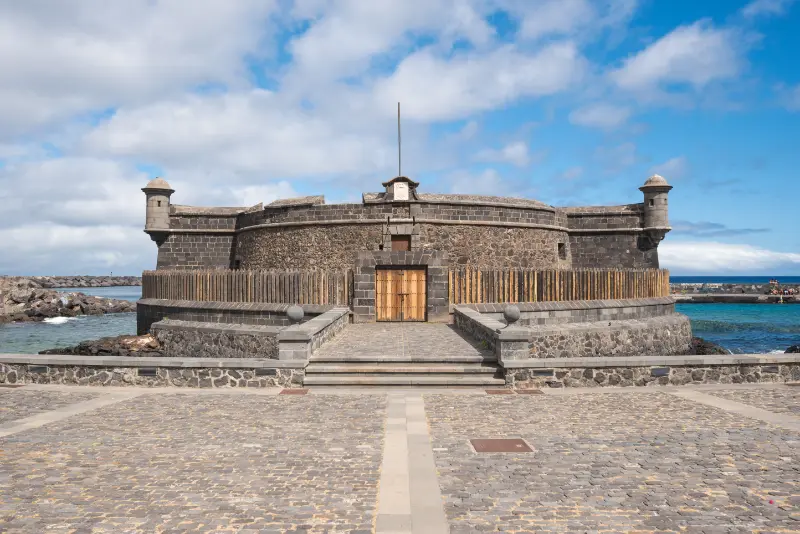
Castillo de San Juan Bautista (Castillo Negro) is the compact circular fort that sits between some of Santa Cruz’s most modern landmarks. The contrast is the reason I like the stop: a seventeenth-century coastal defence beside the Auditorio, Parque Marítimo and Palmetum makes the city’s layers visible in a single walk.
The Santa Cruz heritage service says construction began in the 1640s and that the fort took its present appearance after eighteenth-century remodelling. Turismo de Tenerife describes it as the best-preserved castle on the island. I would plan primarily for an exterior heritage stop unless an official event specifically advertises interior access.
Quick practical facts
| Also known as | Castillo Negro |
|---|---|
| Location | Avenida de la Constitución, Santa Cruz de Tenerife |
| Original construction | 1641–1643/44 period |
| Major later remodelling | 1765–1767 |
| Heritage status | Protected historic monument / BIC context |
| Best combined with | Auditorio, Parque Marítimo César Manrique, Palmetum |
Why I would give Castillo de San Juan Bautista (Castillo Negro) its own stop
Santa Cruz can feel like a city of twentieth- and twenty-first-century architecture when a visitor concentrates on the seafront. Castillo Negro interrupts that impression. Its low volcanic-stone form is evidence of the defensive coastline that existed long before the current avenues and cultural buildings.
The stop is also efficient. I do not need a dedicated taxi ride or a half day; it belongs naturally in a walking route between the Auditorio, the maritime park and Palmetum.
What to look for once you are there
The circular military form
The fort was designed for coastal defence rather than ceremony. Its compact round mass is especially striking against the sweeping forms of the Auditorio nearby.
Volcanic masonry
The dark stone helps explain the popular name visually, although the city heritage page notes that the name is also associated with the old place-name Caleta de los Negros.
The seafront contrast
This is one of the best places in Santa Cruz to photograph different periods of the city in one frame: fortification, modern cultural architecture, leisure pools and port infrastructure.
The Nelson-era defensive story
Santa Cruz’s forts belong to the wider military history of the port, including the failed British attack led by Admiral Nelson in 1797. I use Castillo Negro as a starting point and the Castillo de San Cristóbal interpretation centre for the deeper Nelson story.
The context that makes the visit more interesting
Santa Cruz grew around a strategic harbour. Coastal batteries and forts were not decorative architecture; they responded to the vulnerability of an Atlantic port connected to imperial trade routes.
The city’s heritage service explains that San Juan Bautista was built to defend this section of coast and was financed and maintained within the island’s defensive system. Its later remodelling produced much of the appearance visitors see today.
I avoid simplifying the name “Castillo Negro” into a certainty about black stone. Official local heritage material points to the historic toponym Caleta de los Negros as a likely origin, which is a good example of why place names deserve more care than a quick caption.

How I would plan the visit
I would see the fort after the Auditorio de Tenerife and before or after the maritime park. The walking sequence makes the architecture itself part of the story.
For the defensive history of central Santa Cruz, I would also add the Castillo de San Cristóbal guide under Plaza de España on the same or another day.
How much time to allow
Ten to twenty minutes is enough for a simple exterior stop. If a heritage event opens the interior, I would follow that event’s timetable rather than assume regular access.
As part of a seafront architecture walk, I would allow two to four hours because Palmetum, the Auditorio and Parque Marítimo can each become a substantial visit.
Getting there without turning the visit into a transport problem
The fort is on Avenida de la Constitución in the modern seafront cultural zone. It is easier to treat this as a walking cluster than to move the car between each landmark.
If I am staying in the capital, I may compare hotels in Santa Cruz and use tram/bus/walking for the city rather than keeping a rental car for every central stop.
Accessibility and comfort
Viewing the exterior is generally a low-effort urban stop, but I do not promise interior accessibility because regular interior opening is not the basis of this guide. If an event is announced, I check its specific access information.
The surrounding seafront is exposed to sun and wind. Even on an urban day, a hat and water make the walk between the Auditorio, fort and Palmetum more comfortable.
Is it worth visiting with children?
Yes, especially if children enjoy forts, cannons or “spot the old building among the new ones” challenges. The short duration means it can add history without causing museum fatigue.
I would not oversell a long list of dates. One simple story—why a port needed coastal defence—usually makes the building more memorable.
Best time of day
Morning gives softer light on parts of the seafront and makes it easy to continue into Palmetum or the maritime park. Late afternoon can create strong contrast with the modern architecture.
At midday the exposed paved area can feel hot even when the Atlantic breeze is pleasant. I build in shade or an indoor stop rather than walking the entire waterfront continuously.
Photography and respectful visiting
My favourite composition is not an isolated fort. I deliberately include the Auditorio or the maritime park to show the time contrast that makes the location distinctive.
I stay on public paths and never climb historic masonry for a better angle. A protected defensive structure is not a viewing platform.
Useful nearby stops
A realistic half-day plan
A strong half-day starts at Palmetum or Parque Marítimo, walks past Castillo Negro and finishes at the Auditorio. If I still have energy, I continue toward the historic centre rather than adding another car journey.
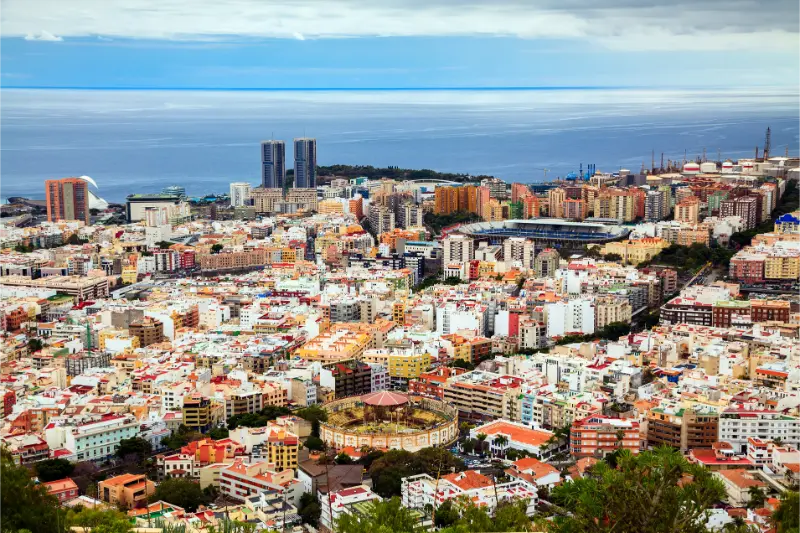
On a history-focused day I reverse the emphasis: Plaza de España and Castillo de San Cristóbal first, then the seafront fort as the final outdoor comparison.
Common mistakes I would avoid
- Expecting regular interior access without checking an event or official notice.
- Driving between nearby seafront landmarks instead of walking the cluster.
- Calling the building “black” only because of stone colour and ignoring the place-name history.
- Climbing or sitting on protected masonry for photographs.
- Visiting without linking it to Santa Cruz’s wider port-defence story.
Current information: what I would check again
The building is easy to identify from the public seafront, but interior access can depend on heritage programming. I therefore plan the visit so the exterior alone is worthwhile.
For any special opening, reenactment or guided visit, I check the Santa Cruz cultural or heritage channels rather than relying on an old timetable.
Official source
For the fort’s history I use Santa Cruz de Tenerife – historic castles.
Frequently asked questions
Is Castillo Negro the same as Castillo de San Juan Bautista?
Yes. Castillo Negro is the popular name for the coastal fort of San Juan Bautista.
Can I go inside?
Do not assume regular interior access. Plan for an exterior visit unless an official cultural event or guided opening is advertised.
Is it far from the Auditorio?
No. The fort sits in the same seafront zone and is very easy to combine with the Auditorio and Parque Marítimo.
How long do I need?
Around 10–20 minutes for the exterior, longer if a special guided opening is available.
How I decide whether this stop belongs in my itinerary
I do not add a place simply because it appears on a “top things to do” list. I ask what new layer it adds to the trip. Does it explain a part of Tenerife I have not understood yet? Does it fit naturally with places already on the route? Can I visit it without creating an hour of unnecessary driving? Those questions are especially useful on an island where a short distance on the map can still mean mountain roads, city parking or a change of microclimate.

I also distinguish between a destination visit and a cluster visit. A destination visit is worth crossing the island for; a cluster visit becomes valuable because it sits beside two or three other strong stops. Many museums, churches, small forts and interpretation centres are at their best in the second category. That does not make them less important. It simply means the itinerary should respect their real scale.
What I would verify on the morning of the visit
Opening hours, temporary closures, road conditions and special events are the four details most likely to change. I save the official source rather than relying on a screenshot taken months earlier. For cultural buildings I also check whether a private event, religious service, renovation or guided group affects normal access. For Teide locations I add mountain weather and road status to that list.
This last check takes only a few minutes and prevents the most common frustration in Tenerife planning: arriving with perfectly researched historical information but an outdated practical detail. I would rather change the order of a day than force an itinerary after the conditions have changed.
What makes a good Tenerife visit different from a checklist
The strongest days usually contain contrast. A museum works better when I can walk through the neighbourhood it explains; a volcanic trail means more after a visitor centre; a historic fort becomes clearer when modern city architecture surrounds it. I therefore build connections between places instead of treating every stop as an isolated review score.
I also leave blank space. Tenerife rewards unplanned pauses: a view of Teide appearing above cloud, a local café, a small plaza, or a change in light can become more memorable than the tenth scheduled attraction. A complete travel site should help a reader make those choices, not pressure them to “complete” the island.
Final thoughts
Castillo Negro works because it is small, authentic and perfectly placed. In a few minutes it changes the waterfront from a collection of modern attractions into a timeline.
I would see it slowly enough to notice the masonry and then turn around: the modern city surrounding it is part of the interpretation.