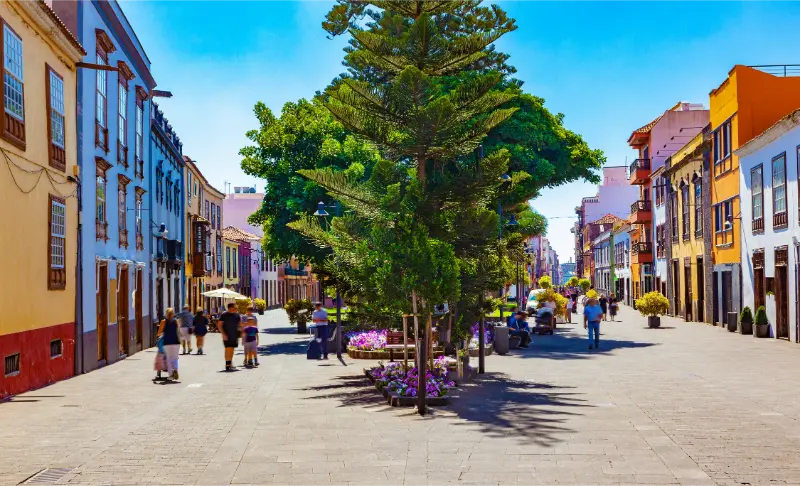
Plaza del Adelantado is the square I use to understand La Laguna’s ‘Villa de Abajo’. It looks pleasant enough as a place to sit under trees, but its real value comes from the buildings and institutions around it. The square took its name from Alonso Fernández de Lugo, the Adelantado associated with the conquest and early government of Tenerife, and for centuries it functioned as one of the city’s principal civic stages. I would not treat it as a two-minute photo stop: it is a useful orientation point for reading the planned part of the UNESCO city.
Quick visit facts
| Location | Historic centre of San Cristóbal de La Laguna |
|---|---|
| Name | Named after Adelantado Alonso Fernández de Lugo |
| First paving | 1798 |
| Garden layout | Interior garden areas arranged in 1843 |
| Fountain | Marble fountain commissioned from a French workshop and installed in 1870 |
Why this square matters to the city plan
La Laguna developed with a contrast between the less formally planned early settlement and the more geometric lower town. Plaza del Adelantado became the civic heart of that ordered section, surrounded by government, religious and aristocratic buildings. Looking outward from the square makes the city’s urban history much easier to grasp than reading a plaque in isolation.
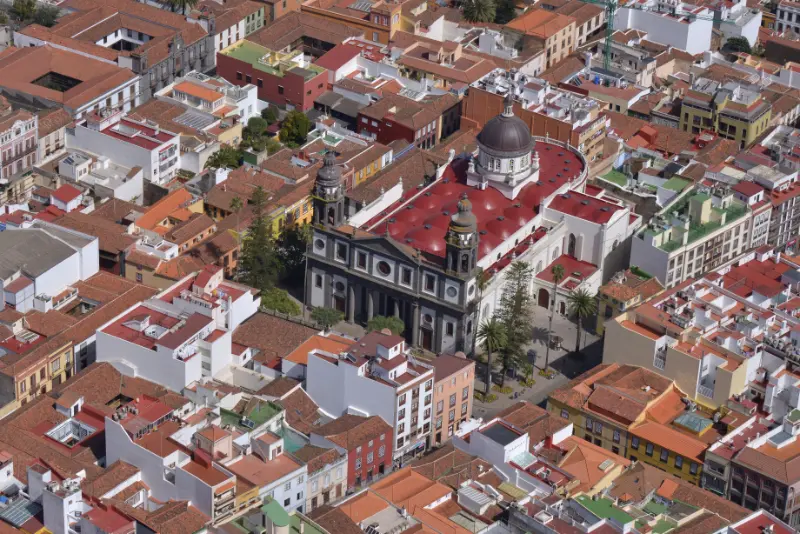
I like to stand near the centre and turn slowly through the four sides. The sequence of façades is the lesson: Palacio de Nava, municipal buildings, Casa Anchieta and the convent area each represent a different kind of power or social role.
The fountain and the nineteenth-century square
The square changed with the city. Official tourism information records its first paving in 1798, the arrangement of interior garden areas in 1843 and the installation of the present marble fountain in 1870 after it was commissioned from a French workshop. Those dates matter because the landscaped square visitors see today is not simply a surviving sixteenth-century space.
This is a good example of how historic centres accumulate layers. The location is early, the urban importance is early, but the visible furniture and landscaping reflect later ideas about civic beauty and public space.
What to look at around the edges
The north side is dominated by the stone presence of Palacio de Nava, while nearby buildings connect the square with municipal and religious history. Casa Anchieta adds another layer because of its association with José de Anchieta and its modern cultural use. The convent of Santa Catalina introduces a still-living religious community to the same urban frame.
Instead of photographing only the fountain, I would use the square as a base for short five- to ten-minute detours. Each return to the plaza makes the relationships between the monuments clearer.
The best time to stop
Morning is practical if I want to combine the square with museums and heritage interiors. Late afternoon is better if my priority is atmosphere, outdoor cafés and softer light on the stone façades. Because the square also hosts civic and cultural activity, the feel can change dramatically during festivals and special heritage events.
I avoid designing a visit around an exact promise of silence. Plaza del Adelantado is a functioning city space, not an archaeological enclosure, and that everyday use is part of its appeal.
How I would plan the visit
I build the stop into a compact local route rather than drive across Tenerife for one doorway. That reduces parking stress and gives the site context. Historic centres and small museums are often more rewarding when I can compare them with the streets, squares, markets or landscapes that produced them.
I also leave flexibility. Opening hours can change for public holidays, conservation work, religious services, private events or temporary exhibitions. My practical rule is simple: if entering the building is essential to the day, I check the official source again that morning. If the exterior or surrounding district is valuable by itself, I can be more spontaneous.
How much time I would allow
I separate time inside from total visit time. A compact museum may need only 45 minutes, yet the real stop can take 90 minutes once I include walking, ticketing, photography and a nearby coffee. A church or palace may be quicker if only the exterior is accessible, but I still avoid scheduling another fixed-time activity immediately afterwards.
For a culture-heavy day, I rarely stack more than three substantial interiors in one half-day. Alternating an indoor visit with a square, garden, lunch or short walk keeps attention higher and makes details easier to remember.
Photography, accessibility and families
Photography rules are not universal. I keep flash off around artworks and living collections, look for signs and ask before filming extensively. In active religious sites I never photograph worshippers without permission, and in gardens or wildlife spaces I avoid handling plants or animals for a better picture.
Accessibility also has to be checked site by site. A pedestrian historic centre can be easy to reach while a heritage staircase, old threshold or narrow gallery is not. When step-free access is essential, I contact the venue rather than infer accessibility from a modern-looking entrance. With children, I shorten the visit and give them one or two things to look for; that usually works better than expecting them to read every label.
When I would go
Weekday mornings are usually the easiest time for combining cultural attractions with open museums, but they are not automatically the quietest during school visits or organised groups. Late afternoon often gives better street atmosphere, while indoor opening can be more limited. I choose according to the experience I want rather than chasing a mythical hour with no other visitors.
Tenerife’s local fiestas, Carnival, religious celebrations and heritage weekends can transform normal access. Those dates can be wonderful, but they require a different plan. I check road closures, event programmes and special opening rules before assuming an ordinary timetable still applies.
Where I would stay if I wanted a slower visit
For a day trip, I would normally return to my main base. If I want two culture-heavy days without repeated driving, I sometimes compare accommodation in San Cristóbal de La Laguna. Staying locally is most useful when I want early streets, evening restaurants or several attractions that open on different schedules.

Common mistakes I would avoid
- Using an old Google review as the only source for opening hours.
- Assuming an open gate means every interior room is public.
- Driving from monument to monument inside a walkable historic centre.
- Trying to photograph everything instead of spending time with a few details.
- Ignoring services, worship, conservation work or local events that can temporarily change access.
What I would combine nearby
I prefer these combinations because they keep the day geographically coherent. The point is not to collect the largest possible number of attractions; it is to understand one part of Tenerife more deeply while spending less time in traffic.
Official source
For current access, opening information and temporary changes I check the official information for this site before travelling.
Frequently asked questions
Is Plaza del Adelantado free to visit?
Yes. It is a public square in the historic centre.
How old is the fountain?
The marble fountain was installed in 1870 after being commissioned from a French workshop.
Why is it called Plaza del Adelantado?
It takes its name from Alonso Fernández de Lugo, the Adelantado associated with the conquest and early government of Tenerife.
Is it a good starting point for La Laguna?
Yes. Several major heritage buildings stand on or very close to the square, making it an excellent orientation point.
Final thoughts
Plaza del Adelantado earns a place in a Tenerife itinerary when I treat it as part of its neighbourhood rather than an isolated pin on a map. I would verify the practical details, give the site enough time to reveal its context and then continue on foot to nearby places. That slower approach is usually what turns a short stop into something I actually remember after the trip.
A slower way to experience San Cristóbal de La Laguna
One reason I prefer a slower plan is that the surrounding streets often explain details that a label cannot. Building materials, balconies, gardens, shopfronts, church bells, small courtyards and changes in elevation all connect an attraction to the town around it. I stop before and after the visit, compare what I have just seen with neighbouring buildings and note how locals actually use the area. That simple habit turns heritage from background scenery into a readable landscape.

I also avoid making every decision around headline attractions. A small museum, quiet square or specialist garden can be more memorable than a famous site when it matches my interests. Tenerife rewards this kind of selective travel because the island packs very different histories and ecosystems into short distances. Giving one neighbourhood a full morning often teaches me more than driving to three distant highlights.
My practical checklist before leaving
The night before, I check the official page, public transport or parking plan, expected weather and whether a local event changes access. I carry water even on an urban day, keep a light layer for La Laguna or the north, and leave enough phone battery for tickets and maps. I save the attraction name and address offline in case mobile data becomes unreliable inside a thick-walled heritage building.
On arrival, I read the entrance signs before buying anything or joining a queue. If the current situation differs from what I found online, I trust the staff and posted information. That may sound obvious, but it is the simplest way to avoid turning a small schedule change into a frustrating day.