Tag: Tenerife

  • Garachico Tenerife Guide: Historic Streets, Natural Pools and Volcanic History

    Garachico Tenerife Guide: Historic Streets, Natural Pools and Volcanic History

    Garachico is one of the places in Tenerife where the landscape and the town’s history make sense together. Today it is a peaceful northwest town of cobbled streets, churches, squares and volcanic natural pools, but it was once one of the island’s most important ports. The 1706 eruption of the Trevejo volcano sent lava toward the coast and transformed that port economy. Garachico rebuilt, and the contrast between historic architecture and black volcanic rock is still central to the visit.

    I would not treat Garachico as a quick photo stop between other attractions. The town is compact, but it rewards a few unhurried hours: walk the centre, look at the coastline, have lunch and only then decide whether the sea is suitable for a swim at El Caletón. It combines naturally with La Orotava, Icod de los Vinos or the wider Isla Baja region.

    Why Garachico is worth visiting

    The strongest reason is atmosphere. Garachico has enough historic architecture to feel important but is small enough that the visit remains relaxed. Tenerife’s official tourism information highlights its sixteenth- and seventeenth-century heritage and its protected historic centre. You can understand much of the town on foot without a checklist.

    It is also a useful counterpoint to Tenerife’s resort coast. If you are staying in Costa Adeje, the drive north shows how much climate, vegetation and architecture change across the island. I would include Garachico in a first week if you enjoy historic towns or natural pools.

    Plaza de la Libertad and the historic core

    Plaza de la Libertad is the place I use to orient myself. Around it and the nearby streets you will find traditional façades, religious buildings and old civic architecture. Sit down for a few minutes before deciding where to walk next; Garachico is more enjoyable when you notice details rather than follow a rushed monument route.
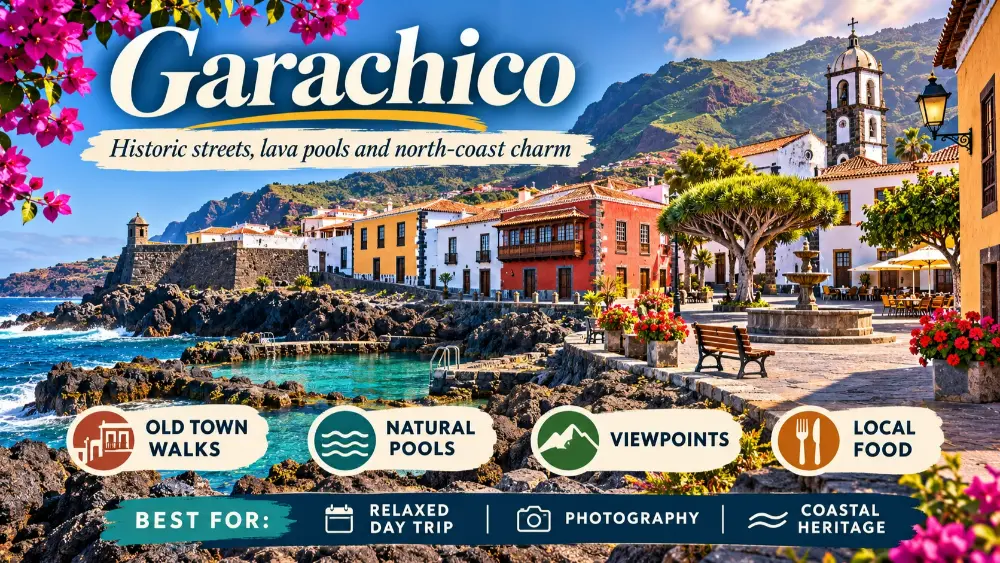
    Illustrated guide: Garachico Tenerife, with practical visitor tips
    Illustrated guide: Garachico Tenerife.

    The Church of Santa Ana and former convent buildings help explain the wealth and significance of the old port. Some interiors have limited hours, so I focus on the townscape first and treat any open building as a bonus.

    Castillo de San Miguel

    The small coastal fortress of San Miguel is one of Garachico’s landmarks and a reminder that the old port needed defence as well as commerce. Its setting beside the volcanic shoreline makes it easy to include in the seafront walk.

    El Caletón natural pools

    El Caletón is one of the main reasons many visitors know Garachico. Lava formations created pools and channels along the coast that can offer a memorable swim when the Atlantic is calm enough. The important phrase is when conditions allow. Natural pools are not ordinary swimming pools, and waves can make them dangerous or lead to closures.

    Check barriers, flags and local instructions when you arrive. If access is restricted, do not treat the visit as a failure. The volcanic coast is still worth seeing, and forcing a swim defeats the point of travelling safely.

    The 1706 eruption and how to read the landscape

    Knowing the basic story of the 1706 eruption changes how Garachico looks. Lava reached the sea and damaged the harbour that had supported the town’s commercial importance. Instead of seeing black rock as a decorative backdrop, you begin to read it as part of the town’s economic history.

    This is one reason I enjoy Garachico more after visiting Teide or learning about Tenerife’s volcanic formation. The island’s geology is not confined to the national park; it shaped where communities developed and how they changed.

    How long to spend in Garachico

    TimeWhat I would include
    1–2 hoursHistoric centre + seafront
    Half dayAdd lunch and El Caletón if open
    Full day in northwestCombine Garachico with Icod, Buenavista or Teno
    OvernightEnjoy the town after day visitors leave

    A half day is ideal for most first-time visitors. If you love historic towns and quiet evenings, staying overnight can be surprisingly rewarding.

    Combine Garachico with La Orotava

    La Orotava and Garachico make a strong cultural day from Puerto de la Cruz. Start in La Orotava when the streets are quieter, then continue west for lunch and an afternoon in Garachico. Trying to add Teide as well turns the day into too much driving.

    Use my La Orotava guide to plan the first half. If you are based in the south, consider returning by a different route only if daylight and road conditions make sense.

    Garachico and Teno

    The northwest also leads toward Buenavista del Norte and Teno Rural Park. This is a beautiful extension for travellers with more than one week, but access rules around popular points such as Punta de Teno can restrict private vehicles. Check current Tenerife ON information rather than assuming you can drive everywhere.

    Garachico Historic Town Tenerife

    Masca is also in the wider Teno area, but its gorge walk now has a regulated system and mandatory transport arrangements. My Masca guide explains why it should be planned separately.

    Food

    Garachico is an excellent place for a slow lunch. I look for Canarian fish dishes, octopus, potatoes with mojo, cheese and local wine rather than eating quickly to reach the next stop. The town’s pace suits a proper midday break.

    For a wider island food list, see what to eat in Tenerife.

    Getting there and parking

    Garachico is on Tenerife’s northwest coast. The final approach is slower than motorway driving and can be busy on popular days. Parking near the centre is finite, so arriving earlier helps. If you park outside the oldest streets, the walk is short enough that I prefer that to circling for the closest possible space.

    Public buses also serve the area, which can work well if you are staying in the north. For island transport strategy, use getting around Tenerife.

    Where to stay

    Most visitors see Garachico as a day trip, which is exactly why an overnight stay can feel special. After buses and rental cars leave, the squares become quieter and dinner feels less rushed. I would choose a historic property or small hotel in or near the old centre rather than expect large-resort facilities.

    Garachico Town And Coast Tenerife

    If that suits your travel style, compare accommodation in Garachico and check parking before confirming.

    What to bring

    • Comfortable shoes for cobbled streets.
    • Swimwear only if you are willing to accept that natural pools may be closed.
    • A light layer for the north-coast weather.
    • Water and sun protection even on cloudy days.
    • Enough time for lunch rather than a schedule built around ten-minute stops.

    My ideal Garachico visit

    I would arrive before late morning, walk Plaza de la Libertad and the historic streets, continue to the seafront and Castillo de San Miguel, inspect the ocean conditions at El Caletón and then have lunch. If swimming is safe, I would stay longer. If not, I would drive toward Buenavista, Icod or return slowly through the north rather than waiting for the sea to change.

    For current background and municipal visitor information, see the official Tenerife tourism page for Garachico.

    Natural pools are weather-dependent attractions

    This point is worth repeating because it changes expectations. A natural pool is connected to the ocean, and the ocean decides whether it is safe. When a pool is closed, the correct response is to enjoy the town and coastline, not search for an unguarded entry point nearby. I build Garachico around history and food so swimming is a bonus rather than the single purpose of the visit.
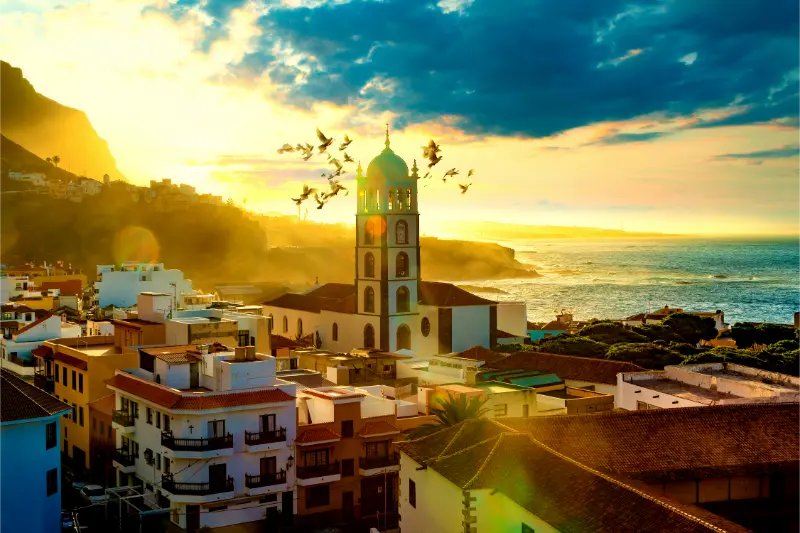
    Garachico Town At Sunset Tenerife

    A slower north-coast road trip

    If I have ten days or more, I like Garachico as part of a northwestern day that begins in the Orotava Valley and ends toward Buenavista. I reduce the number of stops and increase the time spent in each. This is one of the areas where Tenerife feels most rewarding when you stop trying to complete a checklist.

    Practical planning notes I would save before the trip

    For Garachico Tenerife guide, I save the accommodation address, parking or bus information, one official information link and the route back to my base before leaving. Tenerife is easy to travel around, but mountain roads, microclimates and busy coastal areas can turn a simple day into a slower one. I therefore keep one optional stop that can be removed without losing the main purpose of the day.

    I also carry water, sun protection and a light layer whenever the day leaves the immediate coast. Even short journeys can move from warm sunshine to wind, cloud or cooler high ground. That small amount of preparation makes it easier to respond to the island as it actually is rather than force a schedule created before arrival.

    Finally, I avoid judging a destination by the busiest thirty minutes of the day. Arriving earlier, staying later, walking one street beyond the obvious viewpoint and sitting down for a proper meal often changes the experience completely. My goal with these guides is not to collect attractions but to make each place easier to understand and enjoy at a realistic pace.

    I also keep the final hour of the day deliberately open. Traffic, parking, weather and a meal that lasts longer than expected are normal parts of travel in Tenerife, not problems to solve by rushing. Leaving that margin means I can stop at an unexpected viewpoint, wait for safer sea conditions, or simply stay longer in a town that I am enjoying. It also makes the return drive more comfortable because I am not trying to recover time lost earlier in the itinerary. For me, that flexibility is one of the most useful habits on an island where short distances can hide very different roads and conditions.

  • Anaga Rural Park Guide: Laurisilva Forest, Hikes, Villages and Practical Tips

    Anaga Rural Park Guide: Laurisilva Forest, Hikes, Villages and Practical Tips

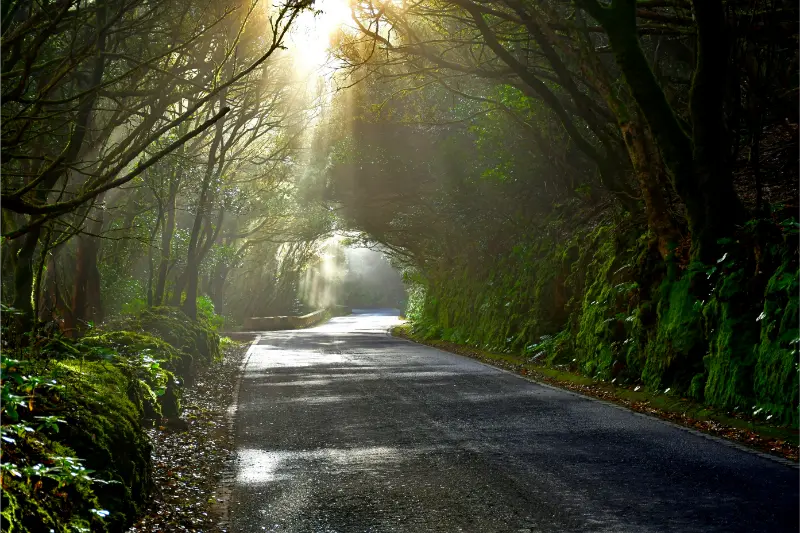
    Anaga is the part of Tenerife that most completely breaks the stereotype of a dry volcanic holiday island. In the northeast, steep ridges fall into deep ravines, laurel forest catches mist and small settlements cling to slopes above the Atlantic. On the same trip you can see Teide’s high volcanic desert and Anaga’s green woodland, and that contrast is one of the reasons I think Tenerife deserves more than a beach weekend.

    The Parque Rural de Anaga covers roughly 14,500 hectares across parts of Santa Cruz de Tenerife, La Laguna and Tegueste. It was recognised as a UNESCO Biosphere Reserve in 2015. The area is ecologically sensitive, and some trails or zones have access controls. I plan Anaga around official trail information first, weather second and scenic ambition third—not the other way around.

    What makes Anaga special?

    Anaga is one of the geologically oldest parts of Tenerife. Erosion has carved the massif into sharp ridges and ravines, while humid trade-wind conditions help support laurel forest that feels almost prehistoric. The scenery changes quickly: forest viewpoints on the ridge, agricultural hamlets, exposed coastal roads and black-sand beaches can all appear in one day.

    The temptation is to drive everywhere because the map looks small. That is exactly what I would avoid. Roads are slow and winding, parking is limited at popular points and repeated stops create more fatigue than the kilometres suggest. Choose one side of Anaga and explore it properly.

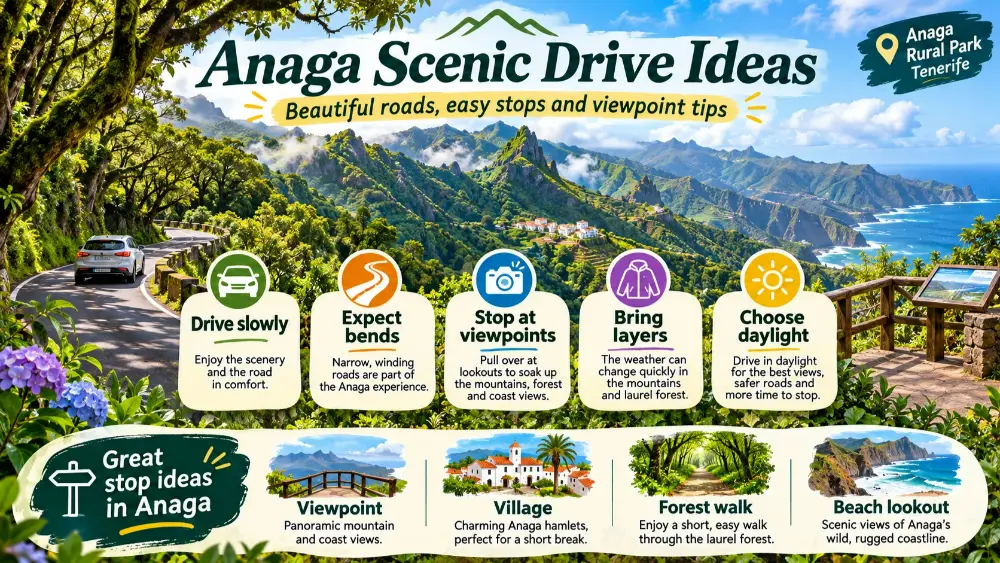
    Illustrated guide: Anaga Rural Park, with practical visitor tips
    Illustrated guide: Anaga Rural Park.

    Cruz del Carmen: the easiest introduction

    Cruz del Carmen is one of the most practical starting points from La Laguna. It gives access to viewpoints, visitor information and several walking options. On a misty day the forest can be atmospheric rather than disappointing, but if the cloud is thick enough to remove every view, I shorten the drive and focus on woodland instead of chasing the coast.

    A short walk near Cruz del Carmen is often enough for a first-time visitor who is not a serious hiker. If hiking is a priority, use my Tenerife hiking guide as an overview and then confirm the exact route on Tenerife ON.

    El Pijaral and restricted areas

    Some of Anaga’s most sensitive trails, including routes in the El Pijaral Integral Nature Reserve, are subject to access restrictions or reservations. Do not rely on an old blog post or a saved map. The official Tenerife ON platform is the reference I use for current authorisations, closures and route status.

    This matters for conservation as much as convenience. Anaga’s popularity puts pressure on narrow roads, fragile vegetation and small rural communities. A trip that respects access rules is also usually more enjoyable because you arrive with realistic expectations.

    Taganana, Almáciga and Benijo

    The drive down toward Taganana reveals Anaga’s dramatic scale. Taganana is one of the area’s historic settlements, while the coast around Almáciga and Benijo gives you wild Atlantic scenery and dark volcanic beaches. I treat the coast as a landscape experience first and a swimming destination second because currents and waves can be powerful.

    Anaga Tenerife

    Benijo is especially beautiful near the end of the day, but sunset planning requires caution. Mountain roads are slower after dark, parking is limited and the beach involves steps. I would never let a photograph deadline force me into unsafe swimming or rushed night driving.

    Hiking in Anaga

    Routes range from short forest walks to demanding paths that descend through ravines and connect remote hamlets. Distance alone does not define difficulty. Mud, steep gradients, exposed sections, heat on the coast and fog on the ridge can change the effort substantially. Wear proper footwear and carry more water than a city walk would require.

    Download route information before leaving because reception can be inconsistent in mountain terrain. Tell someone your plan for longer hikes, avoid closed routes and turn back if conditions no longer match your equipment.

    Getting to Anaga without a car

    Public transport is possible and can be a smart choice for some routes. Official tourism information lists buses from Santa Cruz and La Laguna to different parts of the massif. Frequencies are more limited than in the main urban areas, so build the day around the timetable rather than assuming a bus will appear when you finish.

    A car gives flexibility but adds parking pressure. If you drive, avoid stopping where you block local traffic or narrow roads. For general island transport choices, see getting around Tenerife.

    Can you combine Anaga with La Laguna?

    Yes, and this is one of my favourite first-trip combinations. Spend the morning walking La Laguna’s UNESCO-listed centre, have an early lunch and then choose a short Anaga route or viewpoint sequence. The combination works because the two places are close but completely different.

    Playa De Las Teresitas Beach And Anaga Mountains Tenerife

    Read my La Laguna guide if you want to build that day. If you are a serious hiker, give Anaga a full day instead.

    Anaga and Santa Cruz

    Santa Cruz also makes a logical gateway, particularly for the coastal road toward San Andrés, Taganana and the eastern approaches. A city morning followed by Las Teresitas is easy; a city morning plus a deep Anaga hike is not. Choose between sightseeing and hiking rather than stacking both.

    My Santa Cruz guide includes a practical city-and-coast version.

    Where to eat

    Small restaurants in Anaga’s villages can be one of the pleasures of the day, but opening hours are not as continuous as in the resorts. I keep water and a simple snack in the car even when lunch is planned. Look for local fish near the coast and traditional Canarian dishes inland.

    Do not turn every rural restaurant into a social-media stop. These are small communities where tourism shares roads, parking and public space with residents.

    Weather and what to pack

    ConditionWhat it means for the day
    Mist on the ridgeForest can still be beautiful; viewpoints may disappear
    Rain or wet trailRoots and stone become slippery; shorten or change route
    Strong sun on coastHeat exposure rises quickly away from forest
    WindExposed ridges and beaches may feel much harsher

    I carry a light waterproof or windproof layer, water, sun protection and closed footwear. The fact that you left a sunny southern resort in shorts does not mean the Anaga ridge will feel the same.

    Where to stay for Anaga

    For repeated Anaga exploration, La Laguna is my favourite practical base because you have restaurants, transport and quick mountain access. Santa Cruz also works well, particularly for the eastern coast. Rural accommodation inside or near the park can be memorable for slow travel, but I would confirm access and parking carefully before booking.

    If you want an urban base, compare accommodation in La Laguna; for a full island comparison use where to stay in Tenerife.

    My first-time Anaga plan

    I would start from La Laguna, stop around Cruz del Carmen, choose one short legal trail, then continue only as far as the weather and daylight comfortably allow. If visibility is good and roads are quiet, I might descend toward Taganana and the coast. If the ridge is soaked in cloud, I would enjoy the forest, return to La Laguna and save the coastal drive for another day.

    Before every visit, check the official Tenerife ON platform for trail status, restrictions and reservations, and use the official tourism overview of Anaga Rural Park for destination background.

    Low-impact visiting

    The simplest way to reduce pressure on Anaga is to do less. Do not stop at every viewpoint, do not park on verges, avoid loud behaviour near villages and stay on legal trails. Carry out every piece of rubbish and use established businesses rather than treating rural communities as scenery. The park’s value depends on the same small settlements and ecosystems that tourism can easily overwhelm.

    Navigation and offline planning

    I save the exact route, official status page and return plan before entering the mountains. A generic map app may show paths that are unsuitable, private or restricted. Tenerife ON should be the reference for official trails. On longer walks I carry a power bank and do not depend on streaming navigation for the whole day.

    Practical planning notes I would save before the trip

    For Anaga Rural Park guide, I save the accommodation address, parking or bus information, one official information link and the route back to my base before leaving. Tenerife is easy to travel around, but mountain roads, microclimates and busy coastal areas can turn a simple day into a slower one. I therefore keep one optional stop that can be removed without losing the main purpose of the day.

    I also carry water, sun protection and a light layer whenever the day leaves the immediate coast. Even short journeys can move from warm sunshine to wind, cloud or cooler high ground. That small amount of preparation makes it easier to respond to the island as it actually is rather than force a schedule created before arrival.

    Finally, I avoid judging a destination by the busiest thirty minutes of the day. Arriving earlier, staying later, walking one street beyond the obvious viewpoint and sitting down for a proper meal often changes the experience completely. My goal with these guides is not to collect attractions but to make each place easier to understand and enjoy at a realistic pace.

  • San Cristóbal de La Laguna Guide: UNESCO Streets, History and Anaga Day Trips

    San Cristóbal de La Laguna Guide: UNESCO Streets, History and Anaga Day Trips

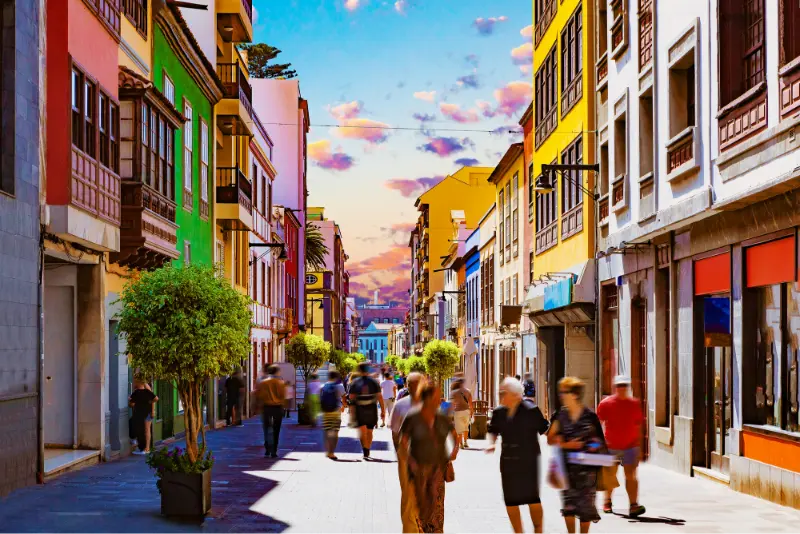
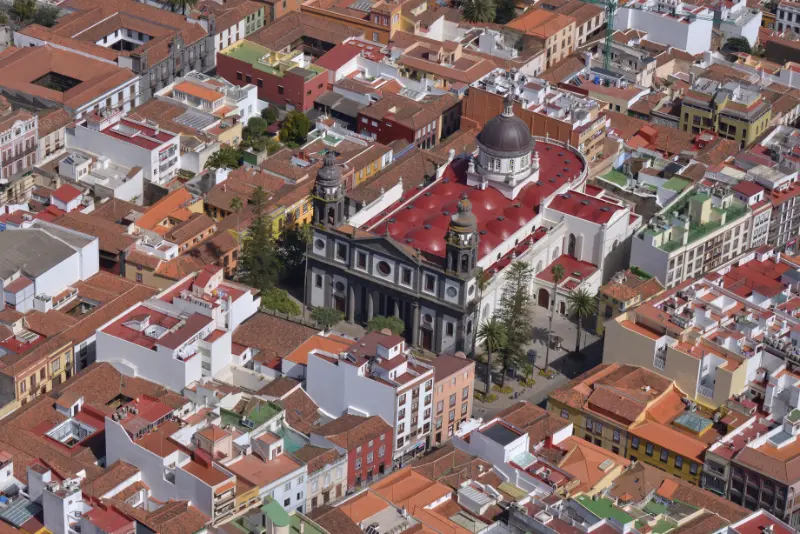
    San Cristóbal de La Laguna is the Tenerife town I recommend when someone tells me they want history, architecture and local life rather than another resort afternoon. Its historic centre is compact enough to explore on foot, yet it rewards slow attention: wooden balconies, inner courtyards, churches, colourful façades, university energy and cafés all sit inside a street plan with global historical importance.

    UNESCO inscribed La Laguna as a World Heritage Site in 1999. The city is often described as the first non-fortified Spanish colonial town whose planned layout later influenced settlements in the Americas. You do not need to be an architecture specialist to appreciate it. The key is to walk rather than drive through, because much of the experience comes from the relationship between streets, squares and building fronts.

    Why La Laguna belongs in a first Tenerife itinerary

    Tenerife’s landscapes are so dramatic that cultural stops can get pushed aside. La Laguna fixes that imbalance. It gives context to the island’s colonial history and creates a natural gateway to Anaga. I would often combine the two: La Laguna in the morning, lunch in or near the city, then a carefully chosen Anaga route or viewpoint in the afternoon.

    Because the city sits at roughly 600 metres above sea level, it can feel noticeably cooler than the southern coast. A light layer is useful even when you leave a warm beach resort. This north–south and coast–altitude contrast is one of the recurring themes of Tenerife; see my Tenerife weather guide for more.

    How to explore the historic centre

    I would start near Plaza del Adelantado and walk toward the main pedestrian streets without worrying about a perfect route. Calle Obispo Rey Redondo, often called La Carrera, and Calle Herradores are natural axes. From them, detour into courtyards, churches and quieter side streets as they catch your attention.

    The city is best when you give yourself permission to stop for coffee. A two-hour march through landmarks misses the university-town atmosphere that makes La Laguna feel lived-in rather than preserved behind glass.

    Cathedral and Iglesia de la Concepción

    The Cathedral of San Cristóbal de La Laguna and the Church of La Concepción are two of the historic centre’s main religious landmarks. Opening hours can change around services, events and restoration work, so I check locally rather than building a rigid schedule around interior access. Even from outside, they help orient a walk through the old town.

    San Cristobal De La Laguna Panoramic View Tenerife

    The tower of La Concepción is also one of the city’s recognisable vertical landmarks. If access is available and you are comfortable with the climb, it can add a different perspective over the tiled roofs and urban grid.

    Historic houses and courtyards

    La Laguna’s real architectural pleasure is in its domestic buildings. Look for wooden balconies, stone portals, patios and the way houses turn inward around courtyards. Some historic buildings are public institutions or cultural spaces, while others remain private, so respect access signs rather than assuming every photogenic doorway is open.

    This is where a guided walking tour can add value. The stories of merchants, religious orders, political power and Atlantic trade explain details you might otherwise pass without noticing.

    University atmosphere, cafés and shopping

    La Laguna is home to the University of La Laguna, the first university in the Canary Islands, and that student population keeps the centre energetic. Cafés, bars, bookstores and independent shops prevent the World Heritage area from feeling like a museum. I like visiting on a weekday when normal city life is active.

    For lunch, this is a good place to look beyond resort menus. Try Canarian dishes or modern restaurants using island ingredients. For a food checklist, use what to eat in Tenerife.

    La Laguna and Anaga

    The pairing is almost too obvious to ignore. From La Laguna, roads climb quickly toward Cruz del Carmen and the laurel forests of Anaga. The landscape can change from urban streets to misty woodland in a remarkably short time. I would choose one trail or a few viewpoints, not try to cover the entire rural park after lunch.

    Some Anaga areas require reservations and temporary closures are possible, so check Tenerife ON before setting off. My Anaga Rural Park guide explains how I plan the nature half of the day.

    La Laguna Colorful Historic Street Tenerife

    Getting to La Laguna

    The tram from Santa Cruz is one of the easiest transport options and avoids parking. Tenerife North Airport is nearby, which makes La Laguna a practical first or last-night base for some itineraries. Buses connect it with other towns and parts of Anaga. If you drive, I prefer to park outside the pedestrian core and explore the centre on foot.

    My Tenerife transport guide covers buses, airports and rental-car strategy across the island.

    Where to stay

    Staying overnight changes the experience. Day visitors leave, restaurants settle into an evening rhythm and the streets feel more local. I would stay here for a culture-focused city break, an early Tenerife North Airport flight, several Anaga hikes or a split itinerary that includes both north and south.

    Accommodation choice is smaller than in the major resorts, which is part of the appeal. Look for a central guesthouse, boutique hotel or apartment within walking distance of the historic core. You can compare accommodation in La Laguna after checking the exact street and parking arrangements.

    How long do you need?

    Time availableWhat I would do
    2–3 hoursHistoric-centre walk, coffee and one interior visit
    Half dayAdd lunch, courtyards and slower shopping
    Full dayCombine with a light Anaga visit
    1–2 nightsUse La Laguna as a base for Anaga and Santa Cruz

    For a first visit, half a day is enough to understand why the city matters. A full day is better if architecture and food interest you. Staying overnight makes sense when you want to explore the northeast without repeatedly driving from the southern resorts.

    La Laguna with children

    The pedestrian centre is easier with children than a car-based sightseeing day, but younger children may lose interest in a long architectural route. I would keep the history portion short, add a pastry or ice-cream break, and then move to an outdoor stop. Combining the town with a very short Anaga walk can work better than expecting children to appreciate every historic house.

    For family pacing across the island, see Tenerife with kids.

    What to wear and weather

    Do not dress for La Laguna based only on the weather at Costa Adeje. Its elevation and northeastern position make it cooler and sometimes mistier. Comfortable walking shoes are more useful than beach sandals on old streets, and a light waterproof or wind layer can save the day before heading into Anaga.

    My ideal La Laguna visit

    I would arrive in the morning, walk slowly from Plaza del Adelantado through the pedestrian core, choose one or two buildings to explore properly, have lunch somewhere that serves island produce and then decide whether the weather favours Anaga. If clouds are thick in the mountains, stay longer in the city rather than forcing a scenic drive with no visibility.

    Aerial View Of La Laguna Tenerife

    For official background and current visitor information, use the Tenerife tourism page for San Cristóbal de La Laguna.

    Photography without missing the city

    La Laguna is extremely photogenic, but I try not to experience it entirely through a camera. Courtyards, doorways and balconies deserve attention, yet many are private spaces. I photograph from public streets, respect signs and spend at least part of the walk without trying to collect every façade. The city makes more sense as a whole than as a sequence of isolated Instagram frames.

    A cooler base in summer

    Travellers who struggle with summer heat may appreciate La Laguna’s elevation, particularly in the evening. It is not a guarantee of cool weather, but conditions often feel different from the coast. That can make it a useful split-stay base when a trip includes both beach days and serious walking in the northeast.

    Practical planning notes I would save before the trip

    For La Laguna Tenerife guide, I save the accommodation address, parking or bus information, one official information link and the route back to my base before leaving. Tenerife is easy to travel around, but mountain roads, microclimates and busy coastal areas can turn a simple day into a slower one. I therefore keep one optional stop that can be removed without losing the main purpose of the day.

    I also carry water, sun protection and a light layer whenever the day leaves the immediate coast. Even short journeys can move from warm sunshine to wind, cloud or cooler high ground. That small amount of preparation makes it easier to respond to the island as it actually is rather than force a schedule created before arrival.

    Finally, I avoid judging a destination by the busiest thirty minutes of the day. Arriving earlier, staying later, walking one street beyond the obvious viewpoint and sitting down for a proper meal often changes the experience completely. My goal with these guides is not to collect attractions but to make each place easier to understand and enjoy at a realistic pace.

  • Santa Cruz de Tenerife Guide: What to See, Eat and Do in the Capital

    Santa Cruz de Tenerife Guide: What to See, Eat and Do in the Capital

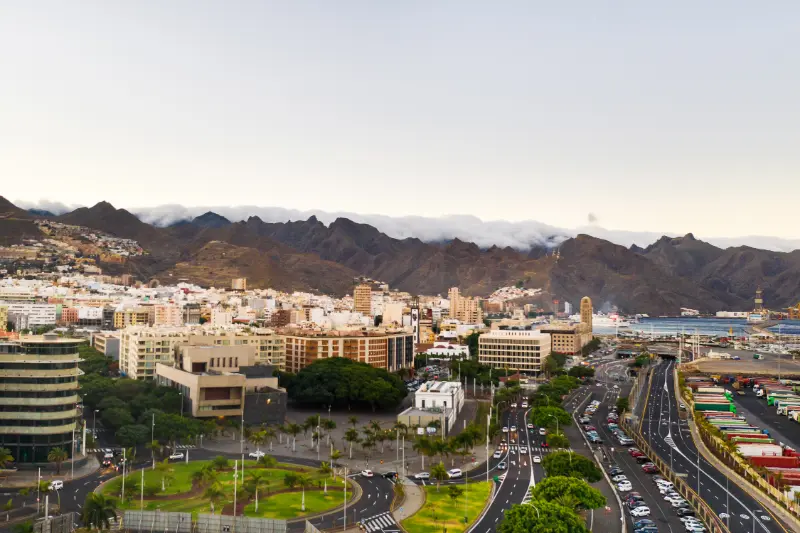
    Santa Cruz de Tenerife is easy to underestimate if you arrive on the island focused only on beaches and volcanoes. It is the island capital, a working city and the main urban counterpoint to Tenerife’s resort areas. I would come here for markets, architecture, museums, parks, shopping and everyday city life, then combine it with Las Teresitas or Anaga so the day moves from streets to coast or mountains.

    The city has been Tenerife’s capital since 1833 and today shares the capital role of the Canary Islands with Las Palmas de Gran Canaria. That administrative importance is visible, but Santa Cruz does not feel like a city of monuments lined up for tourists. Its appeal is more relaxed: a market breakfast, a walk through García Sanabria Park, contemporary architecture around the waterfront and a late lunch before heading to the beach.

    Is Santa Cruz worth visiting?

    Yes, especially if you want to understand Tenerife beyond the resort economy. I would not replace Teide or Anaga with Santa Cruz on a very short trip, but on a week-long holiday it adds an important urban dimension. It is also one of the best places on the island for shopping and cultural venues.

    Travellers who dislike cities may prefer to spend only a few hours here and continue to Las Teresitas. Anyone interested in architecture, food markets, museums or local life could stay overnight. For a broader first-week plan, see my Tenerife 7-day itinerary.

    Plaza de España and the waterfront

    Plaza de España is the easiest place to begin. It opens toward the port and places you within walking distance of central shopping streets and several cultural sights. I use it as an orientation point rather than a destination in itself: arrive, understand the street layout, then move through the centre on foot.

    The waterfront also shows modern Santa Cruz, especially as you continue south toward the Auditorio de Tenerife. Cruise ships, port infrastructure and contemporary buildings make this side of the city feel completely different from La Laguna’s colonial streets only a tram ride away.

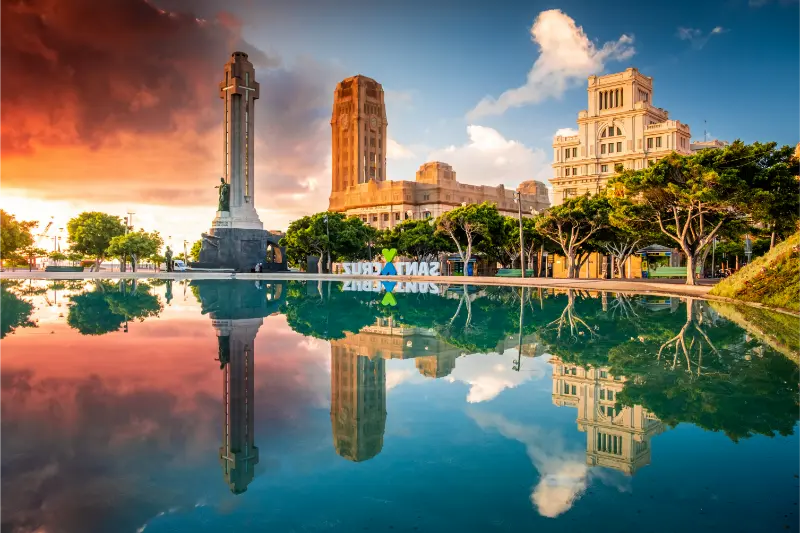
    Plaza de España reflecting pool and civic buildings in Santa Cruz de Tenerife
    Plaza de España, Santa Cruz de Tenerife.

    Auditorio de Tenerife

    The Auditorio de Tenerife Adán Martín, designed by Santiago Calatrava, is the city’s most recognisable contemporary building. Even if you do not attend a performance, the exterior and waterfront setting are worth seeing. I would pair it with the nearby market rather than travel across the city solely for a photograph.

    Check the official programme if concerts or performances matter to you. A live event can turn Santa Cruz from a half-day excursion into an excellent evening in the city.

    Mercado de Nuestra Señora de África

    Markets are one of my favourite ways to understand a city quickly, and this is the place I would choose for a food-focused stop. Go earlier in the day when the market feels most active. Browse fruit, vegetables, fish, meats and local products, then use the visit to identify ingredients you will see elsewhere on Tenerife.

    If you enjoy food, Santa Cruz is also a good place to explore modern Canarian cooking rather than only traditional menus. For a list of island dishes and products, keep my Tenerife food guide open while you visit.

    TEA and the cultural side of the city

    Tenerife Espacio de las Artes, usually known as TEA, gives Santa Cruz a strong contemporary-cultural stop. Exhibition programmes change, so I prefer to check what is on rather than recommend a fixed list of galleries. This is especially useful on a cloudy day or when you want a break from driving.

    Museums work best here as part of a city walk. I would choose one cultural venue, not try to complete all of them in a few hours.

    Parque García Sanabria

    García Sanabria is the city’s major green space and a good reset between shopping streets and museums. Mature trees, shaded paths and sculptures make it pleasant even if you are not a dedicated garden visitor. In a city day full of pavement and traffic, this is where I would slow the pace.

    Las Teresitas: the beach extension of a Santa Cruz day

    Las Teresitas lies by San Andrés, outside the central urban core, but it is the beach I naturally combine with Santa Cruz. Its broad curve of pale sand and relatively sheltered setting is completely different from many of Tenerife’s volcanic beaches. Spend the morning in the city, have lunch, then take the bus or drive to the beach for the afternoon.

    Do not assume sea conditions are always calm just because the beach is sheltered. Follow flags and local instructions. I compare Las Teresitas with other coast options in my best beaches in Tenerife guide.

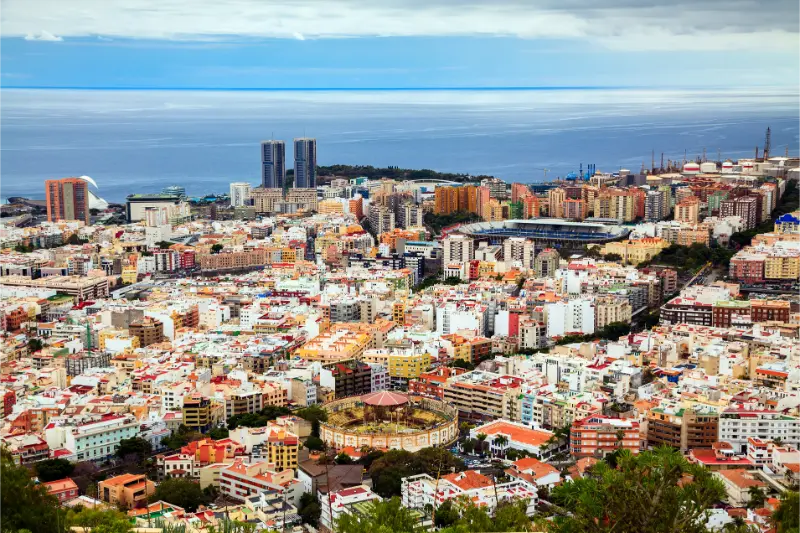
    Aerial View Of Santa Cruz De Tenerife

    Santa Cruz and Anaga in one day

    If you start early, Santa Cruz can also be paired with Anaga, but I would keep the city portion focused. Market breakfast, a short central walk and then the mountains can work. Trying to add TEA, the Auditorio, Las Teresitas, Taganana and a hike becomes unrealistic.

    For nature, use my dedicated Anaga Rural Park guide and check Tenerife ON for trail status and reservations before leaving the city.

    How to get around Santa Cruz

    The centre is best explored on foot. The tram connects Santa Cruz with La Laguna and is one of the easiest ways to combine the two cities without worrying about parking. TITSA buses connect the capital with other parts of Tenerife, including Anaga routes and resort areas. If you arrive by rental car, a paid car park can be less stressful than circling central streets.

    For an island-wide transport strategy, see getting around Tenerife.

    Where to stay in Santa Cruz

    I would stay in Santa Cruz if I had an early flight from Tenerife North Airport, wanted a city-focused break, planned several days around La Laguna and Anaga, or preferred local restaurants and cultural life to a beach resort. The central area around the main shopping streets is convenient for walking; quieter residential streets can offer better value but make location more important.

    Auditorio De Tenerife Santa Cruz Coastline

    If this style of trip suits you, compare hotels in Santa Cruz de Tenerife and prioritise a central position over resort-style facilities you may not use.

    Shopping and evenings

    Santa Cruz has the island’s strongest urban shopping offer, from familiar brands to local stores. I prefer to combine shopping with cafés and food rather than treat it as a separate attraction. In the evening, choose a neighbourhood restaurant, check whether the Auditorio has a performance or enjoy a slower dinner before taking the tram back to La Laguna if you are staying there.

    Carnival

    Santa Cruz is internationally known for Carnival, when the character of the city changes completely. If you are planning specifically for Carnival, accommodation, road closures, event schedules and transport need separate research because the normal city routine does not apply. I would book far earlier than for an ordinary winter visit and use official event information for exact dates and access arrangements.

    A practical one-day itinerary

    TimePlanWhy
    MorningMarket + central streetsBest city atmosphere and food start
    Late morningPlaza de España + park or museumFlexible culture block
    LunchCentral Santa CruzStrong restaurant choice
    AfternoonLas Teresitas or Auditorio/TEAChoose beach or culture
    EveningDinner or tram to La LagunaEasy urban finish

    The best version of Santa Cruz is not the one with the most stops. Pick the city experiences that interest you, then allow time to sit down. Tenerife travel can become very car-heavy, and Santa Cruz is a chance to spend a day on foot.

    For updated attractions and municipal information, check the official Tenerife tourism page for Santa Cruz de Tenerife.

    Santa Cruz on a rainy day

    A cloudy or showery forecast can actually be a reason to choose Santa Cruz over a mountain excursion. Markets, museums, shops, cafés and cultural venues give you flexibility that exposed viewpoints cannot. I keep one urban day unassigned in longer trips so I can move it into whichever day looks least suitable for hiking or the beach.

    City etiquette and practical comfort

    Santa Cruz is a working capital rather than a resort set. Dress for walking, keep valuables secure in busy shopping areas as you would in any city, and remember that restaurant timing may differ from hotel buffet routines. If you are driving, know where you plan to park before entering the centre; the extra five minutes of preparation usually saves much more time.

    Practical planning notes I would save before the trip

    For Santa Cruz de Tenerife guide, I save the accommodation address, parking or bus information, one official information link and the route back to my base before leaving. Tenerife is easy to travel around, but mountain roads, microclimates and busy coastal areas can turn a simple day into a slower one. I therefore keep one optional stop that can be removed without losing the main purpose of the day.

    I also carry water, sun protection and a light layer whenever the day leaves the immediate coast. Even short journeys can move from warm sunshine to wind, cloud or cooler high ground. That small amount of preparation makes it easier to respond to the island as it actually is rather than force a schedule created before arrival.

  • Puerto de la Cruz Travel Guide: What to See, Where to Stay and Practical Tips

    Puerto de la Cruz Travel Guide: What to See, Where to Stay and Practical Tips

    Puerto de la Cruz is where I would stay in Tenerife when I want the convenience of a tourist town without losing the feeling that I am in the north of the island. It has hotels, restaurants and attractions, but it also has an old fishing harbour, historic streets, black-sand beaches, gardens and the green Orotava Valley rising behind it. The atmosphere is very different from Costa Adeje or Los Cristianos.

    It is also historically important to tourism in the Canary Islands. Puerto de la Cruz was receiving international visitors long before the large southern resorts existed. That older tourism tradition is still visible in its promenades, gardens and hotels, while neighbourhoods such as La Ranilla keep a more intimate street pattern. I would choose it for walking, food, northern scenery and easy access to La Orotava, Teide and the northwest.

    Why stay in Puerto de la Cruz?

    The strongest reason is variety within a compact area. You can walk from Lago Martiánez along the waterfront, pass San Telmo, reach Plaza del Charco and the old harbour, then continue into La Ranilla without needing a car. Cafés, shops and restaurants fill the spaces between. For a visitor who likes to leave the hotel and immediately be somewhere interesting, that is a major advantage.

    The trade-off is weather. The north is greener because it is generally cloudier and more humid than the south. That does not mean constant rain, but if guaranteed pool-and-beach sunshine is your only priority, Costa Adeje is the safer choice. If landscape, culture and local atmosphere matter more, Puerto de la Cruz deserves serious consideration. Compare the options in where to stay in Tenerife.

    Plaza del Charco and the historic centre

    Plaza del Charco is the natural orientation point for a first walk. From here, I would wander without a rigid route: the old harbour, Casa de la Real Aduana, Plaza de Europa and nearby streets reveal the city’s relationship with the sea. Tenerife’s official tourism information notes that the protected historic centre contains more than 140 protected buildings, which explains why the town feels more layered than a purpose-built resort.

    Do not rush this part. The appeal is not one spectacular monument but the sequence of balconies, squares, churches, seafront views and everyday life. It is ideal for the first afternoon after arrival because you can understand the town at walking pace.

    La Ranilla and street art

    La Ranilla began as a fishing neighbourhood and is now one of the most enjoyable areas for an evening wander. Traditional streets sit beside contemporary murals, small restaurants and creative businesses. Puerto Street Art turned large walls in the historic district into an open-air art route, giving the neighbourhood a character that feels more current than a conventional old town.

    I like to visit in daylight to see the murals and then return for dinner. It is a good example of why Puerto de la Cruz works well for travellers who want to spend time in the place they are staying rather than leave the resort every morning.

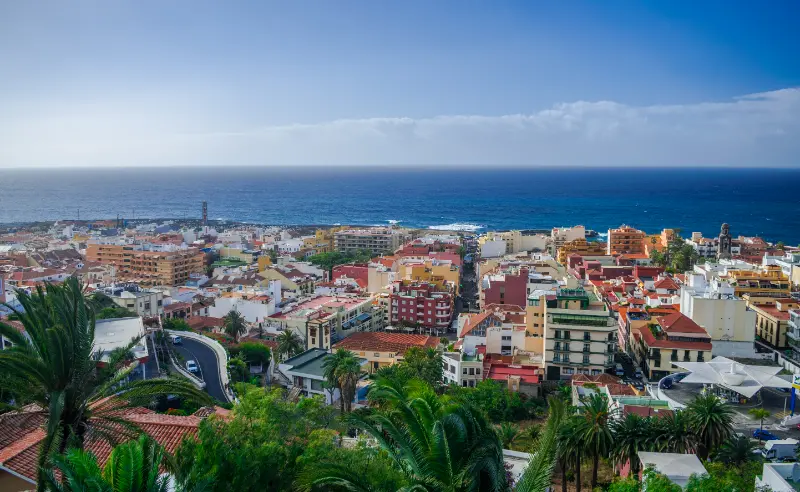
    Puerto De La Cruz City View Tenerife

    Lago Martiánez and the seafront

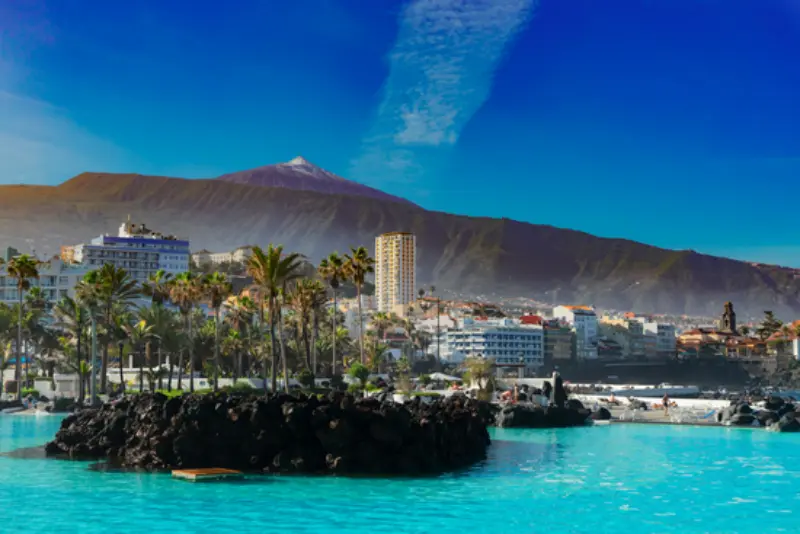
    Lago Martiánez is one of the visual symbols of Puerto de la Cruz: a landscaped complex of seawater pools by the Atlantic, designed with the influence of Canarian artist César Manrique. It can be a useful alternative when the ocean is rough or when you want a relaxed pool day without staying at the hotel.

    Conditions, maintenance and opening arrangements can change, so I always check official local information before planning a full day around any bathing complex. The seafront itself is worth walking even if you do not enter.

    Beaches and ocean conditions

    The north-coast beaches are volcanic and the Atlantic often feels more powerful here than at sheltered southern beaches. Playa Jardín is the best-known beach area near the town, while smaller bathing points sit along the coast. Always respect flags and temporary closures. Northern surf and water quality conditions can change after weather events, so current signs matter more than what an old travel article says.

    If beach time is a major part of your holiday, combine Puerto de la Cruz with selected coastal stops around the island. My Tenerife beach guide explains the differences between sheltered resort beaches, black-sand beaches and natural pools.

    Gardens and Loro Parque

    Puerto de la Cruz is known for its gardens and long tourism tradition, and many visitors also come specifically for Loro Parque. Whether that attraction fits your personal views on wildlife tourism is an individual decision. If you visit, I would plan it as a major part of the day rather than trying to combine it with La Orotava, Garachico and a long drive.

    Puerto De La Cruz Skyline Tenerife

    For a quieter alternative, build a day around gardens, the historic centre and food. The town is rewarding even without ticketed attractions.

    Day trips from Puerto de la Cruz

    • La Orotava: only a short journey away and one of the island’s strongest historic centres.
    • Teide National Park: excellent access from the Orotava Valley; plan for a major altitude change.
    • Garachico: a beautiful northwest town with volcanic coastal history.
    • Icod de los Vinos: useful to combine with Garachico or a wine-focused day.
    • La Laguna and Anaga: a strong full-day trip east for architecture and laurel forest.

    Puerto de la Cruz is especially good for slow travel because many interesting places are close enough that you do not need to cross the entire island each day.

    Getting around

    The town itself is walkable, although some neighbourhoods sit uphill. TITSA buses connect Puerto de la Cruz with other major towns and attractions, and a rental car is helpful for village days or flexible mountain routes. Parking in the centre can take patience, so I prefer accommodation with parking if I know I will drive every day.

    If you are deciding between public transport and a car, read getting around Tenerife. For Teide, always check road and mountain conditions regardless of how you travel.

    Where to stay

    AreaBest forCharacter
    Historic centre / Plaza del CharcoWalking, restaurants, atmosphereLively and central
    Martiánez / Avenida de ColónSeafront and Lago MartiánezClassic tourism zone
    La Paz / BotánicoQuieter hotels and viewsUphill from the centre
    Punta Brava / Playa Jardín sideCoast and western accessMore residential feel

    I would choose the historic centre for atmosphere or La Paz for a calmer hotel stay, but I would check the exact hill and parking situation before confirming. You can compare current Puerto de la Cruz accommodation once the neighbourhood is clear.

    Food and evenings

    Puerto de la Cruz is an easy place to eat well without planning every meal. The centre has a high density of restaurants, but I still look for menus that reflect northern Tenerife: fish, Canarian cheeses, potatoes with mojo, grilled meats and local wines. La Ranilla is especially pleasant for a relaxed dinner after a day trip.

    For a more traditional food experience, drive into the Orotava Valley or nearby wine areas and try a guachinche where appropriate. My Tenerife food guide explains what to order and how guachinches differ from ordinary restaurants.

    Best time to stay in Puerto de la Cruz

    I like the north most when I am travelling for scenery, walking and food rather than chasing uninterrupted beach sunshine. Spring can be especially green; summer is popular with Spanish visitors; winter remains mild but cloud and showers are more likely than in the southwest. Bring a light layer even when the forecast looks warm.

    Aerial View Of Puerto De La Cruz Tenerife

    The upside of that moisture is the landscape. The vegetation of the Orotava Valley and northern slopes is part of what makes the region special. Use my weather and season guide if you are deciding between north and south.

    A one-day Puerto de la Cruz plan

    If you are visiting rather than staying, I would begin near Martiánez, walk the seafront toward San Telmo, continue to Plaza del Charco and the old harbour, explore La Ranilla, have a slow lunch and then choose one final activity rather than three. Depending on your interests, that could be Lago Martiánez, a garden, Playa Jardín or simply another hour in the historic streets.

    For current municipal information and walking ideas, I also use the official Tenerife tourism page for Puerto de la Cruz.

    Why I like the town for repeat visitors

    On a second Tenerife trip, Puerto de la Cruz becomes even more attractive because you may feel less pressure to spend every day visiting headline sights. You can use the town as a base for small northern excursions, come back for dinner, and enjoy cloudy periods without feeling the holiday has failed. That makes it particularly good for travellers who value atmosphere over guaranteed tanning weather.

    Accessibility and hills

    The waterfront and central streets are manageable for many visitors, but La Paz and other higher neighbourhoods involve substantial gradients. If mobility is limited, choose accommodation close to the level you expect to use most often. A beautiful view from high above town may mean repeated taxi journeys if the walk becomes uncomfortable.

  • Los Cristianos Travel Guide: Beaches, Harbour, Ferries and Where to Stay

    Los Cristianos Travel Guide: Beaches, Harbour, Ferries and Where to Stay

    Los Cristianos is one of the easiest places in Tenerife to understand on the first day. The old harbour, urban beach, long seafront promenade, bus connections, restaurants and ferry traffic all sit close together, so you can arrive and quickly learn how the area works. It is more compact and practical than many sprawling resort zones, which is why I often recommend it to travellers who want to stay in the sunny south without depending on a rental car every day.

    It is also a place with two identities. Los Cristianos began as a fishing settlement, but tourism transformed it into one of Tenerife’s main southern resorts. Today you can still see boats in the harbour while large hotels, apartment complexes and international restaurants fill the surrounding streets. I would not come here expecting an untouched village; I would choose it for walkability, transport and an easy holiday rhythm.

    Who is Los Cristianos best for?

    Los Cristianos works particularly well for older travellers, families, couples who prefer relaxed evenings, visitors without a car and anyone planning ferry trips to other Canary Islands. The terrain near the seafront is generally easier than some hillier parts of the south, although accommodation farther inland can still involve slopes. The centre is active without feeling as nightlife-focused as parts of Playa de las Américas.

    If your priority is luxury hotels and a polished resort atmosphere, Costa Adeje may fit better. If you want nightlife, Playa de las Américas is closer to that style. If you want a compact base with ferries, buses and a traditional harbour at its centre, Los Cristianos is one of the strongest choices. My where to stay in Tenerife guide compares all of these areas.

    Playa de Los Cristianos

    The town beach sits beside the harbour and is designed for convenience rather than wilderness. Tenerife’s official tourism site lists it as a 345-metre urban beach with light sand, calm water, accessible entry and the usual resort services. Small boats in the bay give it a different character from the more manicured beaches farther along the coast.

    Los Cristianos Bay Tenerife

    I like it for a simple morning swim or for families who want everything close by. Because it sits beside an active port, I would also walk west along the promenade to compare it with Las Vistas before deciding where to spend a full beach day.

    Playa de Las Vistas

    Las Vistas is the beach I would choose for a longer, more classic resort day. It stretches between Los Cristianos and Playa de las Américas and is backed by a broad promenade. The route is almost a lesson in how the southern resorts connect: you can walk from the harbour through Los Cristianos, continue along Las Vistas and eventually reach the livelier areas toward Las Américas.

    That walkability is one of Los Cristianos’ greatest strengths. You can change beach, find lunch and return to your accommodation without starting a car. For a wider island comparison, see my best beaches in Tenerife.

    The harbour and ferries

    Los Cristianos is one of Tenerife’s important passenger ports, with ferry services linking the island to other western Canary Islands. If La Gomera is part of your trip, staying here can make an early ferry much easier. I would still check the operator’s live timetable before building a day around it, because sailing times and vessel schedules can change.

    The harbour also gives Los Cristianos a sense of movement that most resorts lack. Fishing boats, excursion vessels and ferries share the waterfront. If you are only visiting for a few hours, I would start here, walk the promenade and then continue toward Las Vistas rather than driving around looking for separate attractions.

    What to do beyond the beach

    Los Cristianos is more about a comfortable base than a long list of monuments. The pleasure is in the seafront walk, cafés, harbour views and easy access to activities. Boat excursions depart locally and from nearby Puerto Colón, hiking around Montaña de Guaza is possible for experienced and properly prepared walkers, and the neighbouring resorts add water sports, shopping and nightlife.

    I would resist filling every day with paid attractions. Use the location to make logistics easier, then spend your money on the experiences that are genuinely distinctive: Teide, whale watching, Anaga, a north-coast day or a good Canarian meal.

    Restaurants and atmosphere

    The restaurant scene is international, and that is useful if you are travelling with different tastes. You will find British, Italian, Indian, Asian and Spanish options alongside Canarian dishes. For a more local meal, move a little away from the most obvious seafront menus and look for grilled fish, octopus, papas arrugadas, mojo, Canarian cheeses and island wines.

    Evenings are generally easy-going. You can have dinner, walk the promenade and stop for a drink without committing to a club night. If nightlife becomes the priority, you can walk or take a short taxi toward Playa de las Américas. For food ideas before you order, read my Tenerife food guide.

    Getting around from Los Cristianos

    The main bus station makes Los Cristianos one of the easiest car-free bases in the south. TITSA buses connect the area with Tenerife South Airport, Costa Adeje, Santa Cruz and other parts of the island, although some sightseeing routes still involve changes or slower travel than driving. Taxis are plentiful for short southern journeys.

    A rental car is valuable if you plan several mountain and village days, but I would not automatically rent one for a week of beach time. Parking in busy resort streets can become a nuisance. My Tenerife transport guide explains when a car really adds value.

    Los Cristianos Beach Resort Panorama Tenerife

    Best day trips from Los Cristianos

    • Teide National Park: drive or join an excursion for the island’s essential volcanic landscape.
    • Costa Adeje: easy for beaches, Puerto Colón and a different resort atmosphere.
    • Los Gigantes: combine cliff views with a boat trip on the west coast.
    • La Laguna and Anaga: a full day that feels completely different from the south.
    • La Gomera: possible by ferry, but plan it as a serious excursion rather than a casual extra.

    If this is your first Tenerife trip, I would give priority to experiences on Tenerife before adding another island. A balanced week is already full; my 7-day itinerary shows how quickly the days are used.

    Los Cristianos with children

    Families benefit from the compact layout, beaches with services, easy food options and short transfers from Tenerife South Airport. The main practical question is accommodation location: a map can hide a steep uphill walk. With a buggy or tired child, that matters more than a rooftop pool. I would prioritise a flat route to the beach and access to simple evening meals.

    Build in rest after Teide or a long island drive. Children often enjoy the holiday more when the resort day is genuinely unscheduled. See Tenerife with kids for a slower family itinerary.

    Where to stay

    AreaBest forMy note
    Harbour / old centreWalkability and ferriesBusy but very practical
    Las Vistas sideBeach-focused staysEasy promenade access
    Inland Los CristianosValue and apartmentsCheck hills carefully
    Border with Las AméricasMore nightlife nearbyLess quiet in the evening

    I would choose location before room size. If the neighbourhood works for your plans, compare accommodation in Los Cristianos and then check the walking route to the beach, bus station and supermarket on a map.

    When to visit

    Los Cristianos benefits from the generally dry, sunny climate of Tenerife’s south and is a year-round resort. Winter attracts visitors looking for mild weather, while summer and school holidays bring a different family crowd. Shoulder seasons can be very comfortable for combining beach time with sightseeing.

    The key is to plan island days for the weather you actually get. Teide can be cold while Los Cristianos is warm; Anaga can be cloudy when the south is clear. My best time to visit Tenerife guide explains those contrasts.

    My ideal Los Cristianos day

    I would start with coffee near the harbour, walk the beach before the promenade becomes busy, continue to Las Vistas for a swim, have lunch away from the busiest front-row restaurants and then keep the afternoon deliberately flexible. A sunset walk back toward the harbour is enough. Los Cristianos is at its best when you use its simplicity rather than trying to turn it into an attraction checklist.

    Los Cristianos Palm Lined Promenade Tenerife

    For current beach information, the official Tenerife tourism page for Playa de Los Cristianos is a useful reference before travelling.

    A car-free three-day rhythm

    If I were staying without a car, I would spend one day walking Los Cristianos and Las Vistas, use another for a pre-booked Teide excursion and take a third easy day by bus or taxi around Costa Adeje. After that, I would decide whether a rental car is worth adding for Anaga or the north. This staged approach avoids paying for a vehicle while it sits unused during the easiest resort days.

    What I would avoid

    I would avoid accommodation chosen only for a low price if it sits far uphill, overpacking a beach day with ferry travel and excursions, and treating the harbour promenade as the only part of town. Walk a few streets inland, use the market and local shops, and give yourself time to see how Los Cristianos functions as a real transport hub as well as a holiday resort.

  • Costa Adeje Travel Guide: Beaches, Areas, Things to Do and Where to Stay

    Costa Adeje Travel Guide: Beaches, Areas, Things to Do and Where to Stay

    Costa Adeje is the part of Tenerife I would recommend to a first-time visitor who wants the easiest combination of reliable beach weather, good hotels, restaurants, family-friendly services and convenient access to the rest of the island. It is polished and tourism-focused, but it is not one single resort. The coast changes noticeably as you walk from the livelier areas around Puerto Colón and Torviscas toward Fañabé, Playa del Duque and the quieter atmosphere of La Caleta.

    That variety is the main reason I would not choose a Costa Adeje hotel only by star rating. The exact neighbourhood changes the feel of the holiday. A property close to Puerto Colón is useful for boat trips and activity, while the Del Duque side feels calmer and more upscale. La Caleta is better for travellers who want long lunches, sunset walks and a smaller-village atmosphere. This guide explains how I would choose between them and how I would use Costa Adeje as a base for a wider Tenerife trip.

    Why choose Costa Adeje?

    The biggest advantage is convenience. You have beaches with services, a long seafront promenade, supermarkets, restaurants in many price ranges, taxi ranks, bus connections and a large choice of accommodation. Tenerife South Airport is also much closer to Costa Adeje than the northern resorts. For families, couples and anyone visiting the island for the first time, that reduces the amount of everyday planning.

    The compromise is that Costa Adeje is not the place I would choose for a purely local Canarian atmosphere. It is an international resort zone. I solve that by using it as a comfortable base and then spending several days exploring Teide, La Laguna, Anaga, the north coast and traditional towns. If you want a broader overview before deciding, start with my Tenerife travel guide and comparison of the best areas to stay.

    The main areas of Costa Adeje

    Puerto Colón and Torviscas

    This is one of the most practical parts of the resort if you want activity close at hand. Puerto Colón is a major departure point for boat excursions, including whale- and dolphin-watching trips. Around Torviscas and the lower resort streets you will find a dense concentration of restaurants, bars, shops and services. It is convenient without being dependent on a car, although some accommodation farther inland sits on steep slopes.

    Rows of boats in the Puerto Colón marina seen from above

    Fañabé

    Playa de Fañabé is a classic all-round beach base. The official Tenerife tourism site describes it as a 600-metre urban beach with services, easy access, calm conditions and a promenade lined with restaurants and shops. I like this area for families and travellers who want to alternate beach time with short outings rather than drive every day. The promenade also makes it easy to walk toward Torviscas or Del Duque.

    Playa del Duque

    The Del Duque end is more refined, with higher-end hotels, landscaped promenades and a quieter evening feel than the busiest stretches farther south. The beach itself is one of the easiest recommendations for a relaxed resort day. If budget is comfortable and nightlife is not the priority, this is the part of Costa Adeje I would shortlist first for couples and luxury-focused travellers.

    La Caleta

    La Caleta feels different again. It began as a fishing settlement and still has a more compact, low-rise character near the waterfront, although the surrounding area now includes premium resorts. I would come here for seafood, a slower sunset meal and walks along the coast. It is a good choice for travellers who want to be near Costa Adeje’s facilities without sleeping in its busiest zone.

    Costa Adeje Panoramic View From The Sea Tenerife

    Best beaches in and around Costa Adeje

    For an easy family beach, Fañabé and Torviscas are practical. Playa del Duque works particularly well when comfort and a polished setting matter. Farther along the coast, smaller coves and rocky sections change the scenery. I would not spend the entire holiday trying to sample every beach; choose one convenient local beach and then add one or two very different coastal experiences elsewhere on the island.

    For example, pair a Costa Adeje beach with Las Teresitas on a Santa Cruz day or a wild black-sand viewpoint in Anaga. My best beaches in Tenerife guide compares the island’s resort beaches, volcanic beaches and natural pools.

    Whale watching from Costa Adeje

    The waters off southwest Tenerife are one of the island’s signature wildlife experiences, and Puerto Colón is an easy departure point. I would choose an operator that follows the island’s whale-watching regulations and gives wildlife space rather than a trip marketed around getting as close as possible. Sightings are never something a responsible operator should treat like a staged attraction.

    If seasickness is a concern, check the forecast, choose a vessel that suits you and avoid a heavy meal immediately before departure. Morning conditions can sometimes feel calmer, but there is no universal rule. The official Tenerife tourism site lists authorised whale-watching companies and is a better reference than choosing only by the cheapest online ticket.

    Siam Park and family activities

    Costa Adeje is especially easy for families because many major activities are close together. Siam Park is nearby, beaches are well serviced and short taxi journeys can replace complicated driving. I would still avoid scheduling a water park, a long boat excursion and a late dinner on consecutive days with young children. A beach morning between bigger activities usually makes the week much easier.

    For age-appropriate planning, beach safety, mountain days and a slower weekly rhythm, use my Tenerife with kids guide.

    Restaurants and evenings

    Costa Adeje has almost every type of restaurant, which is useful but can make it easy to eat international food for the whole trip. I would mix resort convenience with at least two more local meals. Look for Canarian potatoes with mojo, grilled fish, goat cheese, gofio-based dishes and local wines, then plan a guachinche or traditional restaurant stop when you explore the north.

    Costa Adeje Resort District Tenerife

    The promenade is ideal for an easy evening walk. The atmosphere becomes busier around some Torviscas and Puerto Colón sections, while Del Duque and La Caleta generally suit a quieter dinner. If you want more nightlife than Costa Adeje offers, Playa de las Américas is immediately nearby. For traditional flavours, see what to eat in Tenerife.

    Do you need a car in Costa Adeje?

    Not for everyday resort life. You can walk much of the seafront, use taxis for short trips and take TITSA buses to many destinations. A car becomes valuable when you want to build flexible days around Teide, Anaga, Teno, small villages and viewpoints. My preferred approach for a one-week holiday is often to rent for only the exploration days rather than pay for a parked car all week.

    Parking can be frustrating around popular beaches and busy resort streets, so check whether your accommodation includes a space. If you will not drive, choose a hotel close to the promenade or a useful bus stop and read my getting around Tenerife guide before booking.

    Best day trips from Costa Adeje

    • Mount Teide: the most important full-day landscape excursion; check mountain conditions and reservations before leaving.
    • Los Gigantes: an easy west-coast day for cliffs, boat trips and sunset.
    • La Laguna and Anaga: a strong culture-and-nature combination, very different from the south.
    • Garachico and La Orotava: ideal for historic streets, northern scenery and a slower pace.
    • Santa Cruz and Las Teresitas: combine city life, market or museums with a beach afternoon.

    For a realistic first week, I would not do a major day trip every day. My 7-day Tenerife itinerary deliberately alternates larger excursions with easier beach time.

    Where to stay in Costa Adeje

    AreaBest forThings to know
    Puerto Colón / TorviscasActivities, boat trips, lively convenienceBusy and some inland streets are steep
    FañabéFamilies, beach access, walkabilityPopular and active
    Playa del DuqueCouples, comfort, upscale hotelsUsually higher prices
    La CaletaQuiet evenings, food, premium staysSmaller beach-resort feel

    Before booking, zoom into the map and check elevation as well as distance. A hotel can appear only 700 metres from the sea but involve a substantial uphill walk. If location is right, you can compare current Costa Adeje hotel prices.

    When to visit Costa Adeje

    Costa Adeje is one of the strongest year-round sun choices on Tenerife because the southwest is generally drier than the north. Winter is popular with visitors escaping colder European weather; summer is warmer and busier around school holidays. Spring and autumn can be excellent when you want warm days with a little more flexibility in prices and crowds.

    Remember that a sunny forecast at the coast says very little about Teide or Anaga. Pack layers for island excursions even if every day beside the hotel pool is warm. My best time to visit Tenerife guide explains the microclimates in more detail.

    My ideal Costa Adeje stay

    For a seven-night first trip, I would use Costa Adeje as a comfortable base rather than as the entire holiday. I would keep three genuinely slow periods for the beach or pool, spend one day at Teide, one day exploring the north, one day around La Laguna and Anaga, and use the remaining time for a boat trip or Los Gigantes. That balance preserves the convenience that makes Costa Adeje attractive while still showing you why Tenerife is much more than a resort island.

    Costa Adeje Resort View Tenerife

    For current destination information, beach details and municipal attractions, I also check the official Tenerife tourism page for Adeje and Costa Adeje before travelling.

    Budget planning in Costa Adeje

    Costa Adeje can be inexpensive or very expensive depending on where you sleep and how often you use hotel restaurants. I would spend on location before room category, because a well-located apartment can reduce taxis and make every evening easier. Beach access itself is public, while loungers, water sports and premium hotel facilities add optional costs. For day trips, compare the real cost of a rental car plus fuel and parking with an organised excursion rather than assuming one is always cheaper.

    A note on hills and accessibility

    The seafront looks flat on photographs, but the resort climbs inland quickly. Travellers with reduced mobility, parents with buggies and anyone who dislikes steep walks should examine the route from accommodation to the promenade in detail. Ask the hotel about gradients, lifts and accessible entrances instead of relying only on the straight-line distance shown by a booking platform.

  • Tenerife Travel Guide: Everything I Would Know Before a First Trip

    Tenerife Travel Guide: Everything I Would Know Before a First Trip

    Tenerife is one of those islands that looks simple on a map and becomes much more varied as soon as you start exploring it. The sunny resorts of the south, the green valleys of the north, the volcanic highlands around Mount Teide, historic towns such as La Laguna and small coastal villages can feel like different destinations within the same holiday. That contrast is exactly why I think a first trip works best when you plan around experiences rather than trying to stay in one resort for the entire time.

    This guide is the starting point I would use for a first Tenerife holiday. It covers where to base yourself, how long to stay, the places that deserve priority, transport choices, beaches, food, weather and the practical details that make the island easier to enjoy. For deeper planning, I have linked the specialist guides throughout the article so you can build a trip that suits your pace rather than follow a rigid checklist.

    Tenerife at a glance: what kind of destination is it?

    Tenerife is the largest of the Canary Islands and its appeal goes well beyond winter sun. The south is generally drier and sunnier, which helps explain the popularity of Costa Adeje, Playa de las Américas and Los Cristianos. The north is greener, more humid and often feels more local, with Puerto de la Cruz, La Orotava and the fertile Orotava Valley as natural bases. Higher up, the landscape changes completely: pine forest gives way to the extraordinary volcanic scenery of Teide National Park.

    For most travellers, the island is best understood as a combination of four experiences: coast, volcano, historic towns and nature. If you include all four, Tenerife feels much richer than a standard resort break. Families can add water parks and easy beaches, hikers can spend several days in Anaga or Teno, and food-focused travellers can build days around guachinches, markets, wineries and traditional Canarian dishes.

    How many days do you need in Tenerife?

    A long weekend is enough for sunshine and one or two highlights, but it is not enough to understand the island. For a first visit I would aim for seven days. That gives you time for a Teide day, an Anaga or La Laguna day, at least one north-coast excursion, several beach periods and a flexible day for weather changes. With ten to fourteen days you can slow the pace, add Teno, Garachico, whale watching, more hiking and a day trip to another Canary Island.

    Trip lengthWhat it suitsSuggested priorities
    3–4 daysShort escapeSouth coast, Teide, one scenic day
    7 daysFirst complete visitSouth + Teide + north + Anaga + beaches
    10–14 daysSlow travelAdd Teno, hiking, villages, food and boat trips

    If you already know you want a balanced first week, use my 7-day Tenerife itinerary as a practical day-by-day framework.

    Where to stay on a first trip

    Choosing the right base matters more in Tenerife than many first-time visitors expect. If reliable beach weather, restaurants and easy tourist services are the priority, Costa Adeje is the safest all-round choice. Los Cristianos works well for a walkable resort atmosphere and ferry connections, while Playa de las Américas is better if nightlife matters. For a more traditional city-and-sea combination, Puerto de la Cruz is attractive, especially if you plan to explore the north.

    I would not choose accommodation only by hotel rating. Look at the exact neighbourhood, gradient, parking situation and walking distance to the places you will actually use. Tenerife has steep areas, and a property that seems close to the sea on a map can involve a demanding uphill return. My detailed where to stay in Tenerife guide compares the main bases by travel style. You can also check current hotel prices in Tenerife once you have chosen the right area.

    The places I would prioritise

    1. Teide National Park

    Mount Teide is not just a single viewpoint. The whole high-altitude landscape is one of Tenerife’s defining experiences: lava fields, strange rock formations, immense caldera scenery and rapidly changing light. Even if you do not hike to the summit, driving through the park and stopping at viewpoints is worth the journey. The cable car can take visitors to La Rambleta at about 3,555 metres, but summit access and some high-mountain trails have separate reservation requirements. Always check the current rules before travelling.

    View Across Tenerife Valley Toward Mount Teide

    2. San Cristóbal de La Laguna and Anaga

    La Laguna is one of the island’s best cultural stops and combines naturally with Anaga Rural Park. I like this pairing because the day moves from colourful historic streets and cafés to laurel forest, ridges and remote coastal scenery. Weather can change quickly in Anaga, so carry a light layer even when the coast is warm.

    3. The north coast: La Orotava, Garachico and Puerto de la Cruz

    The north offers some of the strongest contrasts with the resort south. La Orotava has historic architecture and hillside views; Garachico is known for its volcanic coastline and natural pools; Puerto de la Cruz mixes an older resort tradition with gardens, seafront walks and easy access to the Orotava Valley. These places are especially rewarding if you enjoy wandering rather than moving from attraction to attraction.

    4. Los Gigantes and Teno

    The cliffs of Los Gigantes create one of Tenerife’s most dramatic coastal landscapes. The western side of the island also gives access to Teno, Masca and several viewpoints where the terrain feels rugged and remote. Roads can be slow and winding, so I treat this as a full excursion rather than something to squeeze into a beach afternoon.

    Beaches: do not expect only golden sand

    Tenerife’s volcanic origin is visible on the coast. Some of its most memorable beaches have dark sand or pebbles, while several popular tourist beaches have lighter sand and extensive services. Playa de Las Teresitas near Santa Cruz is very different from Playa del Duque in Costa Adeje, El Médano in the southeast or the wild northern beaches beneath Anaga. The best beach depends on whether you want calm water, family facilities, surf, scenery or a local atmosphere.

    Ocean conditions matter. The Atlantic can be powerful, and a beach that looks inviting may have currents or waves that make swimming unsafe. Respect flags and local warnings, especially at less-developed beaches. I compare the most useful options in the best beaches in Tenerife guide.

    Getting around: car or public transport?

    A rental car gives the most flexibility, especially for Teide, viewpoints, small villages and multi-stop days. It also lets you change plans when cloud covers one side of the island. The downside is parking in busy resorts, historic centres and popular natural areas. If you do not want to drive, Tenerife’s TITSA bus network is extensive and connects the airports, major towns and tourist areas. The ten+ system includes tourist travelcards and stored-value options; current fares should always be checked on the official TITSA website.

    Aerial View Of Tenerife Resort Coast

    For a first trip, I often think the best solution is hybrid: use a car for a few exploration days and walk, bus or taxi on resort days. My getting around Tenerife guide explains the practical differences, including the two airports.

    Weather and the north–south difference

    Tenerife’s famous mild climate is real, but ‘eternal spring’ can be misunderstood. The island has strong microclimates. The south generally gets more sunshine and is drier, while the north is greener and more humid. In the mountains, conditions can be dramatically colder than at sea level. Official tourism information describes average conditions as mild year-round, with coastal temperatures roughly in the high teens in winter and the mid-to-high twenties in the warmest months.

    Pack for layers rather than one climate. Beachwear can be perfect in Costa Adeje while a fleece or windproof layer is useful near Teide. If you are choosing travel dates, see my best time to visit Tenerife guide for seasons, crowds and trip styles.

    What to eat in Tenerife

    Do not spend the whole holiday inside international resort menus. Traditional food is one of the easiest ways to make a Tenerife trip feel more distinctive. Look for papas arrugadas with mojo, grilled fish, octopus, goat dishes, Canarian cheeses, gofio-based recipes and local wines. Guachinches—traditionally simple establishments associated with local wine—are especially linked with the north, although the term is now used more broadly.

    A good strategy is to keep resort meals convenient when you need them, then deliberately plan two or three food-focused stops elsewhere. The Tenerife food guide explains dishes, ordering tips and the kinds of places I look for.

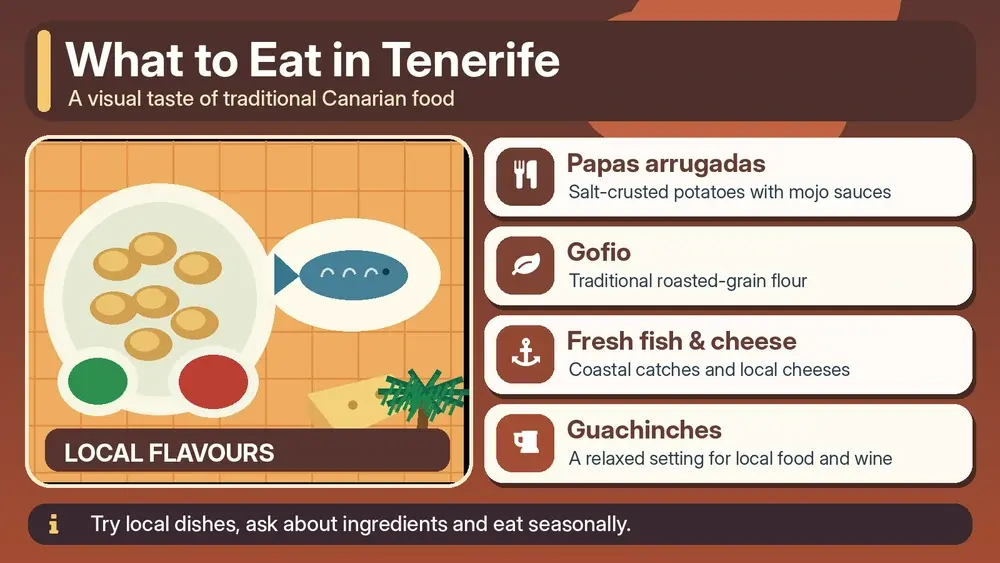
    Illustrated guide: What to Eat in Tenerife, with practical visitor tips
    Illustrated guide: What to Eat in Tenerife.

    Tenerife for families, couples and active travellers

    Families usually appreciate the south because of the concentration of accommodation, beaches and attractions, but the island also offers easy nature walks, botanical gardens, boat trips and volcanic landscapes that work well with children. Couples can mix resort comfort with sunsets, wine country and quieter northern towns. Active travellers have hiking, cycling, diving, surfing, paragliding and high-altitude routes. The important point is not to assume one part of the island has to provide everything.

    For parents, my Tenerife with kids guide focuses on realistic driving times, beach choices, altitude, heat and balancing big attractions with easier days. Hikers should continue with the hiking and nature guide.

    My practical planning rules for a smoother first trip

    • Do not schedule Teide on the only day you can visit: mountain weather and cable-car operations can change.
    • Keep at least one flexible day so you can follow the better weather between north and south.
    • Download offline maps before mountain drives and hikes.
    • Book high-demand activities and regulated hiking access in advance, but avoid overbooking every day.
    • Carry water, sun protection and a warm layer in the car; altitude changes the conditions quickly.
    • Treat driving times on mountain roads as estimates, not promises.
    • Choose accommodation for location first and hotel facilities second.
    • Respect beach flags, protected areas and trail closures even when other visitors appear to ignore them.

    Useful official resources

    For changing conditions, I rely on official sources rather than old screenshots or social-media comments. Check Tenerife ON for regulated nature access and trail information, TITSA for buses, and the official Tenerife tourism website for destination information. For flights, Aena operates both Tenerife South (TFS) and Tenerife North–Ciudad de La Laguna (TFN).

    A simple first-trip formula

    If I were building a first Tenerife holiday from zero, I would choose one convenient base, reserve a full day for Teide, one day for La Laguna and Anaga, one north-coast day, one west-coast day and keep the remaining time for beaches, food and spontaneous stops. That is enough structure to see the island’s range without turning the holiday into a race. The biggest mistake is not missing a specific attraction; it is spending seven days in one resort and assuming you have seen Tenerife.

    Once you know the style of trip you want, move next to the 7-day itinerary, accommodation and transport guides linked above. Together, those three decisions—where you stay, how you move and which days you keep flexible—have a bigger effect on the quality of a Tenerife holiday than any long list of must-see places.