
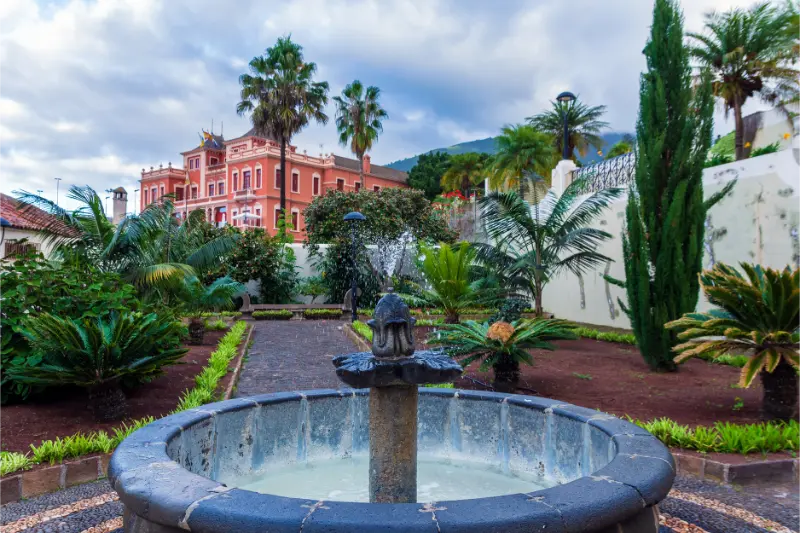
Jardines Victoria is one of the places I would use to explain La Orotava in a single view: formal terraces, a nineteenth-century family story, the unusual presence of Masonic symbolism and a panorama that drops through the historic town toward the Atlantic. The municipal tourism material describes the gardens, also known as the Jardines del Marquesado de la Quinta Roja, as a protected symbolic garden and confirms that entry is free. The white marble mausoleum at the top was designed for Diego Ponte del Castillo after a conflict over his burial because of his Freemasonry, but it ultimately remained empty. That tension between private grief, religion and nineteenth-century society gives the garden much more depth than a simple photo stop.
Quick visit facts
| Location | Historic centre of La Orotava, beside Liceo de Taoro |
|---|---|
| Type | Terraced historic garden and viewpoint |
| Heritage | Bien de Interés Cultural / protected historic garden |
| Key feature | Masonic mausoleum designed by Adolphe Coquet |
| Entry | Municipal tourism information states free entry |
Why the garden is unusual
The stepped layout is not accidental decoration. Municipal heritage material presents the garden as a symbolic composition rising through successive terraces toward the mausoleum. Some interpretations read the ascent as a metaphor for human or spiritual progress. I would not treat every symbolic reading as proven fact, but the design clearly invites movement upward rather than a simple loop around flowerbeds.
The story begins with the death of Diego Ponte del Castillo, the eighth Marquis of Quinta Roja, in 1880. His mother, Sebastiana del Castillo, commissioned a mausoleum after the family suffered a humiliating dispute over burial because Diego was a Freemason. The later resolution meant his remains were placed elsewhere, so the monument never served the purpose for which it had been built.
What I look for while walking
I start at the lower terraces and climb slowly. Fountains, clipped vegetation, walls and changes in level frame different views of the old town. The garden works best when I keep turning around: the relationship between the terraces, roofs, Atlantic and the higher slopes becomes clearer with each level.
At the top, the marble mausoleum is the visual focus. I spend a few minutes looking at its position rather than only the façade. It was designed to dominate the composition, so the approach is part of the experience.
The view over La Orotava
The municipal page specifically highlights the view from the upper garden, from the lower town toward Teide. On a clear day this is one of the easiest places to understand La Orotava’s vertical geography: historic streets in the middle, cultivated slopes above and the coast far below.
Cloud can completely change the atmosphere. I would still visit in overcast weather because the garden itself remains interesting, but I would not promise a Teide panorama on every day of the year.

Best time of day
Morning is my first choice if I want quieter paths and softer light on the historic buildings. Late afternoon can be excellent for the view, but I would check current access rather than assume the garden remains open until sunset in every season.
Because the garden is free and central, I do not build the entire day around it. I use it as a 30–60 minute stop between the nearby church, Hijuela del Botánico and Casa de los Balcones.
How I plan this stop without overloading the day
I get more from small Tenerife attractions when I place them inside a compact area rather than drive across the island for a single doorway, garden or viewpoint. My rule is one anchor attraction, two nearby secondary stops and enough unscheduled time for a café, a market or an unexpected street. That is especially useful in historic towns, where the best details are often between the official sights.
I also separate permanent facts from operational information. Architecture, landscape and historical context change slowly; opening hours, ticket prices, access rules and temporary works can change quickly. I therefore recheck the official page close to the visit, particularly if entry to an interior is essential to the day.
Getting there and parking
In historic centres I normally park once and walk. Narrow streets, one-way systems and limited spaces can make repeated short car moves slower than simply continuing on foot. For rural or edge-of-town attractions I check the final approach on a map before leaving, because the closest bus stop or parking pin can still involve a short walk on uneven ground.
When I use public transport, I look at the return connection before I arrive rather than when the attraction closes. This matters most on weekends and around rural sites where frequency may be lower. I keep a little margin between the official closing time and the last practical connection.
Accessibility, children and pace
I never assume a heritage building is step-free because the entrance looks level in photographs. Old thresholds, internal staircases, steep garden terraces and cobbled streets can all matter. If wheelchair access or a pushchair route is essential, I confirm it directly with the venue. For families, I shorten the historical explanation to one strong story and alternate indoor stops with a garden, square or snack break.
What I bring
Even for an urban visit I carry water, sun protection and a light layer. North Tenerife can change from bright sun to cloud surprisingly quickly, while south-coast agricultural visits can feel hot even in winter. Comfortable footwear matters more than it seems because a day of short museum and church stops can still add up to several kilometres of walking.
Common mistakes I avoid
- Trusting an old review instead of the current official source.
- Assuming every protected historic building has regular interior access.
- Driving between attractions that are only a few minutes apart on foot.
- Scheduling too many similar interiors in a row.
- Arriving just before closing when the site needs at least 45–60 minutes.
- Forgetting that religious buildings remain active places of worship.
What I would combine nearby
These combinations keep the day geographically coherent and reduce unnecessary driving. I prefer a route where each stop adds a different layer—architecture, landscape, local food or everyday culture—rather than repeating the same type of attraction several times.
Where I would stay
If I wanted more than a quick day trip, I would compare accommodation in La Orotava. Staying locally is useful when I want early streets, a slower dinner and enough time to see several nearby places without turning the day into a motorway itinerary.
Official information
For current access, opening times, temporary closures and event information I check La Orotava municipal tourism page shortly before travelling. I treat this as the final word for operational details because schedules can change after publication.
Frequently asked questions
Is Jardines Victoria free?
Yes. The municipal tourism page currently states free entry.
Was the marquis buried in the mausoleum?
No. The monument was built for him, but the burial dispute was eventually resolved and the mausoleum remained unused.
How long do I need?
Around 30–60 minutes works well for the garden itself, longer if I combine it with the surrounding historic centre.
Is it worth visiting without clear Teide views?
Yes. The symbolic layout, mausoleum and town views are still worthwhile even when high cloud hides Teide.
How I photograph and observe the place
I try not to make photography the only purpose of the stop. I first walk through once without constantly raising the phone, then return to the details that best explain the site: a façade seen from across the street, a change of level in a garden, the relationship between a church and its square, or the working structure of an agricultural property. This usually produces better pictures and a better memory of the visit.
When people are worshipping, working or guiding a group, I give them priority. I do not use flash in religious interiors unless it is explicitly permitted, and on farms I stay on marked routes rather than stepping into planted areas for a cleaner composition.
How this stop fits different travel styles
For a first-time visitor, I would use the place as part of a broad introduction to the area rather than build an entire day around one small attraction. Repeat visitors can go deeper, pairing it with specialist museums, neighbourhood streets or local food. Travellers without a car should prioritise clusters where several worthwhile stops are reachable on foot, while drivers can use the attraction as a bridge between towns.
On a short Tenerife trip I keep the schedule selective. On a two-week stay I am much more willing to spend a morning on small museums, gardens and heritage buildings because they reveal the island beyond the headline sights. That slower layer is often what makes a second or third visit feel genuinely different.
Weather and seasonal considerations
Tenerife’s microclimates matter even for culture days. La Orotava, Icod and La Laguna can be cooler or cloudier than the southern resorts, so I carry a light layer. Outdoor gardens and viewpoints are more rewarding in clear weather, while museums and churches become useful alternatives when cloud or showers move in.
During local festivals, religious celebrations and school holidays, normal access can change. A closed street is not necessarily a problem—it may be part of a valuable local event—but I allow extra time and avoid assuming parking or interior access will work exactly as on an ordinary weekday.
Final thoughts
Jardines Victoria La Orotava is most rewarding when I use it to understand a wider part of Tenerife rather than treat it as another box to tick. I would give the place enough time for its context to emerge, connect it with nearby stops and keep the practical plan flexible enough to respond to weather, access or local events.