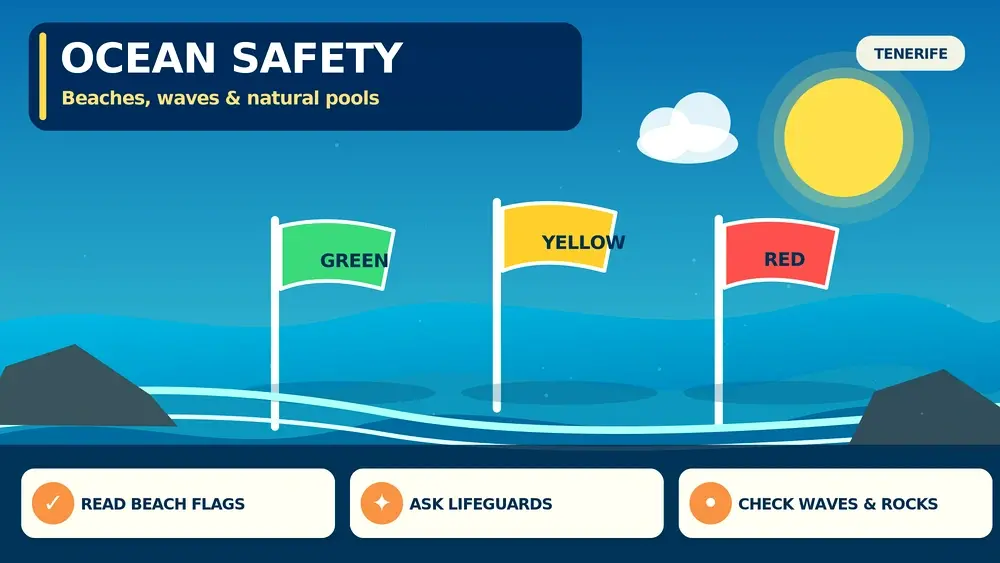
Tenerife Ocean Safety Guide is a practical topic I would rather understand before the trip than solve under pressure. Tenerife has beaches for almost every kind of traveller, but the Atlantic is not a swimming pool. Conditions can change between one bay and the next, and a calm-looking shoreline can still have surf, currents, slippery lava rock or a strong shore break. I treat the beach flag and the lifeguard as part of the plan, not as background scenery.
This guide is about making simple decisions before entering the water. The Government of the Canary Islands uses the familiar green, yellow and red beach-flag system, while 112 Canarias regularly reminds residents and visitors to respect coastal alerts, avoid exposed piers and breakwaters during rough seas, and call 112 immediately in an emergency.
At a glance
| Topic | Tenerife ocean safety |
|---|---|
| My approach | Use official information for rules and safety, then keep a simple backup plan rather than overcomplicating the holiday. |
| When to recheck | Anything involving alerts, medical guidance, road rules, live infrastructure or beach conditions should be checked again close to the day. |
| Emergency number | 112 for urgent medical, rescue, fire or security emergencies in the Canary Islands. |
What I would know before the trip
- 112 Canarias states that a red flag means bathing is prohibited, yellow means caution and green means conditions are considered suitable for bathing.
- Official Canary Islands emergency advice warns that north-coast beaches can be more exposed to wind, swell and currents than many sheltered southern beaches.
- During coastal alerts, authorities advise avoiding piers, breakwaters and places where waves can sweep people into the sea.
- Natural pools can become dangerous when swell overtops walls or lava shelves even if the water inside looked calm a few minutes earlier.
- In any serious coastal emergency in Tenerife, 112 is the single emergency number for rescue, medical and security coordination.
Official sources I would save: 112 Canarias sea-safety advice · 112 Canarias coastal alerts.
How I read beach flags before swimming
I look for the flag before I choose where to put the towel. A green flag does not mean there is zero risk; it means current conditions are considered suitable for bathing. Yellow tells me to reduce ambition, stay where I can stand or swim comfortably, and pay closer attention to the lifeguard. Red is simple: I do not enter the water.
I also notice whether the flag has changed during the day. Wind and swell can build after a calm morning. If the lifeguard closes a section or asks swimmers to move, I follow that instruction immediately rather than judging the sea from the shore.
Waves, shore break and currents
The most common mistake I see is judging only the height of a wave. A modest-looking shore break can knock someone over in shallow water, while a current can pull a swimmer sideways or away from the easiest exit. I watch the water for several minutes before entering and choose a supervised section when I am unfamiliar with the beach.
If I feel myself being carried or I am no longer comfortable, I stop trying to prove anything and signal for help. I do not exhaust myself fighting the sea. The exact response to a current depends on conditions and ability, so lifeguard instructions at that beach take priority over generic internet advice.
Why natural pools need extra respect
Tenerife natural pools are beautiful because they sit directly in volcanic coastline, but that also means they are exposed to swell. A pool can be calm inside while a larger set of waves suddenly crosses the outer wall. Wet lava is slippery, ladders can be difficult in surge, and spectators standing on the seaward edge can be at greater risk than swimmers.
I only use a natural pool when local access is open and the sea state looks appropriate. If waves are overtopping the structure, if barriers are closed or if locals are staying back from the edge, I treat that as a clear sign to choose another activity.
North coast versus south coast
I never turn the phrase “the north is rougher” into a rule that the south is safe. It is simply a planning clue. North and west coasts are often more exposed to Atlantic swell, while several southern resort beaches have breakwaters and lifeguards. But local wind, tide and swell direction can reverse expectations on a particular day.
For families or weaker swimmers, I prioritise a supervised beach with easy access and facilities rather than the most dramatic cove in a photograph. I save wild beaches for walking, photography or a dry-foot visit when conditions are uncertain.
Coastal alerts and rough-sea days
When the Canary Islands government issues a coastal warning, I do not drive around trying to find a place where the alert “does not look serious”. I postpone exposed swimming, cliff-edge photography and fishing from wave-washed rocks. Rough-sea incidents often happen to people who never intended to swim but were standing too close to breaking waves.
A rough-sea day is easy to repurpose in Tenerife: historic towns, museums, inland viewpoints, food markets and sheltered urban walks can all work. I would rather lose one beach session than turn a holiday into a rescue.
What I do if someone gets into difficulty
If a lifeguard is present, I alert them immediately. If there is no professional rescue service, I call 112 and give the exact beach, nearest access point and what I can see. I avoid entering rough water for an improvised rescue unless I am trained and equipped, because a second casualty makes the incident harder.
I keep my phone accessible rather than buried under everything in the beach bag. On remote coasts I also note the name of the beach or cove before going down, because describing an unnamed cliff from memory during an emergency wastes time.
How I verify information on the day
I use a simple source hierarchy. Safety and health information comes from the competent public authority; road rules come from DGT; live infrastructure comes from the operator or current map; hotel-specific details come from the property in writing. Traveller reviews are useful for atmosphere and recurring practical problems, but I do not use an old review to overrule a current official rule.
I also pay attention to dates. Tenerife information can stay high in search results long after a restriction, warning system or operating procedure has changed. If a detail affects safety, health, money or whether I can legally use a service, I verify it again shortly before acting.
What I keep offline on my phone
I keep the accommodation address, one emergency contact, insurance details when relevant and the one official page I may need if mobile data becomes unreliable. I do not save dozens of screenshots. A small offline folder is useful only when I can find the answer quickly.
For driving or remote days I also keep the rental-company assistance number, a charged power bank and the exact name of the place I am visiting. For health-related topics I carry the documentation or medication I have been advised to bring rather than assuming I can reconstruct everything after a problem begins.
Common mistakes I would avoid
The first mistake is turning a general travel tip into a legal or medical rule. The second is relying on a screenshot from a previous year. The third is taking a small inconvenience and solving it with a risky shortcut—swimming under a red flag, driving with the wrong child restraint, continuing with an almost empty fuel tank or ignoring a serious allergic reaction because the holiday schedule is busy.
I would rather lose twenty minutes to a check than lose a day to a preventable problem. Good travel planning is not about removing uncertainty; it is about knowing which decisions deserve a reliable source and which can stay flexible.
Useful related guides already on this site
Best Beaches In Tenerife, Tenerife Safety Guide, Tenerife Weather By Month, Tenerife Travel Apps Guide. I use these pages to connect this practical topic with the wider Tenerife itinerary without repeating the same advice everywhere.
Where accommodation changes the answer
Accommodation can remove a surprising amount of friction. I compare the exact location, reception hours, parking or transport access, kitchen facilities and any service relevant to the trip. For current availability I use Booking.com accommodation in Tenerife, then verify the property details that matter before I pay.
A central hotel can simplify emergency access and short transfers; an apartment can help with food routines, children or a longer stay; a rural house offers space but often increases driving and self-sufficiency. I choose the format that makes the specific itinerary easier rather than the one with the longest amenity list.
Bookable activities and tours
I use an organised activity when it solves a real planning problem such as transport, specialist equipment, local interpretation or a day when I do not want to drive. I still check meeting points, physical requirements, cancellation terms and current conditions before booking.
Frequently asked questions
What does a red flag mean on a Tenerife beach?
Bathing is prohibited. I stay out of the water and follow lifeguard instructions.
Is the north coast always dangerous?
No, but many northern beaches are more exposed to Atlantic swell and currents. Conditions vary by beach and day.
Are Tenerife natural pools safe in rough seas?
They can become dangerous when swell overtops the walls or lava shelves. Use them only when access is open and sea conditions are suitable.
What number should I call for a sea emergency?
Call 112 in the Canary Islands for urgent rescue, medical or security assistance.
Can I rely on a green flag all day?
No. Conditions and flags can change, so I keep checking the sea and any lifeguard instructions.
Final thoughts
Tenerife ocean safety is easiest when I keep the decision tree short: know the main rule, save the right official source, prepare one backup and then get on with the holiday. Tenerife has enough variety that changing a beach, route or transport plan rarely means losing the entire day.
I would use this page as a planning framework and recheck anything time-sensitive shortly before travel. That combination—good preparation without rigid scheduling—is what makes the practical side of Tenerife feel simple rather than stressful.