
Parque Marítimo César Manrique is Santa Cruz’s large seawater-pool complex and one of the most practical places to combine César Manrique design, family swimming and an urban sightseeing day. It covers about 22,000 square metres beside the Auditorio and Palmetum.
For September 2026 the official site lists winter-season hours of 10:00–18:00, with pools closing at 17:45. It also currently warns that only one pool is open during the winter period, while maintenance affects the children’s and cascade pools. Those operational details are exactly why I would check the official page on the day of the visit.
Quick practical facts
| Location | Avenida de la Constitución 5, Santa Cruz de Tenerife |
|---|---|
| Current winter hours | 10:00–18:00; pools close 17:45 |
| 2026/27 winter season | From 7 September 2026 to 19 June 2027 |
| Non-resident adult | €7.50 including sunbed |
| Non-resident under 12 | €4.00 |
| Under 3 | Free |
| Pools | Three seawater pools in the complex; current opening can vary by maintenance/season |
| Accessibility | Ramps, adapted facilities, pool hoist and amphibious chair published by the operator |
Why I would give Parque Marítimo César Manrique its own stop
A lot of Tenerife advice treats Santa Cruz as a culture-and-shopping day and assumes swimming belongs only in the resort south. Parque Marítimo is a good counterexample. It gives the capital a genuine pool day option without leaving the urban waterfront.
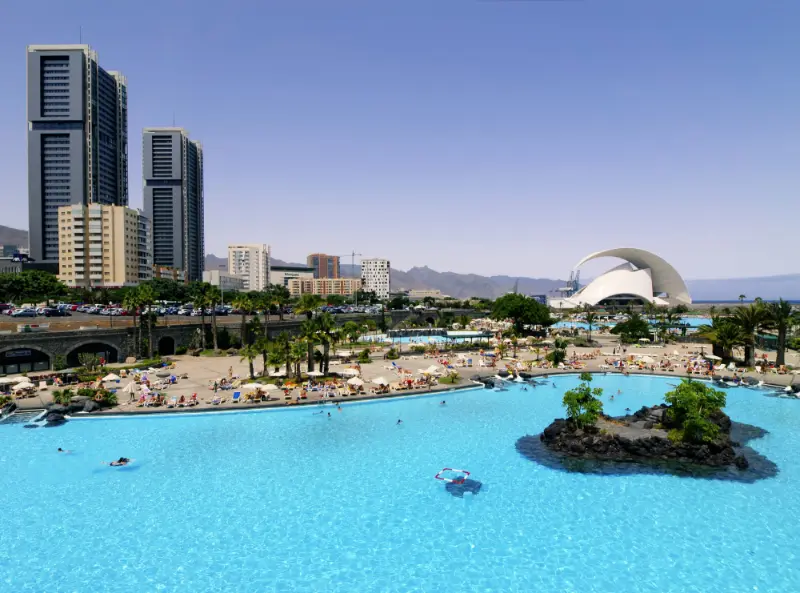
The design matters too. Volcanic rock, white surfaces, palms, salt water, waterfalls and Manrique-style wind elements turn the complex into more than a municipal swimming pool.
What to look for once you are there
The seawater pools
The complex has two main seawater pools and a children’s pool, although the number operating can change with season and maintenance. I check the live notice before paying.
Manrique’s design language
Volcanic rock, vegetation, water and sculptural elements create the familiar Canarian dialogue between nature and built leisure space. The park opened in 1995 as a posthumous Manrique project.
Family infrastructure
The operator lists changing rooms, showers, food outlets, play facilities and seasonal children’s programming. I still treat specific activities as date-dependent rather than guaranteed every day.
Accessibility features
The official facility page lists reserved parking, ramps, adapted toilets, a pool hoist and an amphibious chair. For a traveller who needs a specific device, I would confirm availability before arrival.
The context that makes the visit more interesting
César Manrique’s influence in Tenerife is often associated with Lago Martiánez in Puerto de la Cruz, but Santa Cruz has its own major Manrique leisure landscape. Seeing both on one trip makes the similarities and differences much clearer.
The maritime park belongs to a broader transformation of the southern city waterfront. Today the Auditorio, Palmetum, Castillo Negro and pools sit within a compact area that can be explored almost as one urban design district.
Because this is an operating leisure facility, conditions are less static than at a monument. Pool maintenance, seasonal opening, children’s activities and tariffs can all change; I prefer a current official notice to a timeless-sounding blog promise.
How I would plan the visit
If swimming is the priority, I arrive soon after opening and then add the Auditorio or Palmetum later. If culture is the priority, I reverse the order and use the pools as the relaxing end of the day.
I bring swimwear, sandals, sun protection and a light cover-up. Glass containers are prohibited by the facility rules, and the current website also states that smoking is prohibited inside.
How much time to allow
For a real swim-and-sun session I allow at least three hours. Entering for 45 minutes rarely makes sense once changing, finding a sunbed and drying off are included.
For families, four to five hours is more realistic. If only one pool is open, I also adjust expectations about how much variety there will be inside the complex.
Getting there without turning the visit into a transport problem
The park is on the southern edge of central Santa Cruz near the Auditorio and Palmetum. It is accessible by public transport and the operator advertises a large parking area, but I do not build a peak-time plan around the assumption that parking will always be effortless.
For a city break, I may compare Santa Cruz accommodation and walk or use public transport for most central attractions.
Accessibility and comfort
This is one of the stronger accessibility stories in the city’s leisure offer. The operator lists ramps, adapted bathrooms, reserved parking, an elevator, a pool hoist and an amphibious chair.
Specific equipment can be temporarily unavailable, so if access to the water depends on it I contact the park before travelling rather than assuming every listed service is ready at every moment.
Is it worth visiting with children?
Yes. The facility is designed for families, and summer programmes add activities for children. In the current winter period, however, the official website warns that only one pool is open and that some pools are closed for maintenance.
That distinction matters. A family should decide whether a relaxed single-pool day still sounds worthwhile before arriving with expectations based on summer photos.
Best time of day
I prefer opening time or late morning, especially on warm days. It gives a better choice of space and leaves time to combine the visit with the surrounding seafront.
In winter the earlier 18:00 closing makes a late-afternoon arrival poor value for most visitors. I check the seasonal timetable before fixing lunch reservations elsewhere.
Photography and respectful visiting
The best images use volcanic black, bright water and palms together. I also like compositions that include the Auditorio, because they show how the maritime park fits into Santa Cruz rather than making it look like an isolated resort.
I keep photography considerate around swimmers and children. A public pool is not a location where strangers should become the foreground of a travel photo without consent.
Useful nearby stops
A realistic half-day plan
A simple warm-weather half-day is maritime park first, then an early dinner or walk around the Auditorio. A culture-first version starts at Palmetum and uses the pool complex afterward.
I do not try to add Las Teresitas to the same short half-day. The maritime park already solves the swimming need without a bus or car journey to San Andrés.
Common mistakes I would avoid
- Using summer photos to assume every pool is open in winter.
- Arriving late without checking seasonal closing time.
- Bringing glass containers despite the rules.
- Assuming a listed accessibility device is guaranteed without confirmation.
- Planning Santa Cruz as a beach-only day and overlooking the surrounding cultural cluster.
Current information: what I would check again
As of the official September 2026 update, winter hours are 10:00–18:00 with pool closure at 17:45. The non-resident adult ticket including sunbed is listed at €7.50 and under-12 at €4.00.
The facility currently states that only one pool is open during the winter period and that the children’s and cascade pools are closed for maintenance. I would check the live notice immediately before visiting because this is operational information, not a permanent feature.
Official source
For current hours, tariffs and maintenance notices I use Parque Marítimo de Santa Cruz – official hours and tariffs.

Frequently asked questions
Is the water seawater?
Yes. The complex is built around seawater swimming pools.
How much is a non-resident adult ticket in September 2026?
The official tariff page currently lists €7.50 including a sunbed. Check again because prices can change.
Are all pools currently open?
No. The official website currently states that only one pool is open in the winter season and that other pools are affected by maintenance.
Is it accessible for reduced mobility?
The operator publishes extensive accessibility features including ramps, adapted bathrooms, a pool hoist and an amphibious chair. Confirm specific equipment before travelling if it is essential.
How I decide whether this stop belongs in my itinerary
I do not add a place simply because it appears on a “top things to do” list. I ask what new layer it adds to the trip. Does it explain a part of Tenerife I have not understood yet? Does it fit naturally with places already on the route? Can I visit it without creating an hour of unnecessary driving? Those questions are especially useful on an island where a short distance on the map can still mean mountain roads, city parking or a change of microclimate.
I also distinguish between a destination visit and a cluster visit. A destination visit is worth crossing the island for; a cluster visit becomes valuable because it sits beside two or three other strong stops. Many museums, churches, small forts and interpretation centres are at their best in the second category. That does not make them less important. It simply means the itinerary should respect their real scale.
What I would verify on the morning of the visit
Opening hours, temporary closures, road conditions and special events are the four details most likely to change. I save the official source rather than relying on a screenshot taken months earlier. For cultural buildings I also check whether a private event, religious service, renovation or guided group affects normal access. For Teide locations I add mountain weather and road status to that list.
This last check takes only a few minutes and prevents the most common frustration in Tenerife planning: arriving with perfectly researched historical information but an outdated practical detail. I would rather change the order of a day than force an itinerary after the conditions have changed.
What makes a good Tenerife visit different from a checklist
The strongest days usually contain contrast. A museum works better when I can walk through the neighbourhood it explains; a volcanic trail means more after a visitor centre; a historic fort becomes clearer when modern city architecture surrounds it. I therefore build connections between places instead of treating every stop as an isolated review score.
I also leave blank space. Tenerife rewards unplanned pauses: a view of Teide appearing above cloud, a local café, a small plaza, or a change in light can become more memorable than the tenth scheduled attraction. A complete travel site should help a reader make those choices, not pressure them to “complete” the island.
Final thoughts
Parque Marítimo is useful because it makes Santa Cruz work for more kinds of traveller. A city day can include architecture, gardens and a proper swim without changing destination.

I would just treat it like the operating pool complex it is: check the live opening notice first, especially outside summer, and then enjoy the Manrique design without assuming every brochure image matches today’s configuration.