
Isla Baja is the northwest corner of Tenerife I choose when I want old towns, volcanic coast, rural valleys and Teno scenery in one compact region. Turismo de Tenerife defines Isla Baja around Buenavista del Norte, Garachico, Los Silos and El Tanque. Each place already deserves its own guide, but the region makes more sense when I connect them rather than treating them as isolated day-trip pins.
This is not the fastest part of Tenerife. Roads are slower, weather can be greener and cloudier than the south, and the best moments are often small: a plaza in Los Silos, a natural pool, a coffee in Garachico, a viewpoint above El Tanque, or the first sight of the Teno massif beyond Buenavista.
Quick planning facts
| Region | Northwest Tenerife |
|---|---|
| Core municipalities | Buenavista del Norte, Garachico, Los Silos, El Tanque |
| Best for | Historic towns, volcanic coast, Teno landscapes, hiking, rural stays |
| Ideal time | One full day minimum; two nights for a slower trip |
| Main coastal road | TF-42 |
| Mountain connections | Roads toward El Tanque, Teno and Santiago del Teide |
| Good bases | Garachico, Buenavista del Norte, Los Silos |
Why I treat Isla Baja as a region
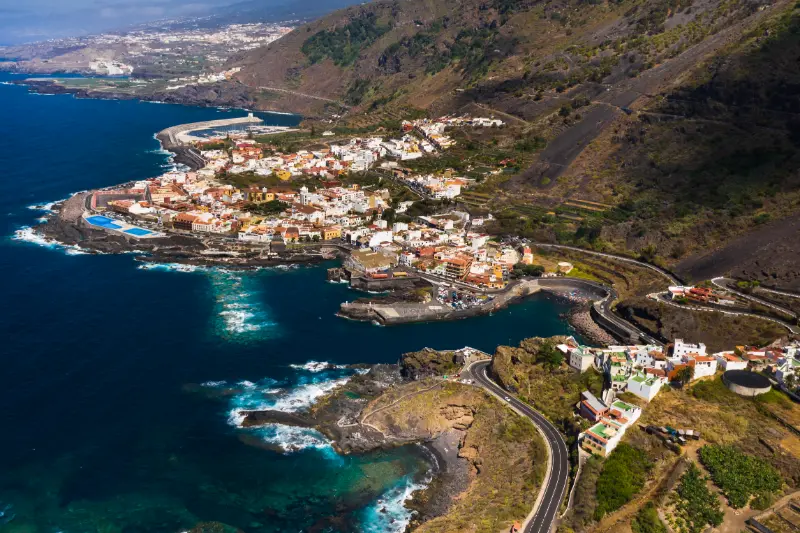
The northwest has a shared rhythm. Garachico brings the strongest historic architecture and the memory of the 1706 eruption. Los Silos adds a quieter square, agricultural landscape and access toward Teno. Buenavista opens into broad rural scenery and the road toward Punta de Teno. El Tanque sits higher, with mist, farmland and volcanic viewpoints.
I use my individual guides to go deeper: Garachico, Los Silos, Buenavista del Norte and El Tanque. This regional article is about sequencing them without wasting the day.
My one-day Isla Baja route
If I start from Puerto de la Cruz or the north, I begin in Garachico early, before parking becomes more competitive. I walk the historic centre and look at El Caletón from a safety-first perspective rather than assuming swimming will always be possible.
I then continue west to Los Silos for a slower town stop and perhaps the coastal road. Buenavista is my lunch or early-afternoon anchor. If Punta de Teno access works with the current transport rules, I treat it as a separate timed component, not an automatic extension.
El Tanque works best late in the day if the weather is clear enough for viewpoints, or as the first stop when I approach from Santiago del Teide. I avoid trying to add Masca unless I have deliberately designed a very long day.
Garachico: history first, pools second
Garachico is one of Tenerife’s most attractive historic towns, but I think its value is reduced when the visit becomes only a swim at El Caletón. I walk the plazas, churches and old streets first. The natural pools are a bonus when sea conditions allow.
For swimming details I use my El Caletón guide. Atlantic surge can make natural pools dangerous even on a sunny day, and local closures always override an itinerary.

Los Silos: the quiet centre
Los Silos is where I slow the trip down. The town centre around Plaza de la Luz feels very different from a resort, and the coast gives access to natural bathing areas and broad views. The municipality also reaches into the Teno landscape and forest routes such as Monte del Agua.
My Monte del Agua guide is a better choice than adding a random forest track if hiking is the priority.
Buenavista del Norte: Teno on the doorstep
Buenavista is the point where the northwest begins to feel more open and rural. The historic centre is modest but pleasant, and the municipality contains some of Tenerife’s most dramatic Teno scenery.
If Punta de Teno is part of the day, I check the latest access and bus rules in my Punta de Teno guide before leaving. Access management changes over time, so I never assume I can simply drive to the lighthouse.
El Tanque: altitude changes the mood
El Tanque sits above the coast, and that altitude changes both climate and perspective. It can be misty when Garachico is bright. The area is useful for understanding rural northwestern Tenerife and for views across lava landscapes toward the coast.
I carry a layer in the car even if I plan to spend most of the day at sea level. Tenerife’s microclimates are especially obvious on a route that climbs from Garachico to El Tanque.
Where to eat
I look for Canarian food rather than one “must-eat” restaurant. Fish makes sense near the coast; goat cheese, potatoes, stews and local wine fit the rural interior. Restaurant hours and weekly closing days vary, so I check on the day instead of building the entire route around a place I saw in an old blog post.
For food context I use my what to eat in Tenerife guide and Tenerife cheese guide.
Driving and parking
TF-42 links much of the coastal route, but town centres can have narrow streets and one-way sections. I park on the edge when practical and walk. The time lost searching for a central space is rarely worth it.
Mountain roads toward Teno, Masca or El Tanque require more concentration. I avoid stacking too many mountain segments into the same day, especially after dark.
How long I would stay
A day trip gives a good overview. Two nights are much better if I want Punta de Teno, a real hike or an unhurried evening in Garachico. Staying locally also lets me use the best morning light and avoid crossing the island twice.
For a regional base I compare places to stay in Garachico with Buenavista del Norte. Garachico has more evening atmosphere; Buenavista feels quieter and closer to Teno.
Official regional context
I use Turismo de Tenerife’s Isla Baja page and the official scenic-drive material for the northwest. It identifies the region around Buenavista, Garachico, Los Silos and El Tanque and emphasizes nature, rural accommodation and the Teno landscape.
Frequently asked questions
Can I do Isla Baja from Costa Adeje in one day?
Yes, but it becomes a long driving day. I would choose fewer stops and avoid combining it with a full Masca visit.
Is Isla Baja good without a car?
Some towns are connected by bus, but a multi-stop day requires more timetable planning. Staying overnight makes public transport much easier.
Is it always cloudier than south Tenerife?
No, but the northwest is more exposed to northern humidity and trade-wind cloud. Conditions can differ sharply from the south on the same day.
Final thoughts
Isla Baja is one of the best regions for seeing Tenerife as a lived-in island rather than a sequence of attractions. I would give it time, keep the route simple and let the contrast between historic towns, lava coast and Teno mountains do the work.
How I keep a road-trip day realistic
I plan by time rather than by distance. A place only 20 kilometres away can still require slow roads, parking and a walk from the edge of town. I normally choose one major stop for the morning, one for the afternoon and leave smaller villages as optional additions.

I download the route before leaving and note the last easy fuel and supermarket stop. In rural Tenerife I do not assume every village has a petrol station, late-opening restaurant or public toilet.
Parking without annoying residents
I prefer public car parks or legal spaces on the edge of historic centres. I never block garage doors, agricultural tracks, bus stops or narrow turning areas. Walking an extra five minutes is almost always easier than trying to force a rental car into the smallest street.
My rule for food stops
I keep at least two possible lunch options because opening days change and small restaurants can fill. If a particular guachinche or seafood restaurant is essential, I verify it directly. Otherwise I let the day stay flexible and eat where the route naturally slows down.
What makes a regional itinerary better than a checklist
A good regional day gives me a sense of landscape and everyday life. I would rather remember one conversation in a market and one long coastal walk than ten rushed photographs through a windscreen. I leave unplanned time on purpose because that is often where the most memorable part of the day appears.
A final planning rule I use on Tenerife
I leave at least one hour of unscheduled margin around rural, mountain or cultural stops. That buffer absorbs parking problems, weather changes, a longer lunch or a road that is slower than expected. It also gives me permission to stay when a place turns out to be more interesting than the itinerary suggested.
Before driving away, I check the next fuel, food and return option. This small habit matters most in the parts of Tenerife where tourism infrastructure is deliberately light. Good planning should make the day feel freer, not more rigid.
Why this article belongs in a complete Tenerife plan
The island becomes much more interesting when I connect major sights with smaller landscapes and cultural stops. This experience adds context rather than another box to tick, which is exactly what I want from a second or third day away from the main resort areas.