
Quick summary: For an Erasmus semester in Tenerife, I would base the plan around the University of La Laguna rather than around the beach resorts. ULL says incoming Erasmus students must be officially nominated through a valid bilateral agreement, and its current guidance states that Spanish is the usual language of instruction with a B1 Spanish requirement for incoming students. Housing, tram access and everyday costs matter far more over five months than a resort sea view.
| Main university | Universidad de La Laguna (ULL) |
|---|---|
| Incoming route | Nomination through home institution and bilateral agreement |
| Language | ULL currently lists B1 Spanish for incoming students |
| Best base principle | Live near campus/tram, visit resorts at weekends |
Start with the official nomination process
An Erasmus exchange is not something I arrange by simply turning up in Tenerife and enrolling. ULL requires nomination by the home university under an active agreement for the relevant study level and field.
I follow the ULL International Relations instructions and deadlines exactly, because academic paperwork is less flexible than holiday planning.
Spanish matters
ULL states that Spanish is the normal language of instruction and that university services are primarily offered in Spanish. Its incoming guidance currently lists B1 CEFR Spanish and identifies accepted proof routes.
Even if some classes are in English, Spanish makes housing, healthcare, shopping, group projects and everyday life much easier. I treat language preparation as part of the mobility experience, not an administrative obstacle.
Where students live
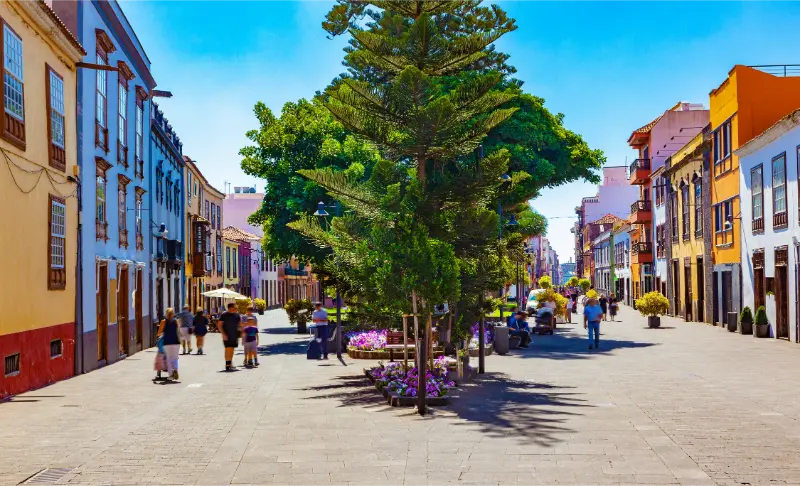
La Laguna is the natural centre because campuses, student life and tram links concentrate there. Areas along tram Line 1 can also work because Santa Cruz and La Laguna are connected without needing a car.
I compare walking time to my actual faculty, not to “ULL” as one map pin. The university has multiple facilities, and a cheap room can create a long daily commute if I choose by city name alone.
Housing and scams
ULL notes that its Erasmus Office does not arrange private accommodation. I therefore use university guidance, reputable platforms and local viewing where possible, and I never send a large deposit only because a social-media listing claims demand is urgent.
I ask what is included in rent, how utilities are calculated, whether the room can be registered as needed, and what happens to the deposit at the end of the stay.
Transport without a car
The Santa Cruz–La Laguna tram is one of the biggest advantages of student life in the metropolitan area. TITSA buses then connect the rest of the island. A rental car is useful for occasional exploration but unnecessary for many students day to day.
I learn the ten+ ticket/card system early and keep enough balance for late classes or unexpected trips. For weekend hikes I check the return bus before starting the trail.
Budget reality
Student costs are driven by housing first, then groceries, transport and social life. Resort restaurants and tourist bars can distort the idea of “Tenerife prices,” while supermarkets, campus cafeterias and local menus can be much cheaper.
I keep a separate weekend-travel budget for ferries, Teide tours or occasional car hire rather than letting island exploration eat the monthly rent money.
Arrival week
ULL recommends incoming students arrive before studies begin and provides registration instructions after admission. I use the first week to sort SIM/data, transport, supermarket, pharmacy, campus route and basic paperwork before trying to see the whole island.
A Welcome Day or mobility event is also one of the easiest ways to meet people beyond a private WhatsApp group.
Map the faculty before renting
I use the exact building where most of my classes take place, then calculate walking and tram time from each room listing.
Keep tourism for weekends
Living in La Laguna gives a real student routine while buses, ferries and occasional car hire still open the beaches and national parks when classes finish.
How I would use this guide on a real Tenerife trip
I treat tenerife erasmus student life as one practical layer of the trip, not something that should dominate the holiday. I check the facts that can cause a real problem—rules, opening hours, transport, access, documentation or food requirements—and then keep the rest flexible. Tenerife changes quickly between the south coast, the metropolitan area, the green north and the high mountains, so location and timing often matter more than adding another attraction.
I save the most important booking references and official links offline. Mobile coverage is generally easy to arrange, but the moment I most need a detail is often when I am at an airport counter, ferry terminal, hotel reception or remote viewpoint. A screenshot, a small time buffer and one realistic backup plan are simple habits that make the island much easier.
Useful related guides on My Tenerife Experience
Where I would stay
I choose a base according to the hardest part of the itinerary. Costa Adeje and Los Cristianos are convenient for resort services and the south airport, Puerto de la Cruz works well for the greener north, while Santa Cruz and La Laguna are useful for city life, university services and public transport. I compare accommodation in Tenerife and then read the newest reviews for details that matter to this specific trip rather than relying only on the headline score.

Official information to recheck
Frequently asked questions
Do I need Spanish for Erasmus at ULL?
ULL currently lists B1 Spanish for incoming students and says Spanish is the usual language of instruction.
Does ULL find a private flat for Erasmus students?
ULL states that the Erasmus Office does not arrange private accommodation.
Should I live in Costa Adeje?
For a ULL semester I would usually prioritise La Laguna or the tram corridor; the south is better as a weekend destination than a daily commute.

Final thoughts
Tenerife can be an exceptional Erasmus destination when I build life around the university first and the holiday island second. Good housing, Spanish confidence and a simple tram commute create more freedom to explore every weekend.
Practical planning checkpoint 1
Before I lock this part of the trip in, I check the exact date, municipality and provider rather than relying on a screenshot from months earlier. Tenerife is compact, but weather, transport frequency, business hours and service availability can differ sharply between the north, south, metropolitan area and high mountains. I keep one backup in the same part of the island so a small change does not force a cross-island detour.
I also check how this topic interacts with the rest of the day. An early flight changes the hotel choice; a food restriction changes the value of a supermarket nearby; a ferry connection changes how much time I leave before a flight; a flower or wildlife trip changes what I pack. Good Tenerife planning is usually about connecting these small practical decisions rather than adding more stops.
Practical planning checkpoint 2
Before I lock this part of the trip in, I check the exact date, municipality and provider rather than relying on a screenshot from months earlier. Tenerife is compact, but weather, transport frequency, business hours and service availability can differ sharply between the north, south, metropolitan area and high mountains. I keep one backup in the same part of the island so a small change does not force a cross-island detour.
I also check how this topic interacts with the rest of the day. An early flight changes the hotel choice; a food restriction changes the value of a supermarket nearby; a ferry connection changes how much time I leave before a flight; a flower or wildlife trip changes what I pack. Good Tenerife planning is usually about connecting these small practical decisions rather than adding more stops.
Practical planning checkpoint 3
Before I lock this part of the trip in, I check the exact date, municipality and provider rather than relying on a screenshot from months earlier. Tenerife is compact, but weather, transport frequency, business hours and service availability can differ sharply between the north, south, metropolitan area and high mountains. I keep one backup in the same part of the island so a small change does not force a cross-island detour.
I also check how this topic interacts with the rest of the day. An early flight changes the hotel choice; a food restriction changes the value of a supermarket nearby; a ferry connection changes how much time I leave before a flight; a flower or wildlife trip changes what I pack. Good Tenerife planning is usually about connecting these small practical decisions rather than adding more stops.
Practical planning checkpoint 4
Before I lock this part of the trip in, I check the exact date, municipality and provider rather than relying on a screenshot from months earlier. Tenerife is compact, but weather, transport frequency, business hours and service availability can differ sharply between the north, south, metropolitan area and high mountains. I keep one backup in the same part of the island so a small change does not force a cross-island detour.
I also check how this topic interacts with the rest of the day. An early flight changes the hotel choice; a food restriction changes the value of a supermarket nearby; a ferry connection changes how much time I leave before a flight; a flower or wildlife trip changes what I pack. Good Tenerife planning is usually about connecting these small practical decisions rather than adding more stops.